

The Office for National Statistics counted 49,320 hairdressing and beauty salon enterprises across the UK as at March 2024, broken down by English region, Scottish council area, Welsh unitary authority and Northern Ireland district (ONS analysis of UK SIC 96.02 enterprises). That figure reframes what a room search in Inverness involves. You're not competing for one of a handful of premises. You're working inside a large, locally distributed trade where plenty of small operators hold space they don't fill every day of the week.
The ONS count covers VAT- and/or PAYE-based businesses, so it misses sole traders who work informally. Those are exactly the people who rent a room by the day or week instead of signing a lease.
Three things decide whether a rented room works: what the room can legally and practically support, how the rent is calculated against your working pattern, and what you agree in writing before any money changes hands. Get those right and the search takes a week. Get them wrong and you're paying for a room you can't use for half your treatments.
Table of Contents
- Inverness Therapy Suite Rates at a Glance
- Choosing Day, Week or Monthly Rent for Your Schedule
- How to Find and Enquire About a Suite in Inverness
- Checking Room Fit and Licensing for Your Treatments
- Contract Terms to Agree Before You Pay
- Confirm Your Inverness Suite Before You Commit
Inverness Therapy Suite Rates at a Glance
No single rent applies to a therapy suite in Inverness. Each host sets their own figure and quotes it against a basis: day, week or month. Treatment rooms for facials, massage and aesthetics are usually priced monthly, beauty rooms for lashes, brows, waxing and makeup can be booked by the day, week or month, and chairs and stations are commonly quoted daily or weekly.
That structure follows the shape of the trade. In 2024 the National Hair & Beauty Federation's industry statistics counted more than 63,800 hair-and-beauty businesses in the UK, up nearly 1,900 (3.1%) on the year before, with sector turnover of roughly £5.8 billion. Nearly 64% of those businesses recorded annual turnover below £99,000 and more than 80% employed fewer than five people, and 58% of the people working in the sector were self-employed. Operators at that scale don't take on long leases. They rent the days they need, which is why the basis matters as much as the number.
| Space type | Usual rental basis | What fixes the Inverness figure |
|---|---|---|
| Treatment room for facials, massage and aesthetics | Monthly | A written monthly quote from the host, checked for utilities, cleaning and laundry |
| Beauty room for lashes, brows, waxing and makeup | Day, week or month | The day rate on the listing, compared against the host's monthly figure |
| Styling chair for hairdressers and colourists | Day or week | The listed day or week rate, plus whether colour consumables and trolley use are included |
| Nail station | Day or week | The listed rate, plus whether extraction, a table and product storage come with it |
| Barber chair | Weekly or monthly | The host's quote for the chair and the hours you can use it |
| Whole studio | Weekly or monthly | A written quote covering rooms, access hours and whether anyone else uses the space |
Monthly is the right basis when a room is your main workplace, but ask what the figure includes and whether the host expects a minimum number of days. A monthly room with a basin, storage and laundry is a different proposition from a bare room at the same price. Day and week rates exist because practitioners work in patterns: a lash technician with two clinic days a week, a colourist who only takes Saturday clients. Confirm the minimum booking and whether the host will hold the day for you.
For barber chairs and whole studios, ask about access hours before you discuss money. A chair you can only use until 6pm isn't the same chair as one you can use until 9pm.
Before you compare two figures, settle what sits behind them: utilities and heating, cleaning between clients, laundry and towels, card processing fees, and consumables. The way chair rents are built and why the spread is so wide is set out in this guide to salon chair prices. For scale, listed rents give a benchmark rather than an Inverness price: the only beauty treatment room listed in Edinburgh is £650 a month in the city centre.
Note the rate basis for every space type you're considering, then collect at least three quotes before you compare anything.
Choosing Day, Week or Monthly Rent for Your Schedule
A day rate isn't automatically the expensive option, and a monthly rate isn't automatically the cheap one. Divide the total rent by the number of days you'll realistically work in the room. That cost per working day is the only number worth comparing.
The figure to compare: total rent divided by days actually worked, not the headline rate on the listing.
| Working pattern | Best rental basis | Why it suits |
|---|---|---|
| Occasional clients, one to two days a month | Day rate | You pay only for the days you use |
| Fixed weekly clients, two to three days | Weekly rate | Predictable cost and fewer repeat arrangements |
| Full-time practice in one room | Monthly rate | Lowest cost per working day when the room is booked most weeks |
| Testing a new service or location | Day or week rate | Limits your exposure before you commit |
Run the arithmetic before you fall for a low daily figure. Say a room is quoted at £45 a day or £520 a month (illustrative numbers, not an Inverness quote). Four days a month on the day rate costs £180 and wins comfortably. Eight days costs £360, still cheaper. Twelve days costs £540, and at that point the monthly rate is cheaper per working day and you stop rebooking every month.
The basis also changes your admin load and your security. A monthly arrangement usually gives you keys, storage and a permanent set-up, so your couch, trolley and products stay where you left them. Day rates often mean setting up and packing down each visit, which eats into a 45-minute gap between clients.
Weekly sits between the two and suits the practitioner whose bookings repeat: same days, same clients, same room. It removes the monthly commitment without turning every visit into a transaction.
Write down your expected bookings for the next three months, day by day, before you choose. If the pattern is uneven, price it as uneven.
How to Find and Enquire About a Suite in Inverness
Start with geography. A room only earns its rent if you and your clients can reach it on a wet Tuesday in February, and the cheapest listing two towns away fails that test.
Work through the sequence in order and you get a usable answer fastest.
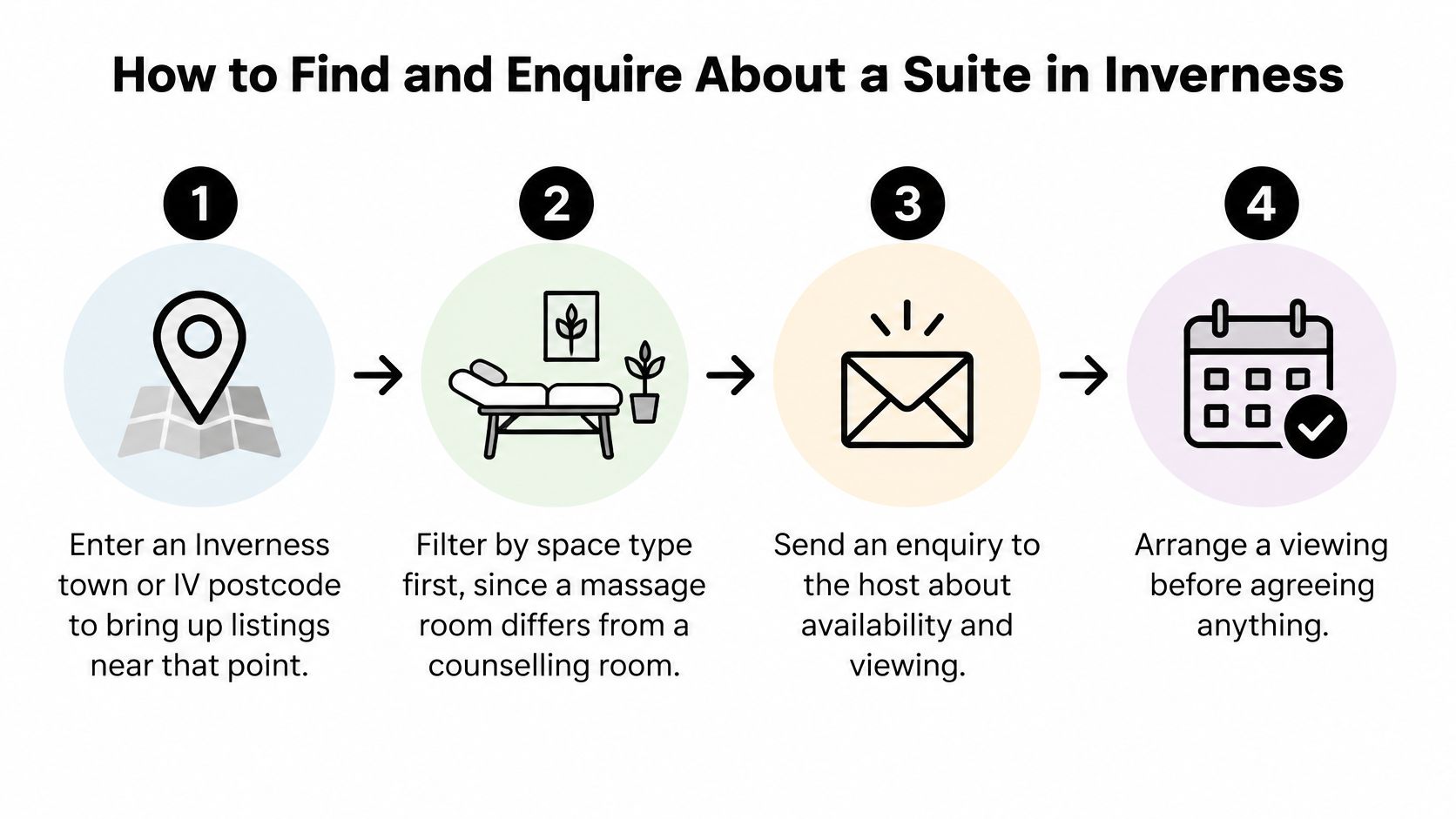
- Search by town or postcode. Enter Inverness or the IV postcode you would travel from. Do not assume two IV postcodes are neighbours: traffic and river crossings can put real distance between addresses that look adjacent on a map.
- Read the described space and permitted treatments against your service list. A massage room and a colour chair are not interchangeable, and a room without a basin rules out most facial work. Check what each listing offers and which treatments the host allows before you compare a single price.
- Compare the rate basis, not just the number. If you settled on a weekly arrangement, read weekly figures. A monthly quote beside a day rate tells you nothing useful.
- Shortlist three to five listings and read the detail. Study the photo gallery and the conditions the host sets out. A precise match gets a faster, more useful answer than a speculative message.
- Send one enquiry per listing with the full picture. Give your name, email address, preferred days and hours, and the services you plan to offer. The enquiry goes to the salon owner, who decides who suits the space and its existing clients, so the more they know, the faster they can judge.
- Expect a reply by email or in the host's account, then arrange dates and payment directly. The enquiry opens a conversation about availability and viewing. The commercial arrangement sits between you and the host.
A useful reply answers three questions: are your days free, what is the rent and on what basis, and what conditions apply, such as treatment restrictions or shared access to a sink. If a reply skips the basis, ask for it in writing before you view.
Widen the map as well as the shortlist. A 2026 Business Gateway market report on hair, beauty and therapy businesses described a new Tornagrain studio with two therapy rooms intended for counselling, massage therapy and physiotherapy, which points to demand running along the Inverness to Nairn corridor rather than sitting only in the city centre.
Checking Room Fit and Licensing for Your Treatments
Choose a room for the treatments it can legally and practically hold, then look at the rent. Scottish policy draws a line between lower-risk procedures that may be delivered in licensed premises and medium- or high-risk procedures restricted to an independent healthcare clinic or another Healthcare Improvement Scotland-regulated setting, generally involving an appropriately qualified healthcare professional, as the Scottish Government's policy notes on licensing non-surgical cosmetic procedures set out. That line decides whether an Inverness room is usable for your work at all.
Room layout carries as much weight as the paperwork.
Where the licensing line falls
A further local-authority licensing route is being introduced under the Civic Government (Scotland) Act 1982 for procedures that pierce or penetrate the skin and do not require healthcare-professional input, according to the Scottish statutory guidance on licensing non-surgical cosmetic procedures. The same guidance points to unregulated salon, home, hotel and mobile settings as lacking consistent external inspection, which is why premises are moving into the frame.
For a practitioner, a suite has to work as an inspectable clinical workspace, with cleanable and well-maintained surfaces, controlled hygiene processes, suitable equipment, appropriate consumables, and documented qualifications, insurance and indemnity.
Practical rule: Ask Highland Council about each treatment you intend to offer, in writing, before you pay a deposit. The answer changes by procedure, not by room.
Demand for that kind of room is rising. The Axiom Flux UK aesthetics market report valued the UK aesthetics industry at £3.2 billion in 2024, with annual growth of 8.4%. The practitioners entering that market are the ones most likely to need premises that can be inspected and licensed.
What an inspectable room looks like
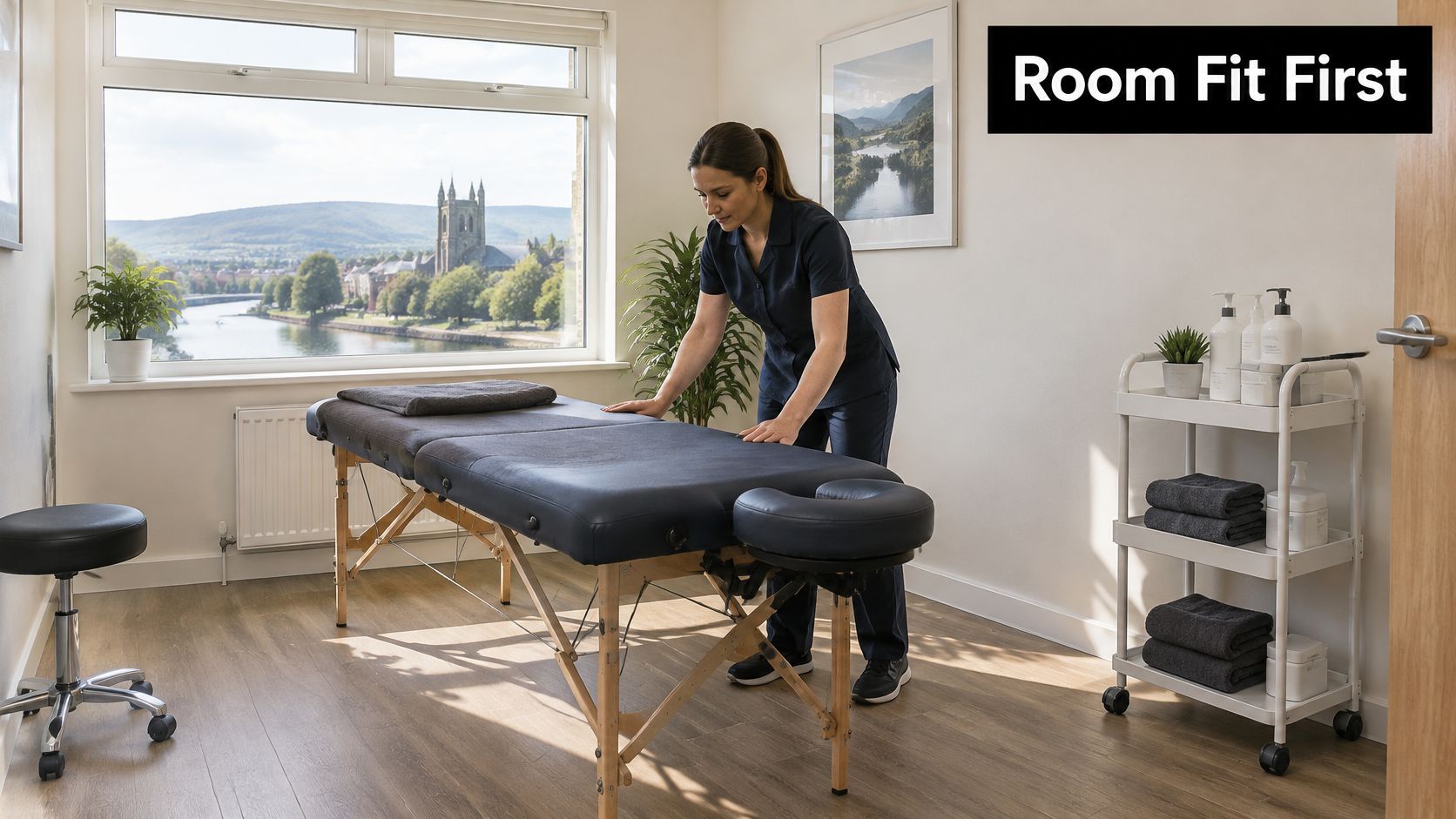
Walk in and look at surfaces first. Vinyl or hard flooring, a couch you can wipe down between clients, and a basin with hot water, liquid soap and paper towels cover more ground than an attractive treatment menu. Add a closed bin for general waste and a separate arrangement for clinical waste if you handle sharps. If massage is the service you're building the room around, the room-by-room specification in this guide to massage therapy rooms sets out what to insist on before you book.
Ventilation matters for nails and colour as much as for aesthetics. Extraction at the station, or a window that opens, decides whether a room stays comfortable through a two-hour appointment.
Then ask about the paperwork. A host advertising advanced skin procedures should already know whether the premises holds local-authority or Healthcare Improvement Scotland status, and be able to separate lower-risk beauty services from procedures that need a regulated setting.
| Service | Room features to confirm | Question to ask the host |
|---|---|---|
| Massage and facials | Treatment bed, hand basin, privacy from corridor, heating | Is there a basin on site and is the room soundproofed? |
| Lashes, brows, waxing and makeup | Good lighting, cleanable surfaces, storage for consumables | Is the bed cleanable and is there a waste bin? |
| Counselling and talking therapies | Sound privacy, separate waiting area, accessible entrance | Can clients enter without passing other rooms? |
| Physiotherapy and clinical aesthetics | Sharps and clinical waste arrangements, hand-hygiene facilities | Does the premises hold the relevant local authority or HIS status? |
| Hair colour and barbering | Station or chair, sink access, ventilation | Is the chair free on my working days? |
The details that decide whether a room works day to day
Parking comes first if your clients drive. Ask where they'll leave the car, how long they can stay, and whether the answer changes on a Saturday. A room that's perfect on paper fails if every client arrives stressed.
Accessible entrance matters more than most listings admit. If you treat older clients, postnatal clients or anyone with limited mobility, a flight of stairs with no alternative removes a chunk of your market.
Storage decides whether you can work efficiently. You need somewhere lockable for products, towels and equipment, and a plan for what happens if the host needs the cupboard back.
Laundry and heating are the two costs that change the maths. Towels for massage add up fast, so confirm whether laundry is included or you take it home. Ask how the room is heated in winter and who pays for it.
Three checks before you sign
- Confirm with Highland Council which licence applies to each treatment you plan to offer, including the ones you're only thinking about adding.
- Ask the host whether the premises already holds local-authority or HIS status, and get the answer in writing so it can't shift later.
- Keep your qualifications, insurance and indemnity documents ready to show the host and, if relevant, an inspector.
These rules are in transition. Check the current position with Highland Council before you sign anything, and treat a host who can't answer licensing questions as a warning rather than an inconvenience.
Contract Terms to Agree Before You Pay
The marketplace introduces you to the host. It doesn't draw up or manage rental agreements and it doesn't collect rent, so terms are agreed directly between the two of you. That makes a written summary essential, because a verbal arrangement six weeks ago is hard to rely on when a booking is cancelled.
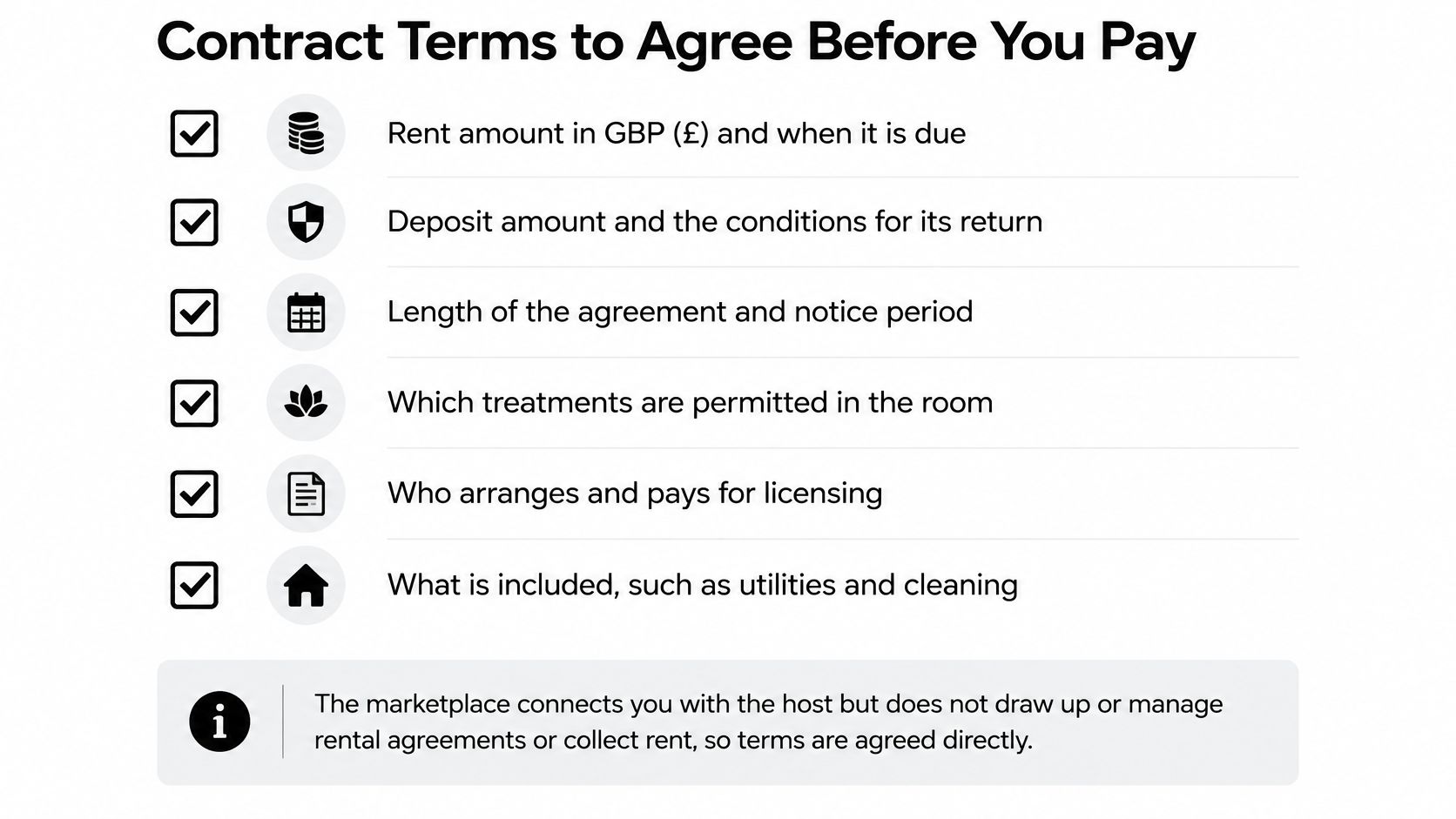
Work through these as questions, and write the answers down.
- Deposit. How much is it, what does it cover, and when is it returned? A deposit held against damage should have a defined release date, not a vague promise.
- Notice period. How much warning do you give to end a booking, and does it run from the date you message or the end of a billing period?
- Hours, keys and access. Which hours are yours, can you arrive early to set up, and who else has a key? Access decides whether an early appointment is possible.
- Cleaning, laundry and waste. Who does what between clients, and who pays for towels and waste removal? These are the costs that turn a cheap room into an expensive one.
- Utilities and card fees. Are energy, water and broadband included, and does the host take a cut of card payments? Ask for the total monthly outlay, not the rent.
- Public liability insurance. Confirm the cover you must hold and whether the host's policy covers the premises. Your own policy should name the address.
- Client records and data. Who keeps consultation records, where are they stored, and who is responsible if data is lost? Records in a shared locked cabinet need an agreed access rule.
- Host changes. What happens to your booking if the host relists the space, changes the permitted treatments or sells the business?
For occasional bookings, ask two more things: whether the host will hold a day or week for you before you've paid, and what cancellation fee applies if a client cancels late.
If you're renting a single chair rather than a room, work through the deposit, notice and access clauses in this salon chair rental contract checklist alongside the list above, because chair agreements tend to be shorter and leave more unsaid.
Keep a one-page summary of agreed terms for every space you rent, dated and shared with the host in writing.
Confirm Your Inverness Suite Before You Commit
Shortlist three Inverness spaces this week and send each host a complete enquiry rather than a one-line question. Search the Inverness postcode you'd travel from on FindMy.beauty to see which spaces are listed near you and on what basis, then repeat the search for each shortlisted area, including the corridor towards Nairn if you'd travel that far.
Before you send anything, have three things ready: a list of the treatments you'll offer, your qualifications and insurance documents, and your preferred days and hours. Every enquiry goes to the salon owner, who decides who suits their space and clients, so a clear picture of your work gets a faster and more useful reply.
Then check the licensing position with Highland Council for each treatment on your list before you commit to a date or pay a deposit. Those rules are changing, and the answer for a facial isn't the answer for a skin procedure.
That leaves you with a shortlist, three written rate quotes on a basis that matches your diary, and a clear view of what each room can legally hold.
FindMy.beauty is a UK marketplace connecting beauty professionals with salons that have a chair, station or room to spare nearby, including private treatment rooms for facials, massage and aesthetics. You can search by town or postcode to see what's listed around Inverness, compare day, week and month rates, and message hosts directly without an account. Visit FindMy.beauty to see the spaces available near you and send your first enquiry.