

Would you rent a treatment room because the price looks right, before checking whether you can safely and legally offer your treatments there? A quiet room, a treatment couch and an attractive postcode don't answer that question.
Searching for retreat rooms in Cheadle Hulme also creates a particular confusion: you might mean The Retreat Rooms, the named local business, or a private workspace for your own practice. Before committing, separate what's publicly confirmed from what only a host, insurer or council can establish.
Table of Contents
- What Public Records Confirm About The Retreat Rooms
- Room Types in Cheadle Hulme and Who Each Suits
- Ventilation Checks for Enclosed Treatment Rooms
- Extraction Requirements for Nail Services
- Licensing and Insurance to Confirm With the Council
- Total Cost Beyond the Advertised Rate
- Send One Enquiry and Decide
What Public Records Confirm About The Retreat Rooms
The Retreat Rooms is an identifiable local beauty and wellness business, not a confirmed room-rental listing. Public records establish its corporate identity and premises. They don't establish that independent practitioners can hire space there.
The Retreat Rooms: confirmed details and gaps
| Detail | Value | Where it is recorded |
|---|---|---|
| Address | 14 Church Road, Cheadle Hulme, SK8 7JB | Companies House and business directories |
| Company incorporated | 8 January 2020 | Companies House |
| Company status | Active private limited company | Companies House |
| Business classification | SIC code 96020, hairdressing and other beauty treatment | Companies House |
| Weekday hours recorded | 10:00 a.m. to 8:00 p.m. on Wednesdays | Appointment-listing information accompanying the business-directory record |
| Rooms available to rent | Not publicly confirmed | Not published |
| Rental price | Unknown until the operator confirms | Not published |
| Number of treatment rooms | Not publicly confirmed | Not published |
The registered entity is THE RETREAT ROOMS CH LTD. Its active company status and beauty-treatment classification offer a more reliable starting point than an unverified social-media mention, while directory descriptions position the venue around skincare and wellness treatments.
What those records don't establish
A company's incorporation date isn't proof of continuous trading under identical arrangements. Likewise, its business classification doesn't establish clinical accreditation, treatment permissions or suitability for your particular procedure.
The published customer opening hours also aren't a promise of practitioner access. A host might use different arrangements for preparation, cleaning, keys and independent appointments.
The available sources don't publish occupancy, external-renter availability, room counts or rental charges. That makes the venue a reasonable place to enquire, but not somewhere to describe as offering available rooms without an operator's reply.
Start with availability: Ask whether the business lets any space to independent practitioners before discussing furniture, branding or a deposit.
Keep the opening enquiry short: ask whether external practitioners can rent a room, which services the operator would consider, and what arrangement they offer. If the answer is yes, request details of the actual space rather than assuming that the business's general treatment offering describes the room you'd receive.
Room Types in Cheadle Hulme and Who Each Suits
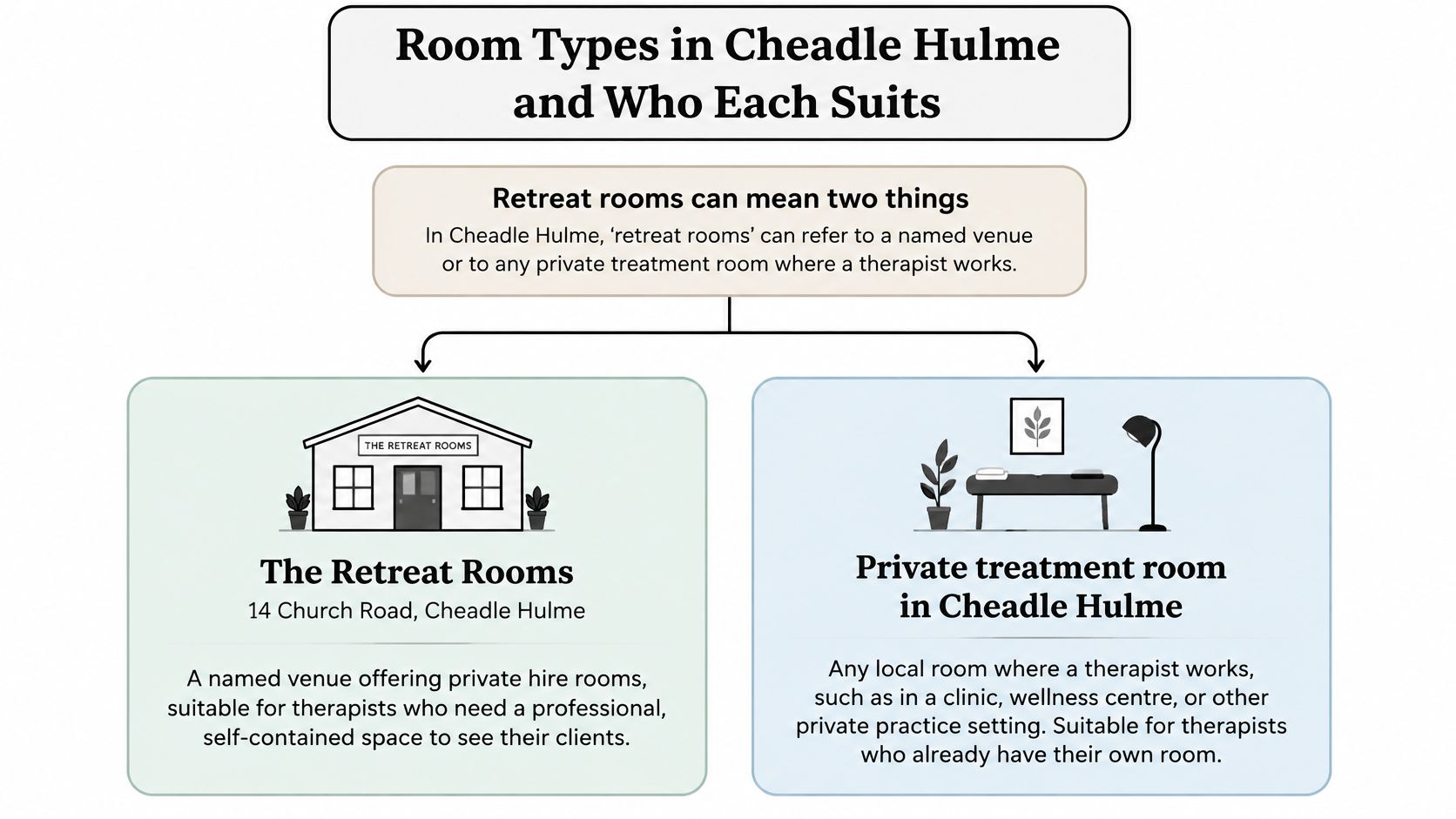
The Retreat Rooms is a named venue. A private treatment room in Cheadle Hulme is a workspace category that could apply to different hosts. Neither the search term nor a venue's name tells you whether a particular room is available or suitable.
Room types by service and key check
| Service | Room type | Typical user | Key check before enquiring |
|---|---|---|---|
| Massage and facials | Private treatment room | Massage and facial practitioners | Fresh-air provision for enclosed sessions |
| Lashes, brows, waxing and makeup | Beauty room | Lash, brow, waxing and makeup professionals | Ventilation suitable for waxing and product fumes |
| Nail services | Nail station or ventilated nail room | Nail technicians | Dedicated extraction and a safe exhaust route |
| Aesthetic procedures | Treatment room with appropriate licence cover where required | Aesthetics practitioners | Council requirements and treatment-specific insurance |
| Hairstyling and colour | Styling chair | Hairdressers, colourists and barbers | Access hours, product storage and client reception |
The diagram distinguishes the named business from the wider workspace search. It shouldn't be read as confirmation that the named venue offers private hire.
Match the room to your working method
For massage, walk around the couch as though you're delivering a treatment. Can you reach the client comfortably, adjust the headrest and move equipment without blocking the door? For facials, check where the trolley, magnifying lamp, clean towels and used linen would go.
A beauty room needs more than a spare couch. Lash work calls for usable task lighting and an ergonomic stool position; waxing requires a safe place for the heater, cleanable surfaces and a practical cleaning routine. Ask permission before assuming you can attach shelving or bring bulky equipment.
A nail station and a massage room aren't interchangeable because both have a door. Nail work introduces an extraction question that a quiet therapy setup may never have needed to address.
For aesthetics, describe the exact procedure, not just the broad category. A room advertised for facials shouldn't be assumed suitable for work involving skin penetration.
Hair professionals should test the journey from consultation to washing, colour processing and checkout. Confirm where clients wait and where colour stock stays between appointments.
A room can support several services only when it passes every relevant check. Start with the row matching your main treatment, then use the broader guide to beauty salons to rent if you're comparing a self-contained room with space inside a shared salon.
Ventilation Checks for Enclosed Treatment Rooms
A room can feel comfortable when empty and become stuffy during appointments. Assess ventilation for the room in use, with the door positioned as it would be during a confidential treatment.
Think about where practitioner and client will sit or lie when you inspect the space.
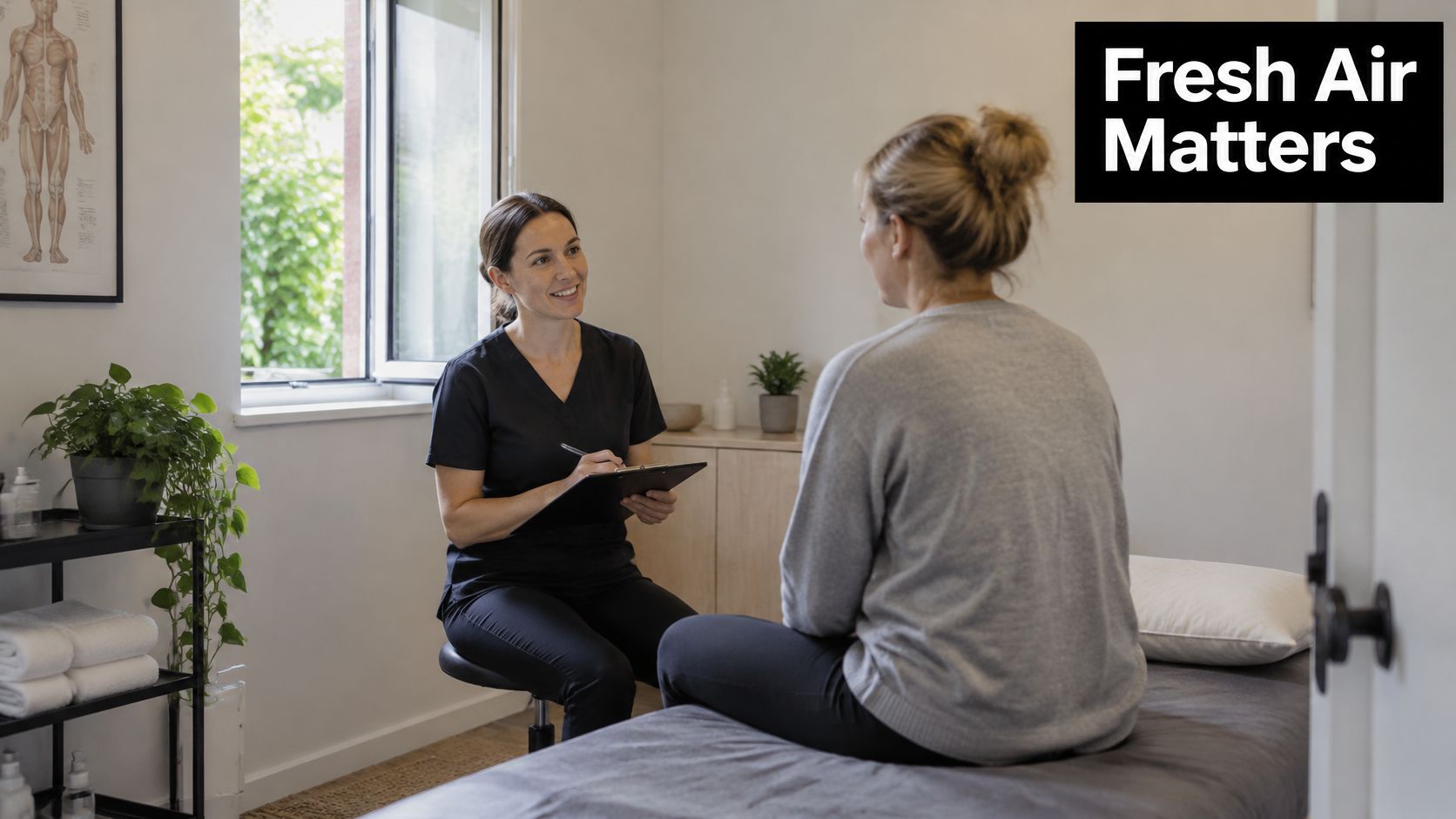
The Health and Safety Executive's ventilation guidance gives a practical benchmark of 5 to 8 litres of fresh air per second per occupant and explains the requirement for sufficient fresh or purified air under the Workplace (Health, Safety and Welfare) Regulations 1992. Treat that as a ventilation assessment starting point, not something you can certify by feeling a breeze.
Check the fresh-air route
- Identify the supply. Ask the host to show you opening windows, trickle vents or the mechanical system that supplies replacement air. A fan moving air inside the room isn't evidence of outdoor-air provision.
- Record maximum occupancy. Include the practitioner, client and anyone else who might remain during a consultation.
- Check the air conditioning. Ask whether it introduces outdoor air or only recirculates and cools existing room air.
- Ask about carbon dioxide monitoring. Request readings taken during occupied periods, rather than relying on an empty-room reading.
- Act on warning signs. Persistently high readings or a stuffy smell warrant reduced occupancy or ventilation-engineer advice.
Product fumes, humidity and body heat can accumulate when fresh-air provision is inadequate. A pleasant fragrance doesn't demonstrate that pollutants are being removed, and cooling alone doesn't answer the ventilation question.
Use this video alongside your practical viewing questions.
Don't accept an arrangement that depends on leaving the treatment door open if your work requires privacy. Ask the host to resolve the ventilation problem before booking, and obtain written confirmation of what will change and when it will be ready.
Extraction Requirements for Nail Services
A room designed for relaxation isn't automatically designed for nail products. The HSE's nail-bar guidance identifies acrylic fumes as capable of causing headaches, dizziness and nausea, and recommends general ventilation alongside local exhaust ventilation, suitable working methods and protective equipment where required.
Source capture matters. A downdraught table or movable hood should collect contaminants where you generate them, rather than waiting for them to spread around the room. Extracted air needs a safe discharge outside, away from doors, windows and air inlets, or correct filtration before it returns indoors.
Ask these questions at the station
- Does this workstation have dedicated manicure extraction? Ask to see it operating at the position where you'd work. A nearby portable fan isn't an adequate explanation.
- Where does the exhaust terminate? Have the host identify the discharge route or explain the filtration arrangement. Don't accept “it goes into the ceiling” as the complete answer.
- Who maintains the fans and filters? Request the service record, filter-change arrangements and responsibility for reporting faults.
- Which nail services was the room assessed for? Establish whether the setup supports your intended products and techniques, rather than only brows, lashes or massage.
Keeping nail work separate from facial or massage appointments can reduce odour transfer and cross-exposure. This supports Control of Substances Hazardous to Health, usually shortened to COSHH, rather than merely making the room smell more pleasant.
Your working method still matters: close product containers promptly, organise the desk so your hands remain near the capture point, and don't obstruct extraction grilles with towels or equipment.
Practical rule: If the host can't explain the exhaust or filtration arrangement, treat the room as unsuitable for acrylic work until a competent assessment resolves it.
Licensing and Insurance to Confirm With the Council
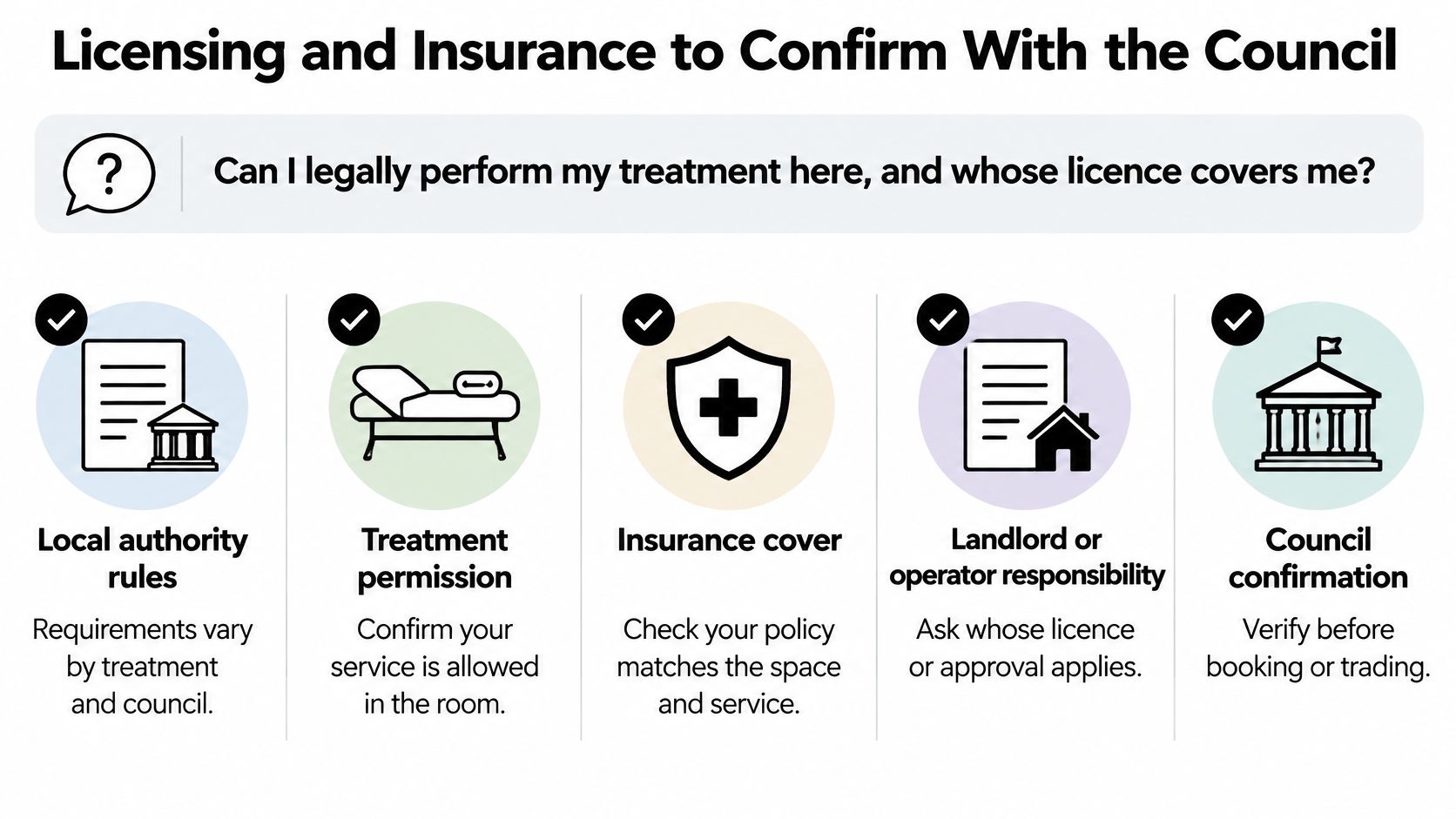
Can I legally perform my treatment here, and whose licence covers me? That question comes before the rental agreement, particularly when procedures involve skin penetration.
Guvnor's salon-rental guidance explains that requirements differ by treatment and local authority, and renting space doesn't automatically transfer premises or practitioner obligations. For a Cheadle Hulme room, confirm the position with Stockport Council rather than assuming another council's rules apply.
Use the checklist as an enquiry aid, not as evidence that a particular licence is required or already held.
Build a treatment-specific confirmation file
- List permitted treatments. Name each service, including any skin-piercing, electrolysis or aesthetic procedure. Broad descriptions can conceal important differences.
- Identify the licence holder where licensing applies. Ask whether approval concerns the premises, the practitioner or both, and whether your proposed arrangement is covered.
- Check qualifications. Give your insurer the actual certificates and treatment descriptions, rather than assuming a general beauty qualification is sufficient.
- Confirm treatment-specific insurance. Obtain confirmation that your proposed work and rented location fit the policy.
- Inspect handwashing facilities. Establish which sink you can use and how you'll access it during treatments.
- Agree waste arrangements. Identify responsibility for clinical waste and sharps where your procedures produce them.
- Set consultation and patch-test procedures. Keep records appropriate to the treatments and products you use.
- Retain written answers. Keep the council's advice, relevant permissions and the host's agreement together.
An operator saying that the venue is a salon doesn't resolve these questions. Nor can a host's informal assurance replace a council decision or your insurer's confirmation.
For hands-on therapies, the massage therapy room guide can help you consider the practical room setup alongside these permission checks. Keep the distinction clear: a comfortable treatment environment and permission to practise are separate requirements.
Total Cost Beyond the Advertised Rate
A rent figure only becomes comparable after you price the whole working week: opening the room, delivering treatments, cleaning, doing laundry, removing waste and leaving equipment stored safely. A room with a lower headline rate can cost more per booked hour if access is narrow or basic supplies are excluded.
The Hair and Beauty Directory's rental guidance explains that independent renters generally need their own public-liability and treatment-risk insurance. It also highlights potential VAT consequences where room or chair rental includes facilities such as reception, basins or waiting areas, so do not assume every arrangement is VAT-free.
Room rental costs and terms to confirm
| Cost item | What to confirm | Agree in writing? |
|---|---|---|
| Room rent | Daily, weekly or monthly rate, access hours and notice period | Yes |
| VAT | Whether charged when reception, basins or waiting areas are included | Yes |
| Insurance | Public-liability and treatment-risk cover in your own name | Yes |
| Consumables and laundry | Who supplies towels, gloves and cleaning products | Yes |
| Card and booking fees | Whether the host passes on card or software charges | Yes |
| Waste disposal | Who removes clinical and sharps waste | Yes |
| Deposit and cancellation | Amount, refund terms and notice required | Yes |
| Utilities and storage | Heating, electricity and storage space | Yes |
Calculate cost per booked treatment hour
Start with the weekly rent. Convert your insurance premium to a weekly equivalent from its annual cost, then add expected consumables, laundry, waste charges, software and payment fees.
Include VAT where it applies to your bill. Divide the resulting weekly operating cost by the client treatment hours you realistically expect to book, not every hour you are allowed into the building.
Cost per booked treatment hour = relevant weekly operating costs ÷ expected booked treatment hours
Treat a refundable deposit separately as cash you must have available. Add non-refundable setup charges or likely cancellation costs to your planning without confusing them with ordinary weekly expenses.
For context, Fresha lists typical Cheadle spa-treatment prices of £25 to £129 in 2026. Those are customer treatment prices, not room rents, and the listing does not establish that the treatments share the same duration or product costs.
Compare your own treatment price and duration with the hourly cost you calculated. A short, lower-priced service is not automatically unprofitable, and a higher-priced procedure is not automatically a strong earner once preparation, consumables and unpaid gaps are included.
Put operating terms beside the price
Record who receives clients, cleans shared areas and pays for damage. Agree access hours, storage, utilities, notice and whether you can trade under your own name.
If you are testing demand, compare the commitments described in the guide to renting a room by the day with a recurring arrangement. For The Retreat Rooms, ask the operator for a written quote before comparing costs, and make sure it states the rate, VAT position, included facilities, access, storage, deposit, notice and damage terms.
Send One Enquiry and Decide
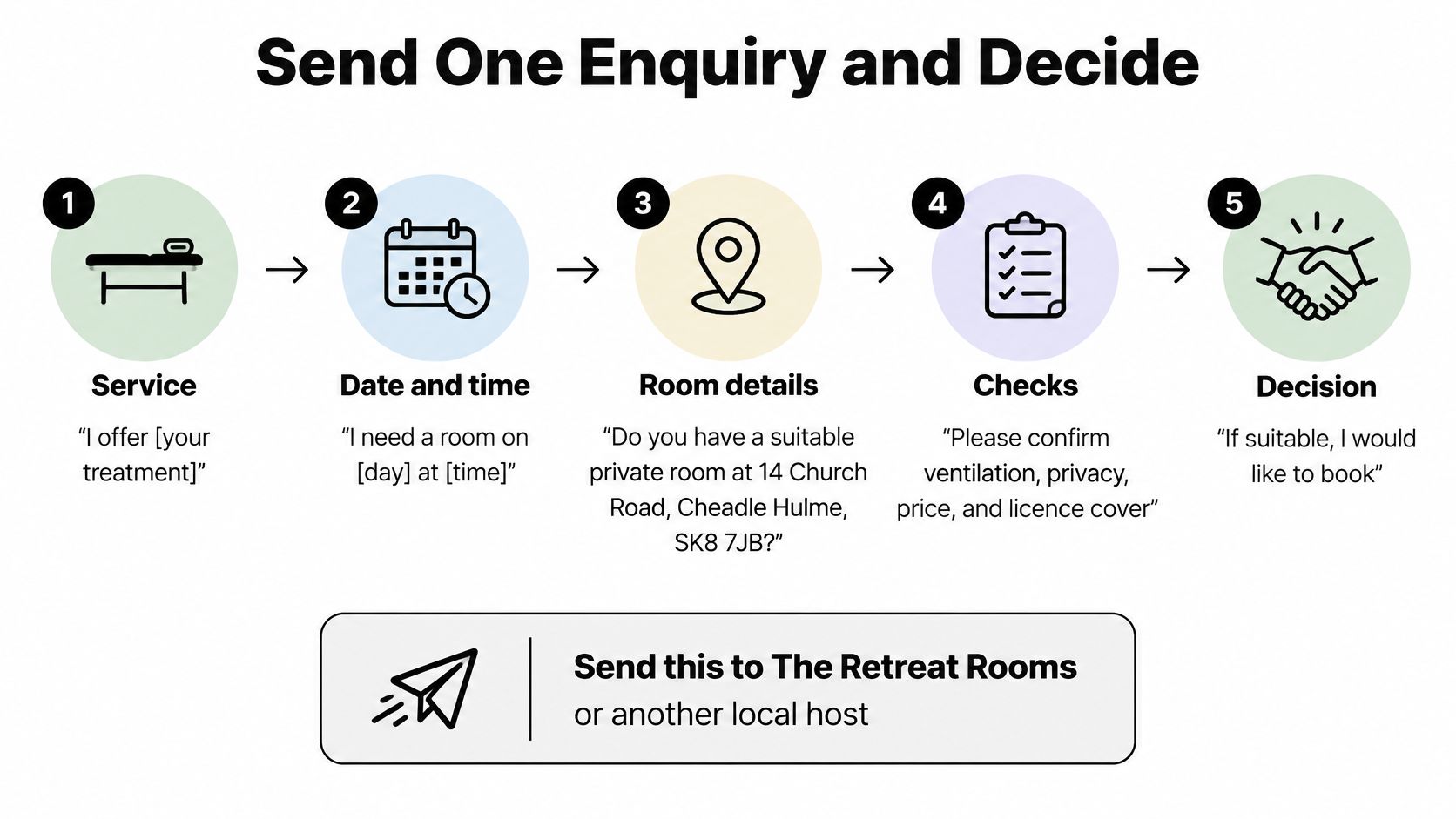
Send a focused enquiry to the operator or another local host. If you've already viewed the space, remove questions that have been fully answered and retain anything you still need in writing.
Use this sequence to keep the message clear.
A message you can adapt
Hello, I'm an independent practitioner offering [specific treatments]. I'm looking for [a private treatment room, nail station or styling chair] on [days], with access during [hours], including preparation and cleaning.
Do you currently let suitable space to external practitioners? If so, please confirm the available arrangement and send details of the room or workstation.
I still need confirmation of [the fresh-air source and occupancy limit], [nail extraction and exhaust route, if relevant], and [any council permission or licence applicable to my treatments]. Please also confirm whether you accept my own public-liability and treatment-risk insurance.
Please provide the rental rate, whether VAT is added, what facilities are included, and written terms for access, storage, utilities, notice, deposit, damage and trading under my own name.
Make the payment decision
A useful reply identifies the actual space, permitted use, complete price and responsibilities. If the operator can't confirm external rental availability, there's no basis for paying a deposit.
Don't commit while treatment permissions, ventilation or acrylic-extraction questions remain unresolved. A friendly conversation is helpful, but it isn't a substitute for a workable written agreement.
On our marketplace, you can search by town or postcode and enquire directly with hosts. Rent is agreed between renter and host, in pounds sterling; the enquiry itself doesn't settle the rental terms.
FindMy.beauty connects beauty professionals with hosts offering chairs, stations and rooms to rent. Visit FindMy.beauty, enter Cheadle Hulme or your postcode, and use these checks when enquiring about any suitable spaces you find.