


It's Saturday morning, and you've noticed a dry, uneven patch on your cheek. You search for facial treatment near me, expecting a straightforward choice, but the results mix relaxing salon facials, clinical-looking procedures and treatment rooms advertised to rent. Before choosing the nearest option, you need to know what's being offered, who'll perform it and whether you're looking at a treatment appointment at all.
Table of Contents
- Two Different Searches Behind One Phrase
- Ordinary Facials Versus Higher-Risk Treatments
- How to Find a Facial Nearby in Five Steps
- Questions to Ask Before You Book
- Aftercare and Sun Protection After a Facial
- When You Need a Room to Rent Instead
- Confirm Your Shortlist Before You Book
Two Different Searches Behind One Phrase
A nearby room with a treatment couch isn't necessarily somewhere you can book a facial. Some listings advertise a practitioner's services; others advertise space for a practitioner to run their own business.
With a service search, you're the client. You want a consultation, a suitable treatment and someone accountable for your care. With a rental search, you're the professional looking for a room, chair or station, and you'll provide the service yourself.
That distinction is easy to miss when both listings show similar interiors.
The Office for National Statistics snapshot reported in Businesscoot's UK beauty-salon market overview counted approximately 50,400 VAT- and/or PAYE-registered hairdressing and beauty-salon enterprises across the UK in March 2025. That's a broad business category, not a count of facial providers or available rooms, but it helps explain the range of businesses behind local results.
A nearby address doesn't establish treatment quality. Nor does a polished photograph tell you whether the person advertising the space performs treatments there.
Start with one question: Am I the client booking care, or the professional looking for workspace?
Clients need to identify the treatment's risk level, assess the practitioner and understand aftercare. Professionals need to assess whether the premises suit their work and whether the rental terms fit their schedule.
Decide which search you're running before opening map results. You'll avoid comparing treatment menus with property listings and can focus on the details that matter to your decision.
Ordinary Facials Versus Higher-Risk Treatments
Facial treatment risk tiers and who should perform them
| Treatment tier | Typical examples | Who should perform it |
|---|---|---|
| Ordinary facial | Cleansing, mask, massage facial | Trained beauty therapist |
| Advanced facial | Exfoliating or enzyme facial, microdermabrasion | Practitioner with treatment-specific training |
| Higher-risk procedure | Deep chemical peel, vampire facial, dermal micro-coring | Appropriately qualified healthcare professional |
| Laser or injectable | Laser resurfacing, injectables, prescription-medicine treatments | Qualified clinician with medical oversight |
Use this table as a safety-led starting point, not a statement that identical legal requirements apply to every procedure. Treatment names can conceal important differences: a gentle exfoliating product and a deep chemical peel aren't interchangeable just because both remove surface skin cells.
An ordinary facial generally centres on cleansing, applying products and massage. Once a treatment involves stronger exfoliation, equipment, puncturing the skin or medicines, you need a clearer explanation of what will happen and why it's suitable for you.
Proposed restrictions aren't the same as current protection
The British Association of Dermatologists' account of the Government's proposed restrictions in England describes plans to reserve high-risk procedures, including deep chemical peels, vampire facials, dermal micro-coring and some laser treatments, for appropriately qualified healthcare professionals, alongside local-authority licensing and safety, training and insurance requirements for lower-risk cosmetic procedures; it also highlights the Professional Standards Authority's concern that people without approved qualifications or sufficient training may legally perform procedures capable of causing severe infection, allergic reactions, scarring or disfigurement.
Those are proposals, not a reason to assume that every provider is already operating under the proposed system. The England-specific position also shouldn't be treated as a single UK-wide rule.
For your own decision, separate the treatment's marketing description from its actual method. Ask whether it uses needles, removes or resurfaces tissue, introduces substances beneath the skin, or involves prescription medicines.
A title isn't enough
A medical qualification can be relevant, but it doesn't establish competence in every cosmetic technique. You need evidence of training in the particular procedure, an appropriate setting and a credible plan for managing complications.
Say a provider advertises both a massage facial and laser resurfacing. A good experience with the massage facial doesn't establish their suitability for the laser procedure.
The more a treatment changes skin structure or involves needles or medicines, the more verification you need before booking.
Use the booking checklist below to turn that principle into specific questions rather than relying on appearance, price or a reassuring title.
How to Find a Facial Nearby in Five Steps
A useful search narrows in stages, from treatment to location to shortlist. Don't start by deciding which attractive photograph looks most convincing.
Use these stages to organise your search.
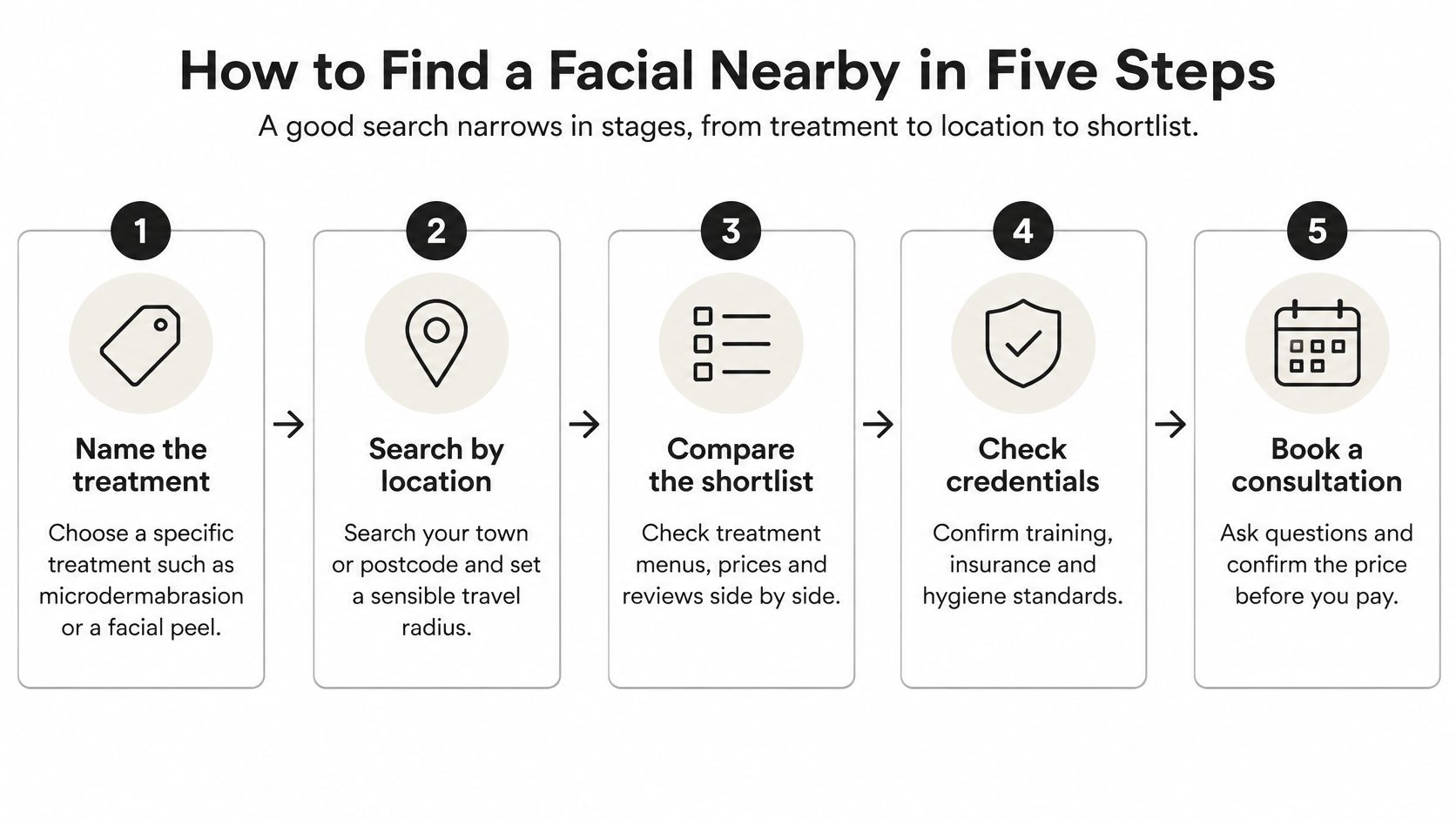
Narrow the results before comparing them
Name the treatment or concern. Search for a hydrating facial, microdermabrasion or a specific peel rather than treating every facial as equivalent. If you don't know what your skin needs, search for a consultation rather than choosing an intensive procedure yourself; a persistent or unexplained skin problem may need medical assessment instead.
Add your town or postcode. Choose a journey you could comfortably repeat, taking parking, public transport and accessibility into account. Don't select a convenient outward journey without considering how you'll get home if your skin feels tender or the provider advises avoiding sun exposure.
Open the full treatment listing. Look for a named practitioner, a written treatment menu and relevant qualifications, not just photographs of the room. Reviews can help you identify questions about communication or appointment organisation, but they don't establish clinical competence.
Compare what the price includes. Check the technique, products, consultation arrangements and any stated follow-up rather than comparing matching treatment names alone. Ask for the complete cost before paying, because an advertised treatment price doesn't necessarily explain every charge.
Make a shortlist of three providers. Each option should have an identifiable practitioner, a clear treatment description and a straightforward contact method. Use your first enquiry to resolve missing information rather than interpreting an incomplete listing as confirmation that everything is included.
Keep a brief note beside each option. Record the exact service, who performs it and what remains unanswered, so you're comparing actual offers rather than remembering which website looked best.
Keep workspace results separate
If you're a professional, the local workspace search serves a different purpose. FindMy.beauty connects beauty professionals with salons that have a chair or room to spare nearby; it isn't a consumer facial-booking service.
For a client, a promising shortlist leads to a conversation about suitability. For a practitioner, it leads to an enquiry about premises and availability.
If you're watching treatment content alongside your search, keep those different purposes in mind.
Questions to Ask Before You Book
Treat the first conversation as part of choosing the provider, not an awkward obstacle before payment. A competent practitioner should be able to explain their work without pressuring you to commit.
The NHS guidance on choosing who will perform a cosmetic procedure explains that non-surgical cosmetic procedures in England have no universal statutory education or training requirement, identifies voluntary registers such as the Joint Council for Cosmetic Practitioners and Save Face, and distinguishes mandatory CQC registration for independent hospitals and clinics providing cosmetic surgery from the position for many non-surgical treatments.
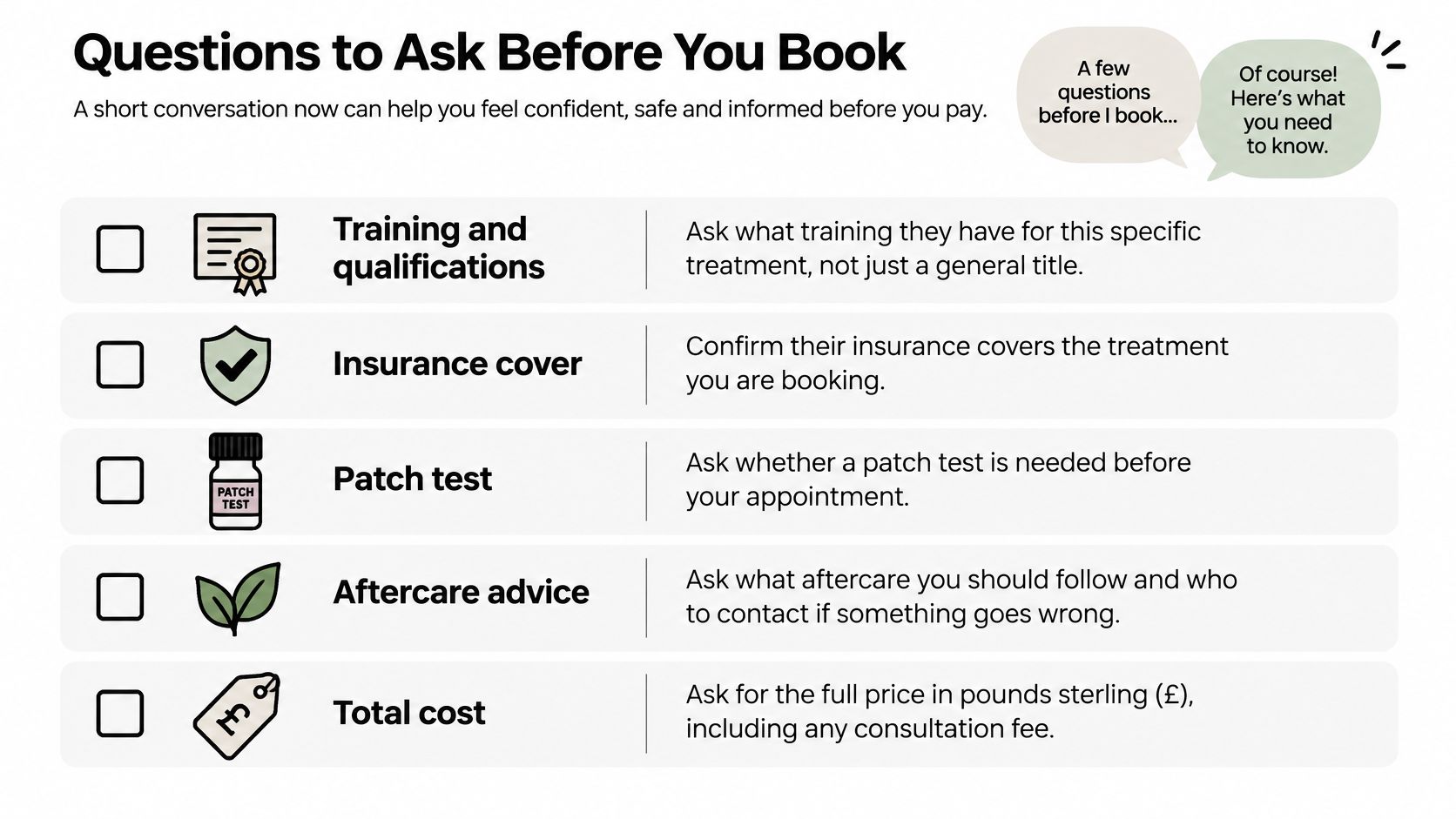
Use a treatment-specific checklist
- Training: What qualifications and practical training do you have for this exact treatment?
- Insurance: Does your insurance cover the procedure I'm considering?
- Consultation: Will you assess my skin and medical history before deciding whether to proceed?
- Contraindications: How do you assess pregnancy, recent sun exposure, active skin infection and current or recent skin medicines?
- Patch testing: Is a patch test appropriate for the products or technique, and when should it happen?
- Complications: What happens if I react badly, and who provides urgent advice or treatment?
- Premises: Does this procedure require clinic or premises registration, and can you provide the relevant details?
- Aftercare: Will I receive written instructions and a contact for concerns?
- Total cost: What's the full price, including any consultation fee?
Keep the essential questions available when you contact a provider.
Listen for specific answers
A useful answer identifies the qualification, explains its relevance and describes what happens if the procedure isn't suitable. A vague claim of extensive experience, without evidence or an explanation of complication management, isn't an adequate substitute.
For an aesthetic practitioner, ask for registration details and search their name on the Joint Council for Cosmetic Practitioners or Save Face register. Check that the entry matches the person and treatment offered; absence from a voluntary register is a reason for further questions, not automatic rejection.
Refusal to show qualifications or pressure to pay before your questions are answered is a reason to leave. If you're combining appointments, our brow-waxing guide can help you consider that separate service rather than assuming every treatment can safely be combined.
Aftercare and Sun Protection After a Facial
Skipping sun protection after exfoliating or resurfacing treatment can undermine the result you wanted. UV exposure can worsen pigmentation, so your plans after the appointment matter as much as the treatment itself.
The NHS sunscreen and sun-safety guidance recommends sunscreen with at least SPF 30 for UVB protection and at least 4-star UVA protection, and identifies the UK's strongest sun-risk period as approximately 11am to 3pm from March to October. Apply protection to exposed facial skin, neck and ears, and reapply liberally according to the product instructions.
Say you arrange a peel before a lunchtime walk. Leaving the clinic without discussing sun exposure could mean exposing newly sensitive skin when you should be protecting it; patchy darkening is a possible concern, not a guaranteed outcome.
Leave with a usable aftercare plan
- Products to pause: Ask which exfoliating acids, retinoids, scrubs or other active products you should avoid.
- Sun precautions: Ask how long you should limit exposure and what protection is appropriate for the procedure.
- Restarting skincare: Get clear instructions about when your usual cleanser, moisturiser and active ingredients can resume.
- Unexpected symptoms: Know which changes the practitioner expects and which require prompt contact or medical attention.
Shade and protective clothing add protection rather than replacing sunscreen. Don't treat sunscreen as permission to spend longer in direct sun, particularly when your practitioner has advised avoidance.
Before you leave: Make sure you can explain the aftercare plan in your own words.
A provider who supplies written instructions and asks about recent sun exposure gives you more useful safety information than a listing containing only a treatment name and price.
When You Need a Room to Rent Instead
A practitioner searching for somewhere to see clients has a different problem from a client booking a facial. The decision now concerns whether the room, access and rental terms support the intended work.
FindMy.beauty lists treatment rooms as private spaces for facials, massage and aesthetics. It also lists beauty rooms for lashes, brows, waxing and makeup, along with salon chairs, nail stations, barber chairs and salon studios.
Compare rental periods on their own terms
Typical listed London rents by rental period
| Rental period | Listed London range |
|---|---|
| Per day | £50 to £150 |
| Per week | £125 to £450 |
| Per month | £400 to £2,500 |
These ranges show how widely advertised workspace rents can vary. They are not quotations for an identical room or a promise of availability, so compare spaces with similar size, access and inclusions. Listings and rents update every hour, but the displayed rent remains the starting point for a direct arrangement.
A daily arrangement can suit occasional appointments, while weekly or monthly terms may fit an established diary better. If the shorter option matches your working pattern, review what to check when renting a room by the day before committing.
Check the premises as well as the rent
Before agreeing terms, establish exactly what is included: treatment furniture, storage, cleaning responsibilities, utilities, access arrangements and permission to perform your intended services. Match the checks to the treatment's demands. An ordinary facial may mainly test privacy and furniture, while a higher-risk treatment calls for closer scrutiny of cleaning arrangements, access and whether the host permits that procedure.
FindMy.beauty lists spaces in English towns and cities including London, Manchester, Birmingham, Leeds, Bristol and Brighton, as well as Glasgow, Edinburgh, Aberdeen, Cardiff and Belfast. A town or postcode search narrows the options, but each listing still needs assessing on its actual facilities and terms.
You can send an enquiry with your name and email address without creating an account. Hosts choose who rents their space and arrange dates, payment and rental conditions directly with the professional.
Maya T., a lash technician in London, replaced a six-month room contract she used three days a week with renting a lash room by the week. She messaged two hosts on a Sunday evening and visited one on the Tuesday.
A workspace listing is a route to premises, so don't expect to use it to book a facial.
Confirm Your Shortlist Before You Book
For a service search, the decision is whether you trust the named practitioner to assess and perform the proposed treatment. Don't let an available appointment push you into a procedure you haven't understood, particularly when a consultation could lead to a different recommendation or no treatment.
For a rental search, the decision is whether the space and agreement support the work you intend to do. Send an enquiry that states your treatment type, intended working pattern, preferred start date and essential facilities, so the host can respond meaningfully.
A nearby option is useful only when it meets the need you actually have.
Questions about how our marketplace works can be sent to hello@findmy.beauty. Treatment suitability and clinical advice belong with the practitioner responsible for your care, while rental conditions are agreed directly with the host.
Your next action is simple: write down three shortlisted providers or rooms, and the one unanswered question you'll ask each before booking. That turns a broad search into a decision you can explain and feel comfortable making.
FindMy.beauty helps beauty professionals find nearby chairs, stations and rooms to rent, including private treatment rooms for facial work. If workspace is what you need, visit FindMy.beauty, search your town or postcode and contact a host with your requirements.