

You've done three facials from the spare room this week and moved the bed each time. The dog barked through one of them. Your neighbour's parking space is now a running negotiation. Somewhere between the third apology and the fourth cancellation you searched for treatment rooms Harrogate and got a wall of salons, a phone number, and no prices.
The search usually goes wrong in the same way. It gets treated as a listings problem: pick the cheapest room that isn't too far, book it, hope. Three months later the therapist finds out the extraction vents into a corridor, the handwashing sink is shared with four stylists, or the host stopped advertising because the last two renters walked. Renting a room is a cost decision and a compliance decision dressed up as a property search.
What follows is the order I'd work in. How the routes differ, what your treatment type demands of a room, how a day rate compares with a monthly licence, what the true monthly figure looks like, and what to ask on the viewing. The rate on the page is the opening figure. It's never the total.
Table of Contents
- Where to Find Treatment Rooms in Harrogate
- Matching the Room to Your Treatment Type
- Choosing Between Day, Weekly and Monthly Rental
- Working Out the True Cost of a Room
- Why Some Harrogate Rooms Stay Empty
- View the Room and Send the First Enquiry
Where to Find Treatment Rooms in Harrogate
Harrogate has treatment-room space arriving from two directions. Part comes from a spa heritage that built purpose-designed treatment buildings. Part comes from a working beauty trade renting rooms above salons, inside skin clinics and in converted townhouses near the centre. The heritage isn't decorative. Mineral-water treatment was promoted in the town from the late 16th century, the Royal Baths opened in 1897, and the Edgepedia history of Harrogate records 18,723 baths delivered in August 1898 alone. That history helps explain why the town has spaces designed for hands-on treatments, alongside rooms adapted from other commercial premises.
The route you choose affects your costs, access and control.
Five routes and what each one asks of you
| Route | Best for | Typical commitment | Check before enquiring |
|---|---|---|---|
| Local room-rental listings | Freelance therapists needing a private room | Day, week or month | Whether rent includes utilities and reception |
| Salons with a spare room | Therapists wanting a few booked sessions a week | Sessional or weekly | Whether the room is private and how client access is shared |
| Spa and wellness venues | Massage, facial and aesthetics practitioners | Negotiated, often sessional | Insurance cover and any treatment-type restrictions |
| Commercial letting agents | Owners wanting a dedicated clinic | Fixed-term lease | Permitted use, fit-out and business rates payable |
| Postcode search on FindMy.beauty | Renters comparing rates by day, week or month | Day, week or month, priced per listing | Whether Harrogate has a listing available |
Treat the routes as filters, not interchangeable options. A salon's spare room may offer a shared front door, but that arrangement can affect privacy and client flow. A spa venue may set insurance conditions or restrict treatments. A commercial lease gives you more control over the premises, while bringing longer commitments and additional costs to check.
Start with the practicalities:
- Search around two postcodes: yours for the commute, and your clients' for their journey.
- Compare five options by rate basis: write day, week or month beside each price so you are comparing like with like.
- Ask about two specific dates: named days make it easier to establish availability than a general question about a future month.
A quick reply with the rate, access arrangements and insurance requirements gives you useful details to compare. It does not, by itself, establish that the room is well run or right for your clients. Shortlist three to five spaces that fit your treatment and budget, then check the conditions before committing.
Matching the Room to Your Treatment Type
The service decides the room, not the other way round. A lash technician and a nail technician can stand in the same converted office and reach opposite conclusions, and both are right. Extraction, plumbing, ventilation and washable surfaces are set by what you do in the space for six hours a day. Write your treatment list down before you open a single listing.
What each treatment demands
| Service | Room requirement | Question for the host |
|---|---|---|
| Facials, massage and aesthetics | Private room, reliable lighting, washable surfaces | Is the room lockable, and who else has access? |
| Lash and brow | Clean working surface, handwashing sink nearby | Where do I wash hands between clients? |
| Waxing | Ventilation for heat and product fumes, disposable paper towels | How is the air changed during treatments? |
| Nail and acrylic | Local exhaust ventilation such as a downdraught table, with extraction discharged outside | Does LEV exist, where does it exhaust, and when was it last tested? |
| Hair and colour | Sink access, drainage, safe chemical storage | Are basins shared, and where are products stored? |
Nail work carries the heaviest requirement and the least room for negotiation. Acrylic vapours, solvent odours and filing dust are associated with irritation, asthma symptoms and respiratory discomfort, and HSE guidance on local exhaust ventilation recommends a downdraught table or a movable extraction hood alongside general through-flow ventilation. Extracted air should discharge safely outside, away from doors, windows and air inlets, and LEV systems need examination and testing at least every 14 months by a competent person. If a host can't tell you where the duct terminates, assume it terminates somewhere unhelpful.
Facial, massage and lash rooms need lighter controls, but the same COSHH thinking applies to every product you open, and ventilation still matters more than the paint finish. If you're building a massage or facial space from scratch, this guide to setting up a massage therapy room covers the practical layout questions.
An unsuitable room is a legal and practical problem, not a matter of taste. Rule it out before you start comparing prices, because a cheap room that fails on extraction is the most expensive room on the list.
Choosing Between Day, Weekly and Monthly Rental
The arrangement matters more than the headline rate. Two Harrogate rooms can quote the same daily figure and leave you with completely different monthly bills, because one expects you in every week and the other lets you disappear for a fortnight.

| Arrangement | Cost pattern | Commitment | Best when |
|---|---|---|---|
| Day rate | Pay per session | None beyond the booking | Occasional work or testing an area |
| Weekly rate | Pay per week | Short notice | Two or three set days a week |
| Monthly licence | Fixed monthly fee | One month plus notice | Steady, regular client bookings |
| Revenue share | Percentage of takings | Set by agreement | Low start-up cash, with the fee basis agreed |
| Fixed-term lease | Rent plus bills and rates | Multi-year | A full-time dedicated clinic |
A therapist testing Harrogate with two clients a week usually suits a weekly rate. It avoids paying for empty weeks in a month that turns out quiet. Someone with a steady client list does better on a monthly licence, where the cost per working day falls once bookings are regular.
Revenue share is the option people reach for when savings are thin, and it can work, provided you check whether takings are measured before or after card fees, product costs and reception charges. Those three deductions decide whether a percentage is generous or punishing.
The sum the rate hides
Multiply the day rate by the number of days you will use in a month. That total, not the per-day figure, is what you're comparing against the monthly licence. A low day rate costs more than a monthly fee if you work every weekday. A monthly licence costs more than anything if you use it twice.
If you can't name the days you'll work, you're not ready for a monthly licence.
Settle three things before you sign anything: the arrangement itself, the notice period in both directions, and whether quoted rates include VAT when the host is VAT-registered. That last one turns a comfortable rate into a 20% surprise. And if you're weighing a per-day booking against a fixed weekly slot, the trade-offs in renting a room by the day are worth ten minutes before you commit.
Working Out the True Cost of a Room
A room quoted at £600 a month can still cost more than expected once you account for laundry, travel, insurance and the time clients spend waiting for you to answer enquiries. Compare the full operating cost, not just the rent. Directory listings can help you find venues and contact details, as the Health Centre's Harrogate beauty directory does, but they do not necessarily show what a rental rate includes.
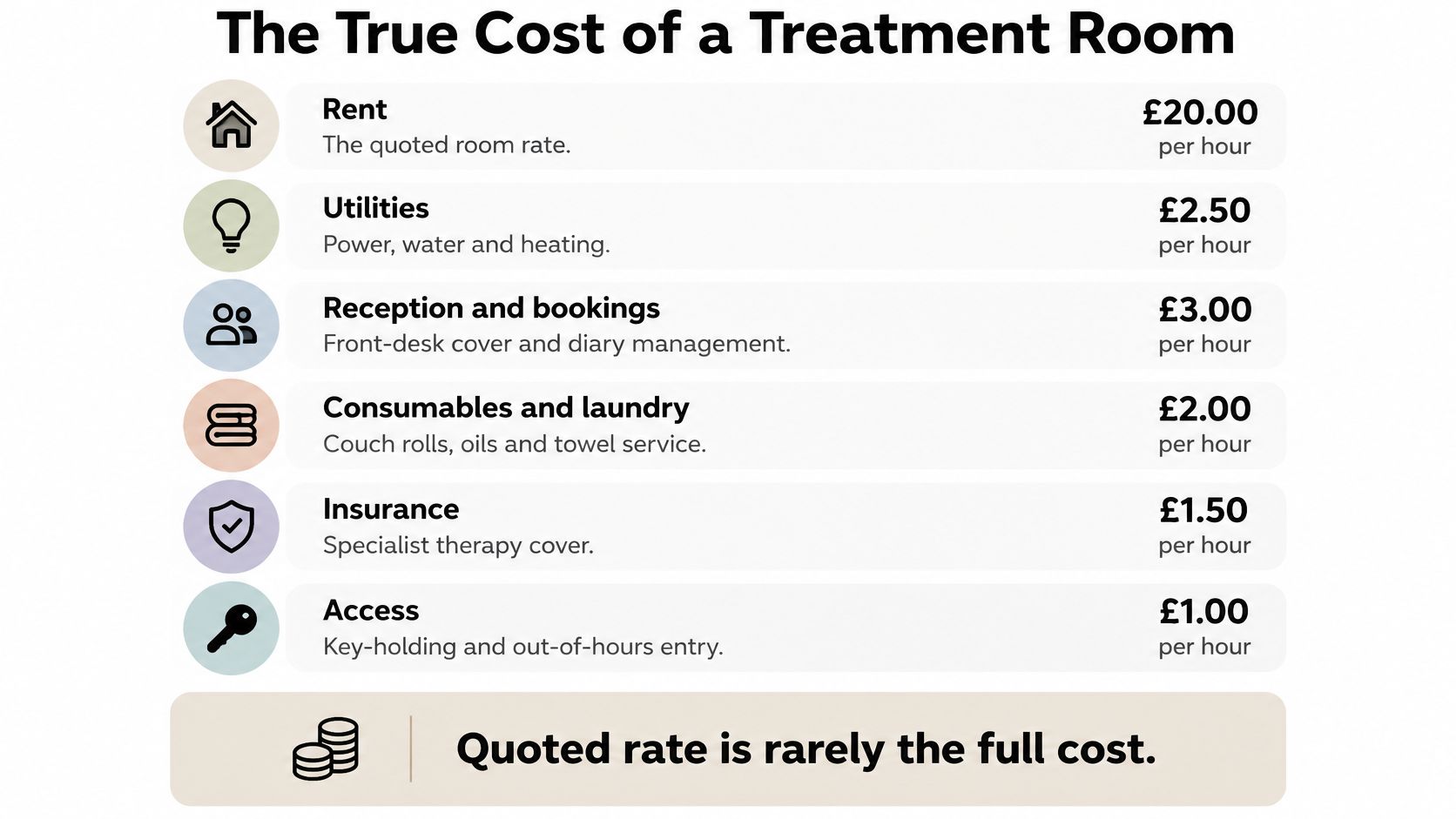
| Cost line | Usually included? | Question to ask |
|---|---|---|
| Rent | Fixed fee or share of takings | Is the fee fixed or a percentage, and is the percentage calculated before or after card fees? |
| Utilities | Often included, but confirm in writing | Are heating, electricity and water included? Is there a fair-use cap? |
| Reception and bookings | Often an extra responsibility or charge | Who takes bookings and payments, and who follows up on missed appointments? |
| Consumables and laundry | Often your responsibility | Who supplies towels, disposables and cleaning products? |
| Insurance | Check whether your own cover is required | Does the host's policy cover my treatments, or do I need separate cover? |
| Access and parking | Depends on the venue | Can I enter outside salon hours, and where can clients park? |
One break-even sum, worked through
Add the monthly room cost, consumables, travel, card fees, insurance and the amount you set aside for tax. Divide that total by your average income per treatment after product and card costs. The result is how many treatments you need to cover those expenses.
For example, if monthly costs total £600 and each treatment leaves £40 after products and card fees, break-even is 15 treatments. That covers costs only. It does not pay you for your time or leave money for quieter weeks.
Check whether your likely bookings can support that figure. Fixed rent leaves you carrying the cost in quiet months. A share of takings reduces the fixed commitment but takes more when bookings are strong. Compare each option against the number of treatments you realistically expect to deliver.
Practical rule: Write down your break-even client number before making an enquiry. Measure every quoted rate against it.
Why Some Harrogate Rooms Stay Empty
A room advertised for months may look like a bargain. It may also point to a demand problem, a staffing gap or a mismatch between the room and the treatments local clients want.
Harrogate's council-run Turkish Baths offer one documented example. In 2018, the BBC reported a projected £295,000 income shortfall, partly linked to a refurbishment that lasted ten weeks rather than the four budgeted, and partly to weaker massage and beauty income when the operator could not recruit enough therapists. A room can be equipped and available, yet remain idle if the business cannot find practitioners to use it.
For an independent renter, the practical question is whether the vacancy reflects a gap you can fill or a lack of clients you would have to solve yourself. Ask the host:
- How long has the room been available, and why? A recent changeover may be routine. A long vacancy calls for a clear explanation.
- What happened with the previous renter? A move away suggests a different issue from a disagreement over how the room is used.
- What client demand does the salon already have? Ask whether the host expects you to bring your own clients or can refer suitable enquiries.
Treat an empty room as a prompt to investigate. A low rate may compensate for weak demand or a staffing gap, and those problems affect how quickly the room can earn. Check that the explanation fits your treatment type, client base and working pattern before you commit.
View the Room and Send the First Enquiry
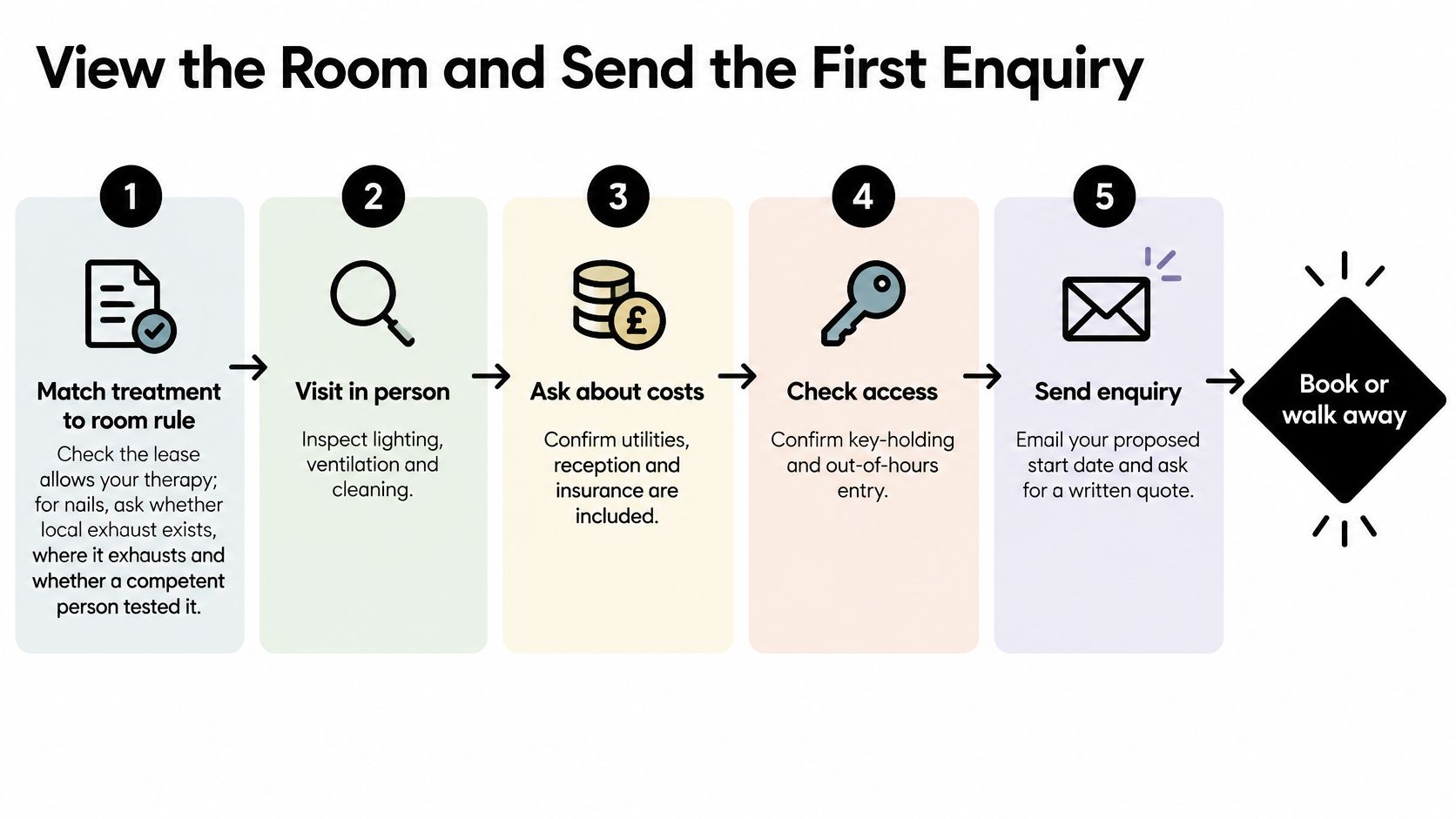
Six steps, one decision at the end. Work them in order and you'll either book a room that earns or walk away with your deposit intact.
The sequence that saves a wasted visit
- Match the treatment to the room rule. For nails, ask whether LEV exists, where it exhausts and whether a competent person tested it within the last 14 months.
- Fix a monthly ceiling from your break-even number. If room costs reach £600 and each treatment leaves £40, 15 treatments only cover the room. Set your ceiling below the point where the diary becomes unrealistic.
- Search every route with a Harrogate postcode and your clients' postcodes. Save three to five options and note whether each rate is per day, week or month.
- Send one enquiry per option. State your treatments, days, hours and start date, ask for every cost line in writing, and ask who keeps the fee if you or the client cancels. Searching and messaging hosts is free, and you deal with the salon directly, so there's no reason to under-specify.
- View during the hours you'll work. A room at 10am on a Tuesday tells you nothing about 7pm on a Thursday when the salon is closing around you.
- Get the rest in writing. Rent basis, notice period, deposit, insurance responsibility and out-of-hours access, in an email you keep. The clauses worth checking mirror those in a salon chair rental contract, just scaled down to one room.
The physical check has a standard you shouldn't flex on. For a treatment room in Harrogate you want a dedicated handwashing sink with antibacterial soap and disposable paper towels, washable floors, walls and ceilings, smooth non-porous surfaces where clients and equipment make contact, and lighting good enough for accurate work and for cleaning afterwards, as the beauty treatment health and safety guidance from Luton Borough Council sets out. That guidance also treats lighting, heating, ventilation and general comfort as required conditions for salon treatment areas. Judge those on the viewing, not on the listing description.
Plenty of hosts run their rooms exactly this way, and a listing that states its day, week or month rate up front saves everyone a phone call. When you're ready, enter your town or postcode, browse for free, and use the Message host button on a listing to send your enquiry straight to the salon. Then decide the room you'll view first, the date you'll go, and the figure you won't go above.
FindMy.beauty lists beauty rooms, private treatment rooms, nail stations and salon chairs across the UK, with day, week and month rates shown before you contact anyone. Search by town or postcode to see what's available near you and near your clients, then message hosts directly to agree dates, payment and terms. Start at FindMy.beauty and shortlist three rooms before you commit to one.