

You've found a chair that suits your clients, or a spare station sits empty most weekdays. The other person seems reasonable, so a handshake feels enough. Then a client has a bad reaction on a busy Saturday, rent lands a week late, or one side wants out, and every answer depends on what was written down.
That is what a salon chair rental contract is for. In a 2024 submission to the UK Parliament, approximately 232,700 people worked in UK hairdressing and beauty salons, with 145,200 self-employed, representing 62% of the sector. Renting a chair means two separate businesses sharing one roof, and the contract is the document that settles everyday questions before they become disputes.
Table of Contents
- Terms Every Salon Chair Rental Contract Should Define
- Settling Whether a Renter Is Self-Employed Before Signing
- What the Rent Covers and How VAT Applies
- Who Handles Cleaning, Insurance and Client Problems
- Notice, Deposits and Ending the Arrangement
- A Worked Example of Two Contracts for One Chair
- Confirm These Terms Before You Sign
Terms Every Salon Chair Rental Contract Should Define
A salon chair rental contract is the written agreement that sets out who uses which space, for what, when, at what price, and how it ends. Treat it as an operations document, not a form you file and forget. On a normal day it answers small questions before they become arguments.
It matters even between friends. Most disputes don't start with bad intent. They start over details nobody wrote down, such as whether the rate covers the backwash, who restocks towels, or whether a missed payment lets the host lock the room. Memory fills gaps differently for each person, especially once money is involved.
The Core Terms to Settle First
Use the table as a working checklist. Read each row and try to fill it in for your arrangement. If you can't, that's a conversation to have before anyone signs.
| Term | What to agree in writing | Example |
|---|---|---|
| Parties and premises | Full legal names, business names, the exact chair, room or station, and its address | Jane Smith trading as JS Hair rents Station 2 at 14 High Street from Bright Salon Ltd |
| Rental period | Start date, end date or rolling basis, and whether the arrangement renews | Rolling weekly, starting Monday 1 June |
| Rent and billing | Amount per day, week or month, currency, and due dates | £200 per week in pounds sterling, due by bank transfer each Monday |
| Access and hours | Days and hours the renter may use the space, and how keys or codes are handed over | Tuesday to Saturday, 8am to 6pm, key held by the host |
| Deposit | Whether one is taken, how much, and when it is returned | £200 on signing, returned within 14 days of leaving if rent is paid and there's no damage |
| Notice to end | Length of notice and how it must be served | Four weeks in writing by email |
| Permitted use | Services allowed, and any limits on retail, products or sub-letting | Hair colour and cuts only, no sub-letting |
Rent is agreed directly between renter and host in pounds sterling, so the contract is where you fix the actual figure, the basis it's charged on, and the due date. Don't copy a rate from a message thread without checking whether it still stands. Write the number both of you've just confirmed.
Practical rule: A blank cell in your draft is not a minor gap. It's a question you'll end up answering under pressure, usually in front of a client.
Name the exact space, too. "A chair in the salon" invites a row when a second renter arrives. "Station 2, including the mirror, trolley cupboard and shared use of Backwash A" leaves nothing to debate. The same goes for access. If the renter can't come in on a Sunday, or can only enter when a keyholder is present, say so now rather than on the first Sunday a bridal party is booked.
Settling Whether a Renter Is Self-Employed Before Signing
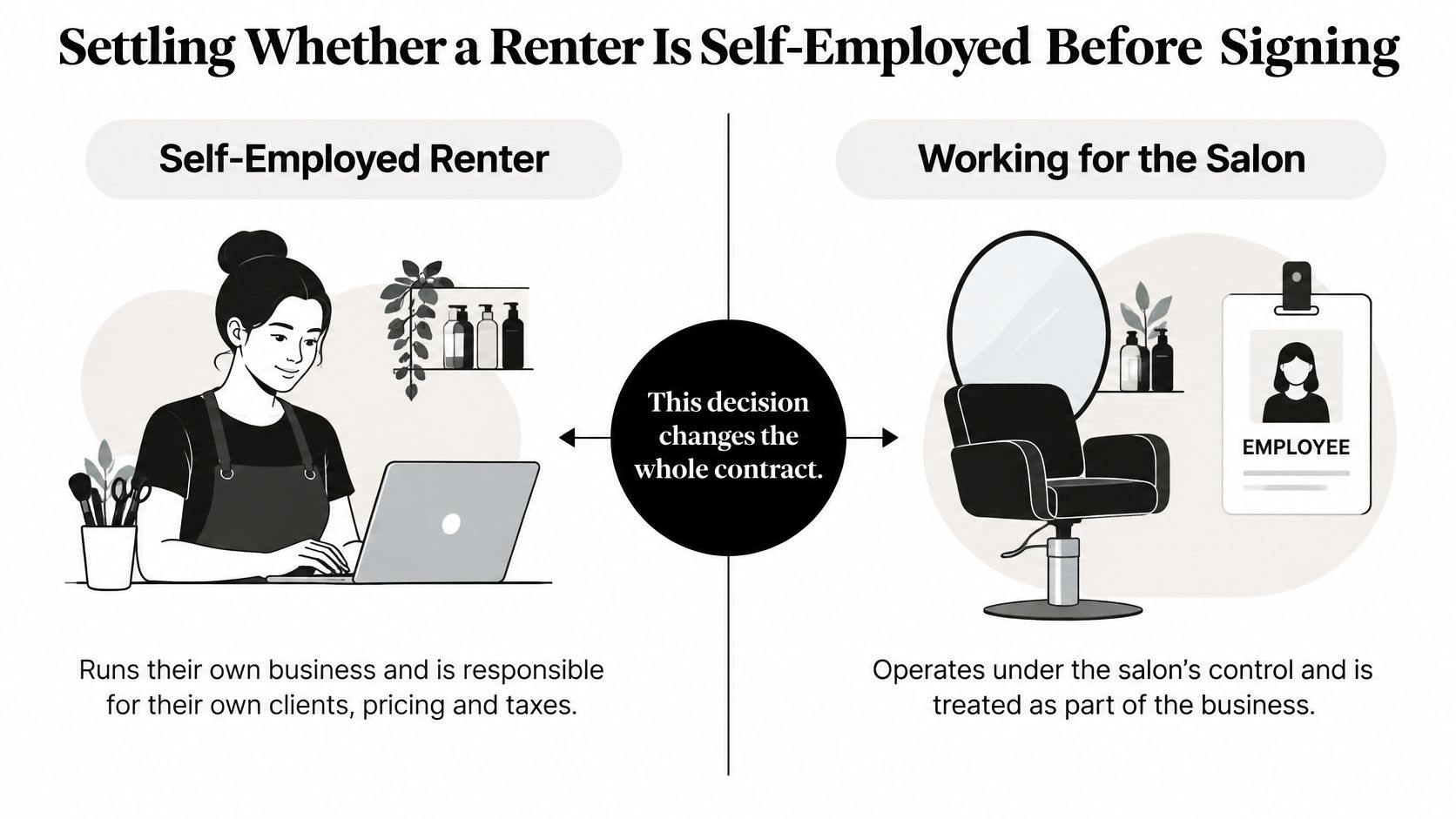
Start with the question that decides how everything else is treated. Is the renter running their own business from your premises, or are they working for the salon? A chair rental should be a licence to use space and facilities, not an employment or services relationship in disguise.
Renting a salon chair is like renting a desk in a shared office. You pay for the chair, choose your own clients, set your own prices, and carry your own costs. You don't join the office payroll, follow its rota, or hand your takings to the building owner. If that picture doesn't match what's planned, you're not describing chair rental.
What Control Actually Looks Like
The HMRC guidance on checking employment status in hair and beauty assesses both the written terms and actual day-to-day practice, including who controls prices, working hours, appointments, customer relationships, equipment, and financial risk. A label saying "self-employed" isn't decisive if the salon controls the work in practice.
So a host who sets the renter's prices, books their clients, dictates their hours, and pays them a net amount after deductions has changed the arrangement, whatever the paperwork calls it. That doesn't mean a host has no say. Deciding who rents the space, and whether they suit the premises and existing clients, is control over the premises. Every enquiry goes to the salon owner, who decides who suits their space and clients. Telling that renter how to cut, what to charge, and when to work is control over the work. Keep those two apart.
Write down each control point before you sign:
- Prices and services: Who sets them, and can the renter change them without approval?
- Hours and bookings: Who chooses working days, takes appointments, and owns the client relationship?
- Money and risk: Who takes payment from the client, keeps income records, and loses out on a quiet week?
- Tools and tax: Who supplies equipment, holds insurance, and handles their own tax obligations?
If the renter is independent, they should generally account for customer takings as their own gross income and claim chair rent as a business expense. Document the agreement term, each party's responsibilities, the termination process, the notice period, and where notice must be served. Then check the contract against a real Tuesday. If practice and paper don't match, change one of them.
What the Rent Covers and How VAT Applies
"Rent" is rarely one thing. It's usually a bundle, and the bundle is where misunderstandings hide.

A typical package includes an allocated chair or defined area plus facilities such as washbasins, reception, a waiting area, laundry, or other salon services. The HMRC VAT manual on chair rentals states that when these elements form an integrated package, the supply to the stylist is normally standard-rated for VAT, even if the stylist has a licence to occupy the space. Don't assume the payment is exempt rent of land because you call it rent.
Itemise It, Don't Shrug at It
Compare a vague one-liner with the same money broken down. The total doesn't change. Your ability to argue about it does.
| Pricing line | Vague version | Itemised version |
|---|---|---|
| Total monthly charge | £800 a month | £800 a month, made up as below |
| Chair and defined area | Included, amount not stated | £650 for Station 2 and shared backwash |
| Shared reception and laundry | Assumed included | £100 for reception cover and laundry |
| Metered utilities | Not mentioned | £50 estimated, reconciled monthly against readings |
| VAT position | Not stated | Stated for each line before signing |
Utilities and shared-area cleaning need fact-specific analysis, so itemise the base occupation right and every included facility instead of describing everything as rent. State whether each price is VAT-inclusive or VAT-exclusive, give the VAT registration number where one applies, and explain how separately charged utilities, consumables, laundry, reception, booking, and cleaning are treated. If you're still working out the figure itself, our guide to how to price a salon chair or room helps you build it from costs rather than guesswork.
Hosts arrange payment terms directly with the renter, and we facilitate the connection while hosts keep full control over their financial agreements. So agree the basis, daily, weekly or monthly, plus the due date, payment method, and what happens on a late payment. Cover mid-month changes too. If the renter drops a day or adds a Saturday halfway through, is rent pro-rated, and from which date?
This short explainer is worth watching before you finalise figures:
Before signing, confirm four things in writing. What's the VAT status of the supply? Are prices inclusive or exclusive? Is there a VAT registration number to record? And should an accountant check the treatment for your situation? That last question is cheap to ask now and expensive to ask after a year of invoices.
Who Handles Cleaning, Insurance and Client Problems
Daily life is organized by these decisions. Who cleans the basin, who buys bin bags, and who responds when a client is standing at reception unhappy with her colour? A good salon chair rental contract answers those questions in plain terms.
The Usual Defaults and What to Write
| Responsibility | Usually handled by | What the contract should say |
|---|---|---|
| Cleaning of shared areas | Host | Cleaning frequency, who supplies products, and who cleans the renter's station between clients |
| Equipment and tools | Renter, unless the host supplies it | Which equipment the host provides, and who repairs or replaces it |
| Utilities and consumables | Split, as agreed in writing | Whether bills are included, metered or charged separately, and who buys towels and disposables |
| Professional liability insurance | Each party for their own work | Confirmation that both hold their own cover |
| Client bookings and records | Renter | Whether the renter uses their own booking system and keeps client records |
| Client complaints and refunds | Renter | Who responds to the client and who pays any refund for the renter's service |
| Permissions and landlord consent | Host | Written confirmation that the host may rent out the space |
| Income and tax records | Renter | Renter keeps their own takings and expense records |
Two rows need extra care. First, hosts must confirm they own the space or have the right to rent it out, including any permission needed from a landlord, freeholder or business partner. A renter who builds a client base in a room the host had no right to let has a serious problem, so ask for that confirmation in writing.
Second, insurance. We recommend that all hosts and renters maintain their own professional liability insurance, and each party should confirm cover for their own work rather than assume the other's policy stretches to them. Put policy holder, insurer, and renewal date in a schedule you can update. Then say what happens if cover lapses. Can the renter still work? On what terms?
If you'd be embarrassed to explain an arrangement to an insurer after an accident, it isn't clear enough to sign.
Say a client complains about a colour result and wants her money back. Who speaks to her? Who decides whether to redo the work or refund? Who pays, and does the renter's insurer need telling before anyone admits fault? Write that sequence down. Our checklist on what to agree before a renter's first day is a useful companion when you're turning these points into first-week habits.
Go through the table line by line together. Any row where each side assumes the other is covering it needs rewriting on the spot.
Notice, Deposits and Ending the Arrangement
Match the notice period to the rental period. That single principle prevents most exit rows.
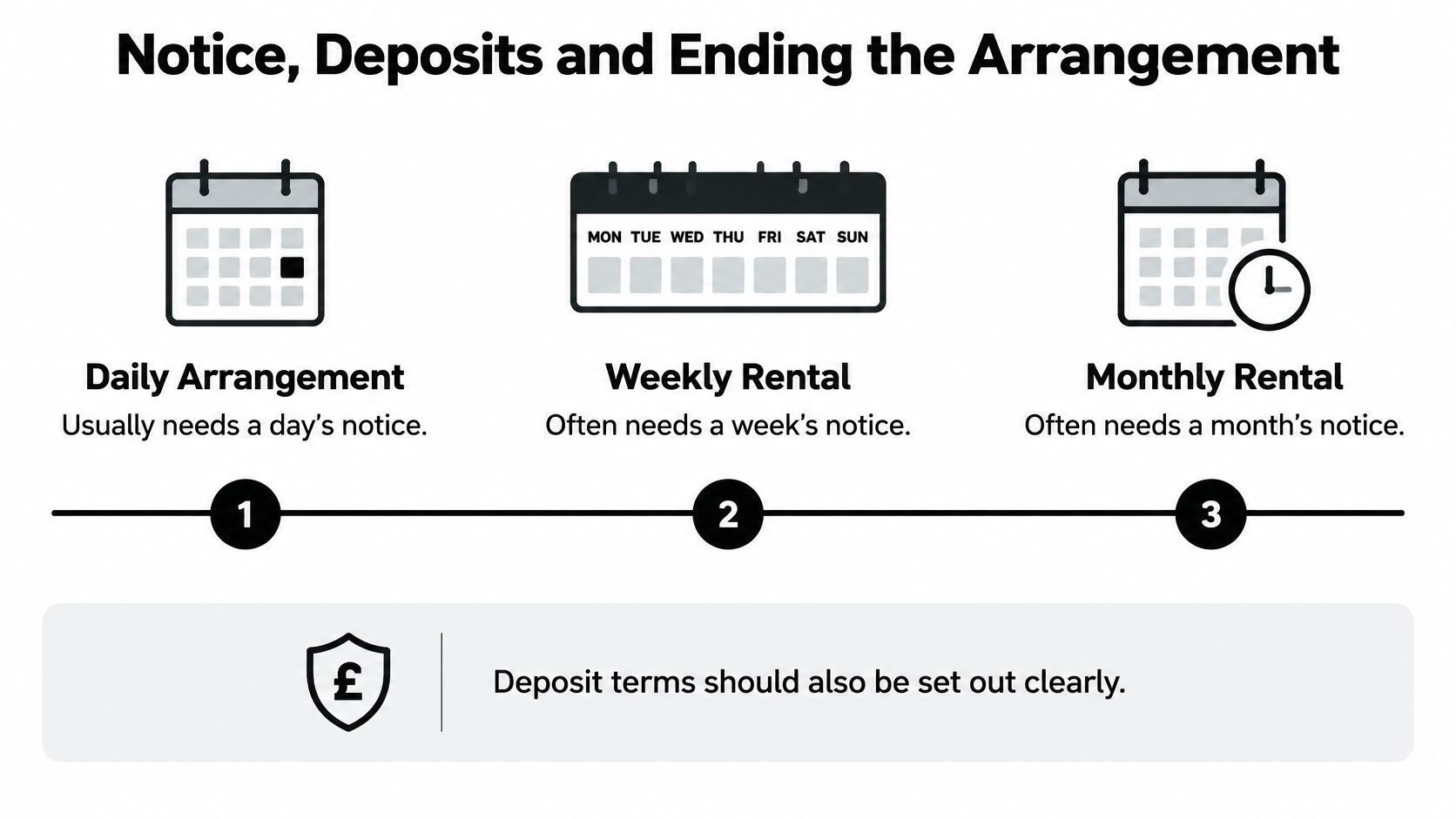
Daily arrangements may need only a day's notice, weekly rentals often run on a week's notice, and monthly rentals on a month's notice. Longer fixed-term agreements may need three months or more. Whatever you choose, state how notice must be served, by email or signed letter, the address it goes to, and the date it counts from. "Let me know sometime" is not a notice clause.
Money, Changes and Default
Cover the deposit in the same detail. How much is it? What can it be used for, usually unpaid rent and damage beyond normal wear? And what's the deadline for returning it once the renter has left, with a list of any deductions? Vague deposit wording is a reliable source of bad feeling, because both sides remember the conversation differently.
Changes need a process, too. Any change to days, rent, or space should be written down, dated, and signed by both sides. A chat over the backwash isn't an amendment. For late rent, build in a notice-to-remedy step. The host writes to say rent is overdue, the renter gets a set number of days to pay, and only then can the host end the arrangement. That protects the host's income without turning one banking delay into an eviction.
Then walk the timeline to the end:
- Notice served: Date confirmed, final working day agreed.
- Notice period: Bookings in the host's system settled, client records confirmed as the renter's to take.
- Final day: Last rent paid, station cleaned, keys and codes returned.
- After leaving: Deposit returned by the agreed deadline, minus any itemised deductions.
We provide only the listing and messaging platform, we're not a party to any rental agreement, and we don't handle rent or deposits. Those terms sit wholly between you and the other party, which is exactly why they need writing down.
A Worked Example of Two Contracts for One Chair
Say a colourist wants a styling chair for her Saturday clients in a busy salon. This is an illustrative case, not a real one, but the incidents are the ordinary kind.
Version one is a text message. "Chair £60 a day, pay when you can, either of us can leave anytime." Short, friendly, and useless the moment something goes wrong.
Version two is a short written agreement for the same chair. It states a daily rate of £60, an itemised utilities line, payment due each Monday by bank transfer, seven days' notice on either side, and a deposit of one day's rent. It also names who supplies towels, who cleans the station between clients, and who handles complaints about the colourist's own work.
Four Ordinary Incidents
First, payment arrives nine days late. Under the text, "pay when you can" means the host can't really say it's late at all. Under the written version, the due date has passed, so the host sends a notice to remedy and the colourist knows exactly how long she has.
Second, a basin cracks. The text says nothing about equipment, so both assume the other pays. The written version lists the backwash as host-supplied equipment, with the host responsible for repairs, unless the renter caused the damage. One phone call, no argument.
Third, a client complains her colour is too warm and wants a refund. With the text, reception staff improvise, and the host ends up apologising for work she didn't do. With the written version, the renter speaks to her own client, decides on a correction or refund, and tells her insurer if the complaint escalates. Responsibilities were assigned before the problem appeared, which is the only time assigning them is calm.
Fourth, the colourist leaves after two months. The text's "anytime" could mean tonight, leaving the host with an empty Saturday chair and no deposit to cover the gap. The written version gives seven days' notice, a final rent date, and a deposit returned once the station is left clean. If she's comparing this with a private room instead, our overview of salon suite rental shows how the same clauses play out in a self-contained space.
The lesson: The second contract isn't longer for its own sake. Each extra line answers a question that would otherwise cost money or goodwill.
Confirm These Terms Before You Sign
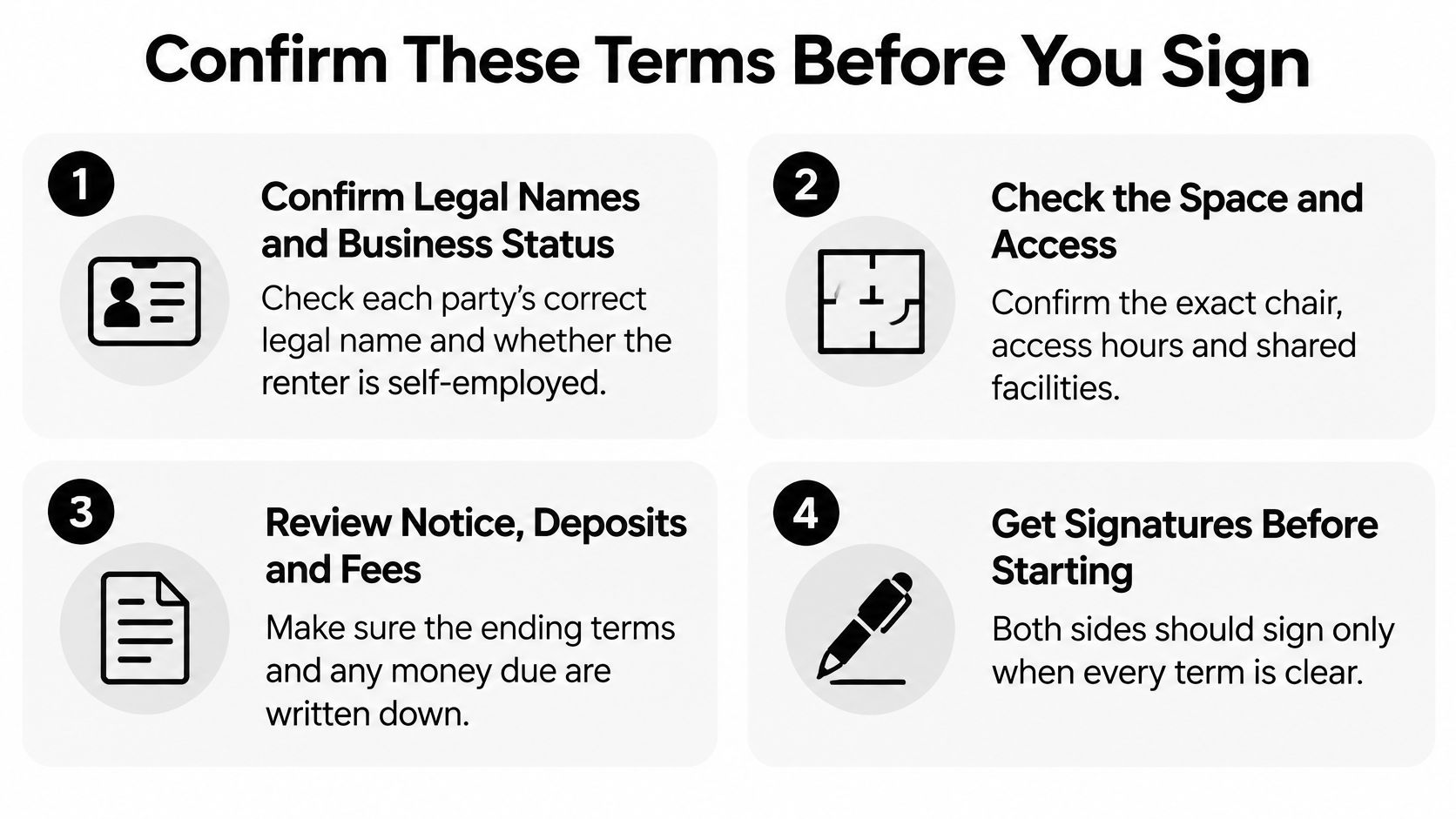
Work through this list together, out loud, before either of you signs anything. Treat it as a shift plan for the chair, not a formality: each item should leave both sides knowing who does what on an ordinary Tuesday and on the Saturday everything goes wrong.
- Confirm identities: Check each party's legal name and business status, so the invoice, notice and deposit all point at the right person.
- Check the space: Name the exact chair or room, access hours, and the shared facilities the rent includes.
- Fix the money: Put the rent, billing basis, VAT position and due date in one written line.
- Assign responsibilities: Go through cleaning, equipment, bookings and complaints line by line, including who speaks to the client first.
- Agree the exit: Set notice, deposit return, and what happens if either side needs to change days.
- Verify permissions and cover: Confirm the host has the right to rent the space and that each side holds its own insurance.
- Sign and keep copies: Both parties sign, date, and keep a copy they can find later.
Browsing spaces and messaging hosts is free, and renters deal with the salon directly. You send an enquiry from the listing, settle dates and payment with the host, and check the space is suitable before agreeing terms. The platform provides the listing and messaging only; it is not part of the rental agreement and does not hold rent or deposits. That direct conversation is where your contract gets built.
Take the questions from this guide into that conversation, printed or on your phone. Ask each one and note the answer. If you cannot get an answer in writing, treat it as an open point, not a settled one. A host who will not confirm a deposit return date today is unlikely to become clearer about it in three months.
Signing slowly is not mistrust. It is how two businesses that like each other stay that way.
Browse styling chairs, barber chairs, treatment rooms and nail stations near you, compare day, week and month rates, and message the salon directly to agree terms that fit your clients. Visit FindMy.beauty to find your next chair, or to list a spare station and start receiving enquiries from professionals in your area.