

Around 63% of UK salon workers were self-employed in 2024, according to the British Hair Consortium's sector analysis. That reframes the search for a therapy room for hire: for many independent practitioners, rented workspace isn't a temporary substitute for owning a salon. It's a way to match premises costs to a client diary.
But flexibility alone doesn't make a room affordable. The useful comparison is the total working cost against the bookings you can realistically deliver, with treatment suitability, licensing and insurance checked before you commit.
Table of Contents
- Therapy Room Hire Prices Across UK Towns
- Which Space Type Suits Your Treatment
- Day, Week or Month Rates Compared
- Checking a Room Is Fit for Your Treatment
- Who Is Responsible for Licences and Insurance
- Working Out the True Cost of Hiring
- Send Your First Enquiry to a Host
Therapy Room Hire Prices Across UK Towns
Our listed London rents run from £50 to £150 a day, £125 to £450 a week and £400 to £2,500 a month. These are advertised rents for rooms and chairs, not a like-for-like survey of private treatment rooms. The spread gives you a starting point for enquiries, but it doesn't establish what a particular specification should cost.
Outside London, the examples below are individual listings. Edinburgh's beauty treatment room, Brighton's salon chair and Liverpool's nail desk are different products, so ranking their rents would tell you little about value.
Therapy room for hire prices by location
| Location | Space listed | Period | Rent (GBP) |
|---|---|---|---|
| London | Listed rooms and chairs | Day | £50 to £150 |
| London | Listed rooms and chairs | Week | £125 to £450 |
| London | Listed rooms and chairs | Month | £400 to £2,500 |
| Edinburgh | Beauty treatment room, City Centre | Month | £650 |
| Brighton | Salon chair, AMOR Hair & Beauty | Month | £1,500 |
| Glasgow | Styling, barber or nail chair space, Chesne Hair & Barbershop | Day | £30 |
| Liverpool | Nail desk, Gemini beauty bar, Crosby | Week | £70 |
The Edinburgh, Brighton and Liverpool entries reflect the sole listed rent in each location in our October 2026 listing snapshot. Glasgow likewise has a single listed example. None is a town-wide average, and availability or terms should be confirmed with the host.
Compare access, not just the rental label
Start by putting competing offers on the same working basis. Multiply the advertised day rate by the days you intend to occupy the space, then compare that total with the weekly offer. For a monthly quote, use your actual planned working dates rather than assuming every month contains the same number of usable days.
Check what each period buys. A weekly arrangement might reserve particular days rather than unrestricted access throughout the week. A monthly price needs an equally clear definition of access, opening hours and whether someone else uses the room when you're absent.
Location also needs practical interpretation. Visit at your intended appointment times and assess the journey your clients will make, the entrance they'll use and where they'll wait. A central address isn't automatically more useful than a quieter room close to your existing clients.
Price comparison rule: Compare the same kind of workspace, for the same usable time, with the same essential facilities.
These are headline rents only. They don't establish whether linen, cleaning, storage, reception or treatment equipment is included, and those omissions can change which offer is affordable.
Which Space Type Suits Your Treatment
Choose the workspace category before judging the price. FindMy.beauty lists salon chairs, beauty rooms, treatment rooms, nail stations, barber chairs and salon studios to rent. Each category describes a different working arrangement, not a guarantee that every treatment can take place there.
A beauty room is intended for lashes, brows, waxing and makeup. A private treatment room is intended for facials, massage and aesthetics, but that broad description still needs checking against the particular service you offer.
Space types and what they suit
| Space type | Suits |
|---|---|
| Beauty room | Lashes, brows, waxing and makeup |
| Treatment room | Facials, massage and aesthetics |
| Styling chair | Stylists and colourists at a salon station |
| Nail station | Nail technicians who need dedicated space |
| Barber chair | Barbers |
| Whole studio | Renters needing the space to themselves |
Turn your treatment menu into a room specification
For lashes, consider bed positioning, task lighting and where your trolley will stand. For waxing, assess privacy, product storage and how you'll move around the client without crossing the clean working area. These are viewing questions, not details to resolve after moving in.
A colourist needs to understand access to backwash facilities and where products can be prepared. A nail technician needs to assess the workstation's exposure controls, not merely whether there's a desk. Don't assume a styling chair is exempt from chemical or ventilation considerations because it sits in an established salon.
Massage introduces different questions: can you move freely around the couch, can clients change privately, and will neighbouring activity disrupt the appointment? For aesthetics, start with the exact procedure and its requirements rather than accepting the treatment-room label as evidence of suitability.
A whole studio gives you the space to yourself, but exclusive occupancy doesn't necessarily mean everything is supplied. Establish which furniture, services and responsibilities come with it. Our guide to salon suite rental helps distinguish that arrangement from renting an individual station.
Build your shortlist around your most demanding intended treatment. Otherwise, you could secure a room that supports the simplest appointment on your menu but prevents you from offering the service on which your income plan depends.
Day, Week or Month Rates Compared
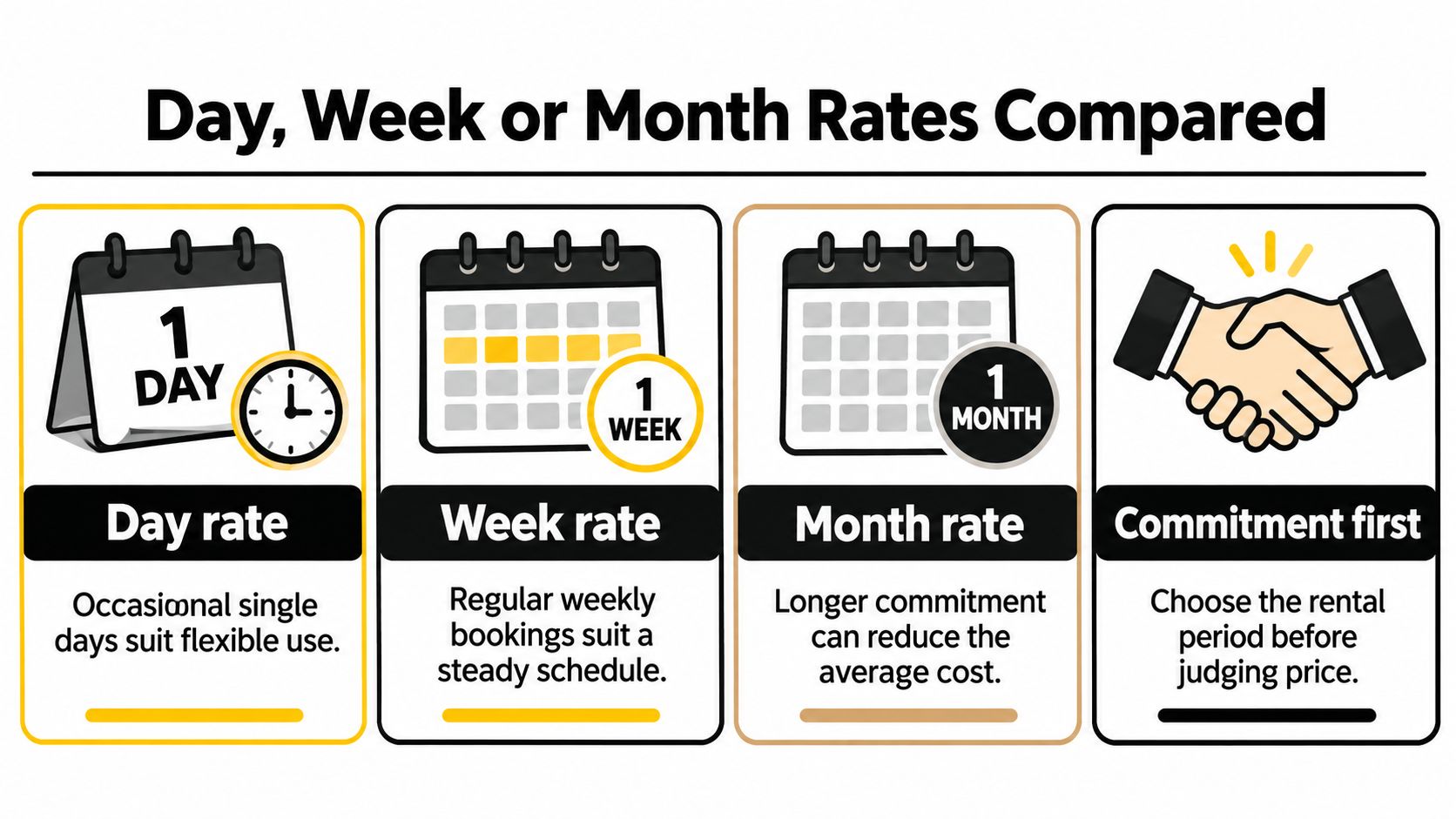
The rental period is a commitment decision before it's a price decision. A lower average rate is useful only if you can use the access you're buying. Empty paid time remains a cost, even when the room looks inexpensive on paper.
Maya T., a London lash technician, replaced a six-month room contract she used three days a week with a weekly lash-room arrangement. She messaged two hosts on a Sunday evening and visited one on the Tuesday. Her example illustrates a change in commitment, not proof that weekly hire is always cheaper.
Match the period to the diary
| Working pattern | Rental period to examine | Main comparison | Commitment risk |
|---|---|---|---|
| Occasional appointments grouped together | Day | Contribution from that day's bookings against its full cost | Cancellations leave paid time unused |
| Regular appointments on fixed days | Week | Weekly cost against dependable weekly demand | Notice terms may keep rent payable after demand changes |
| Established work throughout the week | Month | Total monthly cost against realistic utilisation | A longer obligation can outlast a busy spell |
| Replacing an existing contract | Week or month | New total commitment against remaining obligations | Overlapping contracts can cancel out savings |
A day rate lets you test a location without buying access you don't yet need, provided the host's terms allow that pattern. Our guide to renting a room by the day is useful when occasional salon-based work is the starting point.
Weekly hire deserves close attention when clients reliably request the same appointment days. Confirm whether the arrangement reserves those particular days, whether they can move, and what happens when you take leave.
Test a quieter diary before committing
Assess monthly hire using a plausible quiet period, not your fullest recent diary. Include gaps between appointments, preparation and cleaning when judging how much paid access you can turn into chargeable work.
Ask the host to confirm the proposed terms before you rearrange clients. An enquiry isn't an agreed booking, and a quoted rate without confirmed access dates isn't a complete offer.
Choose the shortest commitment that supports your dependable workload, then consider extending it when the diary justifies the obligation.
There's no universal occupancy percentage at which monthly hire wins. Your treatment margin, access needs and cancellation exposure determine that decision.
Checking a Room Is Fit for Your Treatment
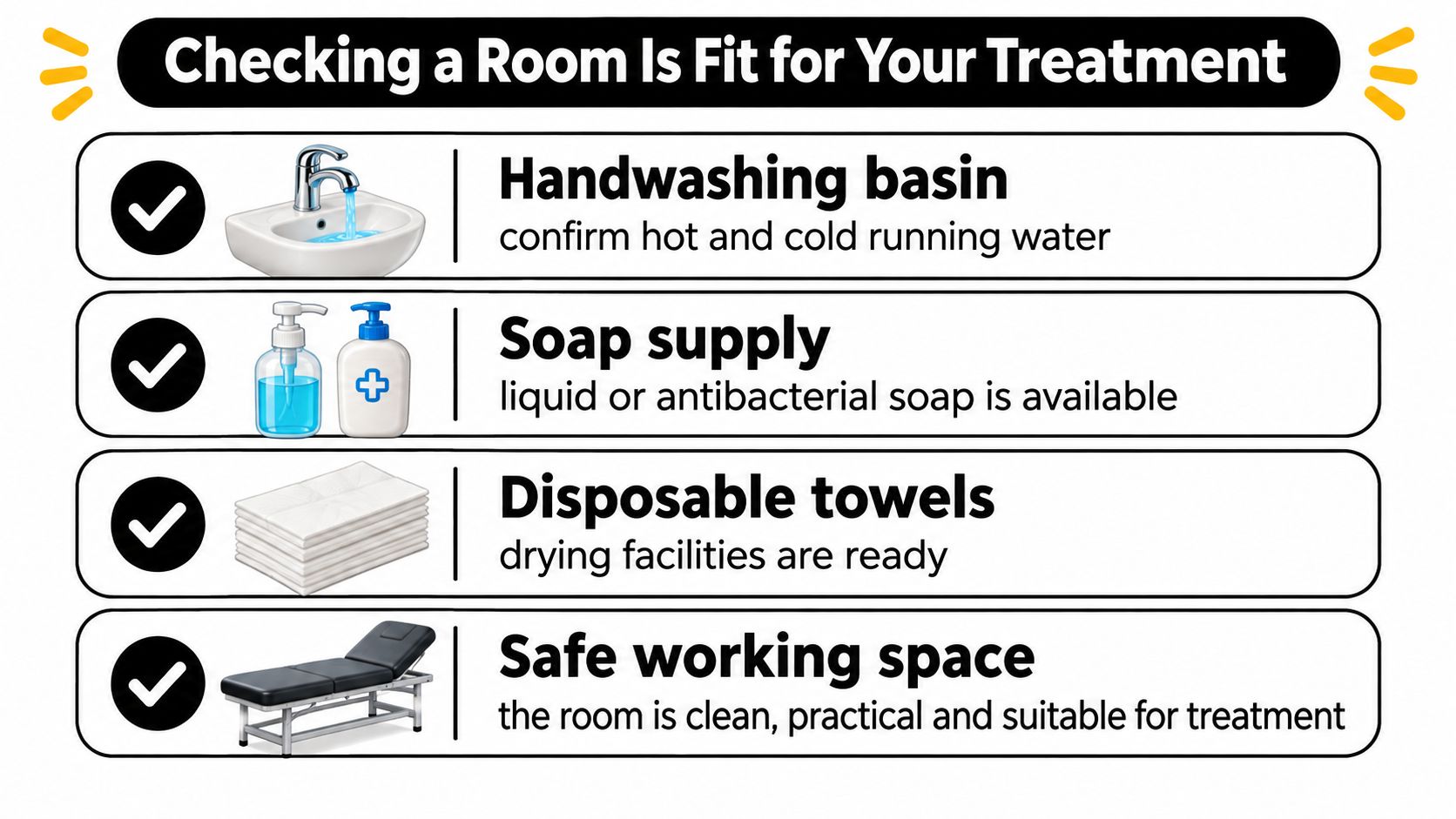
A viewing should test whether you can complete your actual treatment protocol safely. Bring your equipment list and walk through arrival, preparation, treatment, cleaning and departure rather than judging the room from its décor.
Luton Council's beauty-treatment health and safety guidance identifies practical controls including handwashing facilities, washable finishes, suitable lighting and separation of clean and dirty activities. Use those controls to question how the space works between clients.
Walk through the room in working order
Handwashing. Confirm a dedicated basin with hot and cold running water, liquid or antibacterial soap, and disposable paper towels. Locate it yourself and check how you'll reach it during your treatment routine.
Surfaces. Inspect floors, walls and ceilings for washable finishes, and client-contact surfaces for smooth, non-porous materials. Look at the couch, stool and trolley, not just the room's freshly cleaned appearance.
Lighting. Assess whether you can inspect the treatment area properly in your intended working position. Check for shadows when you stand or sit where the procedure requires.
Ventilation. Identify the system rather than accepting a description such as airy. For nail work, the HSE's beautician guidance recommends an extractor hood or downdraught table as part of exposure control. Ask where extracted air goes, who maintains filters and whether the host restricts acrylic, solvent, spray or aerosol work.
Waste and sterilisation. Trace where used linen, waste and reusable instruments go. There should be a workable separation between clean supplies and items awaiting disposal or processing, without improvising storage around the client.
Treatment fit. Run through your complete protocol, especially where it involves skin penetration, bodily fluids, adhesives, chemicals or reusable instruments. Establish whether the required equipment can be used, cleaned and stored in this room.
Put the operating routine in writing
A room can look clean without supporting your cleaning process. Ask who cleans between appointments, who supplies products and who restores the room after another practitioner uses it. Check whether your access includes the preparation and turnaround time you need.
Record cleaning duties, towel replacement, waste handling and equipment sterilisation in the rental terms. Where a system needs maintenance, name who arranges it and how you'll know it has been done. An informal promise leaves too much uncertainty when something stops working.
Who Is Responsible for Licences and Insurance
The host's permission isn't the same as confirmation that your treatment is authorised. The L'Express Franchise guide to opening a UK beauty salon explains that there's no single national beauty-salon licence, while London boroughs can require special-treatment licences for activities including massage, manicure, electrolysis and some beauty treatments.
Identify the relevant council and describe your intended service precisely. Ask what approval applies to the premises and practitioner, then verify that position with the authority rather than relying solely on a listing description.

Agree who verifies and maintains each requirement
- Council licensing. Name who obtains confirmation, who holds any required approval and who monitors relevant renewal conditions.
- Waste disposal. Agree the disposal arrangements for your treatment waste and who pays for the appropriate service.
- Ventilation and sinks. Identify who maintains the facilities and what happens if a fault prevents your treatment.
- Sharps handling. Where relevant, confirm suitable containers, secure handling and collection arrangements before starting work.
- Fire procedures. Obtain the premises' procedures and clarify your responsibilities when working alone or outside the host's usual hours.
- Accessibility and equipment safety. Establish who checks the premises and supplied equipment, and which items remain your responsibility.
This list is a framework for allocating tasks, not a transfer of legal duties. A rental agreement can record who does what, but don't assume it removes obligations that apply to you as the treating practitioner.
Check the policy as well as the certificate
Ask your insurer to confirm cover for the precise treatments at the rented address. Provide the host with the evidence requested, but don't confuse satisfying their document check with establishing that your own policy covers the work.
Our salon chair rental contract guide offers a starting point for recording responsibilities. For treatment-room hire, also agree who pays if an inspection identifies a breach, whether work must pause and what happens to rent during that interruption.
Higher-risk aesthetics, massage and semi-permanent makeup need treatment-specific confirmation. Neither attractive photographs nor a host's welcome replaces the relevant paperwork.
Working Out the True Cost of Hiring
The lowest advertised rent isn't necessarily the lowest-cost way to practise. A room with the necessary equipment, storage and services may leave you with fewer separate bills and less unpaid preparation than a cheaper, sparsely equipped alternative.
Cost discipline matters in this sector: ICAEW's hairdressing and beauty-treatment industry profile reports that labour represents about 60% of hair-and-beauty businesses' expenses. That sector-wide measure isn't your personal cost structure, but it reinforces why rent alone is an incomplete business comparison.
Cost items to confirm before you sign
Treat the inclusion column as a checking prompt, not a promise about a particular listing.
| Cost item | Often included in rent? | What to ask the host |
|---|---|---|
| Base rent | Yes | Rental period and whether the rate can change |
| Deposit | Not always | Amount and when it is returned |
| Notice period | Not always | Days needed to end the arrangement |
| VAT | Not always | Whether the quoted rent includes VAT |
| Utilities | Not always | Heating, electricity and water |
| Cleaning and towels | Not always | Who supplies, launders and replaces linen |
| Storage | Not always | Space for your products and equipment |
| Insurance | Usually your own cost | Your cover and any minimum the host requires |
| Card or booking fees | Confirm separately | Any charges when you pay |
On FindMy.beauty, rent is agreed directly between renter and host, in pounds sterling. Request a written total covering the arrangement you want, rather than building a budget from an incomplete advertised rate.
Calculate contribution before break-even
Use your own appointment prices and costs in this calculation:
Contribution per completed appointment = treatment income minus appointment-specific costs.
Those costs include consumables and transaction charges. Then calculate:
Break-even appointments = fixed working costs for the period divided by contribution per appointment.
Round the result up to a whole appointment. If your services have different margins, use a realistic mix rather than treating every booking as equally profitable.
For an occasional hired day, include that day's rent, travel and any separate setup or linen charges. For recurring weekly hire, use every payable date in the chosen month, including dates that currently have no clients. This exposes the difference between buying occasional access and accepting a standing obligation.
Keep a refundable deposit separate from operating expenses: it affects the cash you need upfront even if it isn't ultimately spent. Allow separately for tax, your own pay and a contingency; covering room costs isn't the same as earning a sustainable income.
Before signing: How many completed appointments, and how many booked hours, must this room support each month before it pays for itself?
If a missing facility makes the treatment unsuitable, don't treat it merely as an extra cost. Reject the room unless suitability can be established before use.
Send Your First Enquiry to a Host
A useful enquiry gives the salon owner enough information to assess fit and gives you enough information to decide whether a viewing is worthwhile. Browsing spaces and messaging hosts is free, and you deal with the salon directly.
Every enquiry goes to the salon owner, who decides who suits their premises and clients. Be specific about what you do, rather than asking only whether the room is still available.
From shortlist to written arrangement
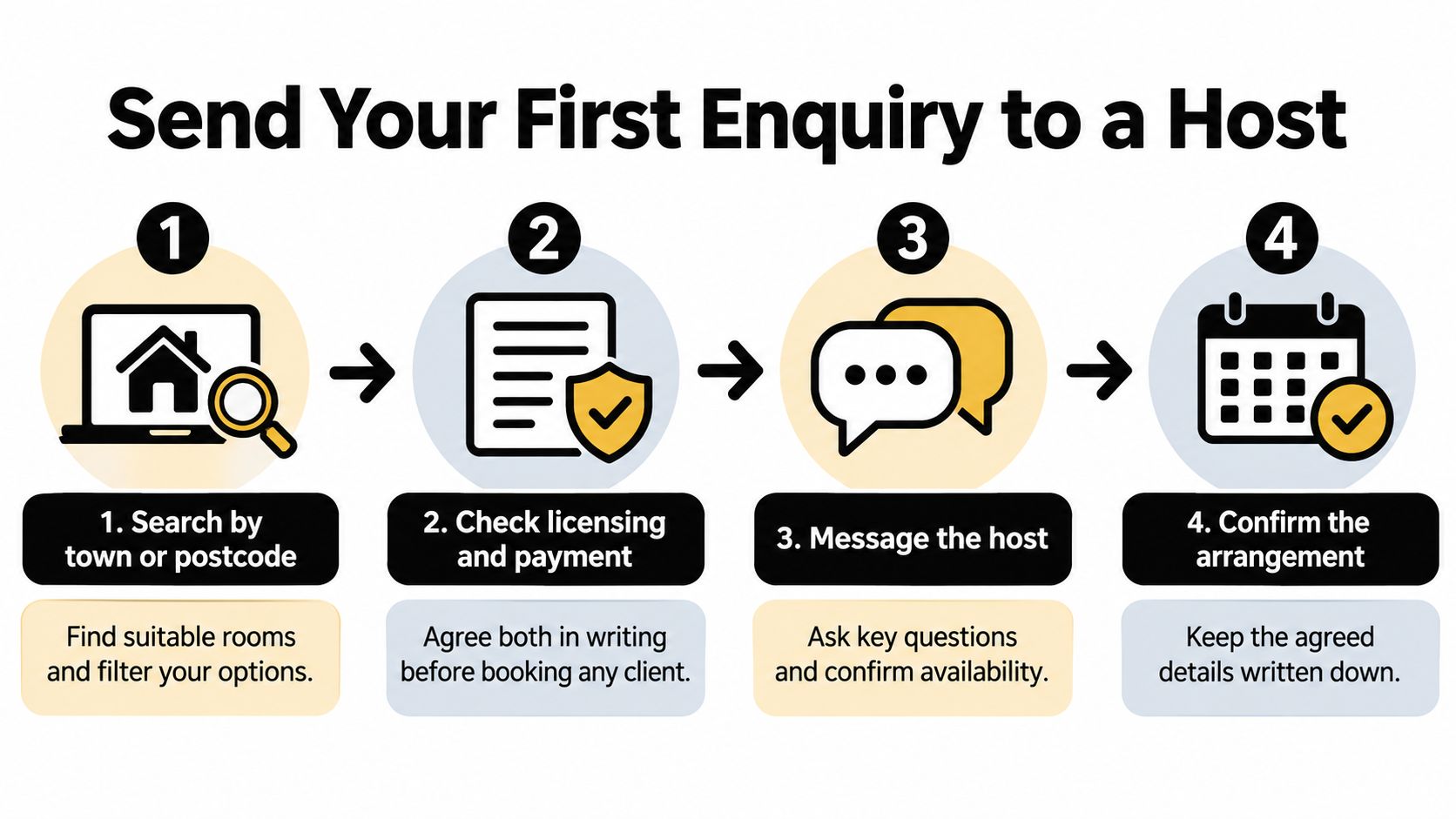
Search locally. Enter your town or postcode and select the appropriate space type. Shortlist places you and your clients can realistically reach.
Compare the advertised periods. Match each day, week or month offer to your intended workload. Note any listing that leaves the access schedule unclear.
Describe your practice. State the treatment, requested days and insurance position. Mention equipment you need to bring and anything material to the host's suitability decision.
Request a complete quote. Ask about the deposit, notice, included services and additional charges. Make clear whether you want occasional access or a recurring arrangement.
Arrange a viewing. Take your treatment protocol and room checklist. Resolve practical questions in the space rather than assuming the photographs show everything.
Confirm before booking clients. Settle dates, licensing checks and payment directly with the host. Keep the agreed conditions in writing before bringing clients in.
Make the first message easy to answer
Aisha R., a Birmingham freelance colourist, found a chair for Saturday colour clients after comparing the displayed day rates. She arranged it in an afternoon without signing up. The useful lesson is the specificity of the requirement: a chair for an identifiable working pattern, not an open-ended search for premises.
For a treatment-room enquiry, adapt this message to your circumstances:
I'm looking for a private room for my facial treatments on recurring weekdays. I hold treatment insurance and can provide details. Could you confirm availability, permitted treatments, facilities, the full rental cost and notice terms, and whether I can arrange a viewing?
Don't send sensitive client information to demonstrate demand. Describe your services and schedule, then provide professional documentation through an agreed channel where needed.
Send one focused enquiry this week to the nearest listing that matches your space type and working budget. Your immediate goal is a clear answer and a useful viewing, not a commitment made before the checks are complete.
FindMy.beauty connects independent beauty professionals with salons offering spare rooms, chairs and stations, with visible rental periods and direct host enquiries. Visit FindMy.beauty to search by town or postcode, compare suitable spaces and ask a host for the full working cost before you commit.