

Your appointment diary looks busy on some days and painfully empty on others. You've found a private room you'd love to work from, but the monthly rent would still be due when clients cancel or you take a holiday. The question isn't just whether you can afford the room. It's whether the days you work can comfortably pay for it.
Salon suite rental works best when the space, access and payment commitment match your diary. A lower advertised rent doesn't automatically mean a cheaper working day, particularly when you're paying for unused capacity.
Table of Contents
- What Salon Suite Rental Means in Plain Terms
- Salon Suites, Chairs and Treatment Rooms Side by Side
- The Main Salon Suite Arrangements Hosts Offer
- Who Rents Salon Suites and Why
- Hidden Costs Behind the Headline Rent
- Comparing Real Cost per Booked Day
- Choosing Between a Salon Suite, Chair or Room
What Salon Suite Rental Means in Plain Terms
A salon suite rental is the hire of a self-contained room inside a salon, usually with a lockable door, for a practitioner or small team, paid by the day, week or month.
Think of a suite as renting a whole flat. A styling chair is closer to renting a bed in a shared house, while a treatment room is a private room within that shared property. The names overlap, so inspect what's available rather than relying on the listing label.
The setting might look like this, but equipment and layout need checking.
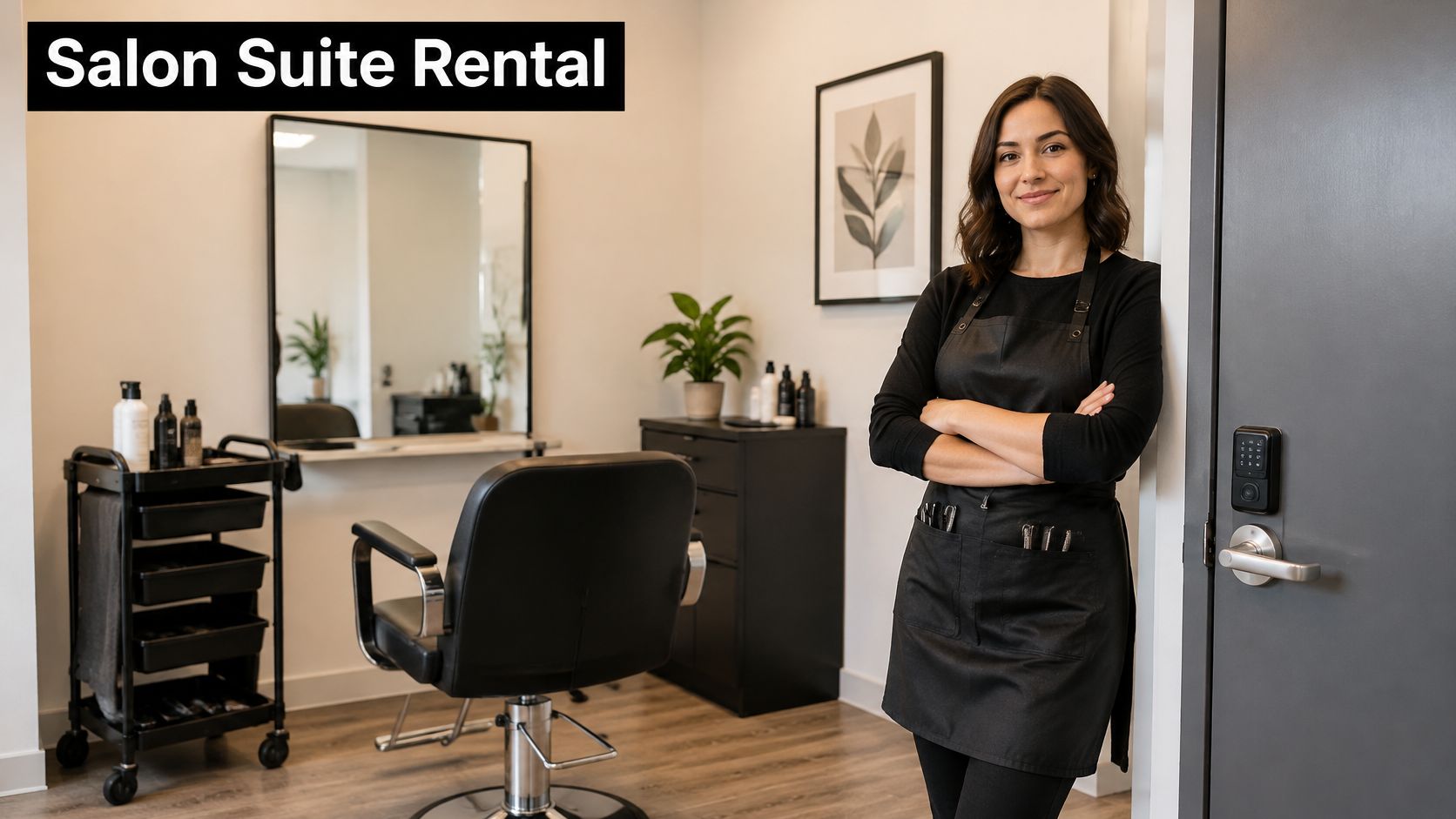
There are three roles: the host, who controls the premises; the renter, who runs their own service; and the client, who attends appointments. A hair-focused suite might contain a basin, mirror, power points, storage and styling chair. A beauty-focused suite might replace the chair with a treatment couch, with waiting facilities shared outside.
- Day rate: Suitable for occasional use without paying for a whole working week.
- Weekly rate: Covers the days and access specified in the agreement.
- Monthly rate: Provides a steadier base for an established diary.
The UK hair, barbering and beauty sector generated £5.8 billion in turnover during 2023–2024, according to the National Hair & Beauty Federation. For an individual practitioner, though, the useful comparison is more personal: what the room includes and what each booked working day costs.
Salon Suites, Chairs and Treatment Rooms Side by Side
Find the option that matches your treatments and client flow, then read down its column. Privacy and practical suitability come before price: an inexpensive space isn't useful if you can't deliver your service properly.
The table describes typical arrangements, not fixed rules. Hosts set their own terms, and a well-equipped treatment room can offer more usable facilities than a listing described as a suite.
Salon suite, styling chair and treatment room compared
| Feature | Salon suite | Styling chair | Treatment room |
|---|---|---|---|
| What you rent | Enclosed room with a lockable door, usually for a practitioner or small team | A station on a shared salon floor | Private room in a salon or clinic |
| Typical rent unit | Day, week or month, often a flat fee | Day, week or month, often per chair | Day, week or month, or per session |
| Term length | Agreed fixed days or ongoing occupation, subject to written terms | Rolling or fixed arrangement with an agreed notice period | Session booking, recurring days or a longer agreement |
| Client access | Usually permitted within host rules | Clients attend on the shared floor | Usually permitted within host rules |
| Privacy | High, with a closing door | Low to medium, with shared noise | High, with dedicated treatment space |
| Best suited to | Lash, brow and aesthetics practitioners, or small hair teams wanting their own room | Hairdressers, colourists and barbers | Facialists, massage and aesthetics practitioners |
| Equipment | May be furnished; check mirrors, basin and storage | Station, mirror and basic fittings; confirm basin access | May include a couch; check linen, lighting and storage |
| Bills and extras | Written inclusions determine utilities, cleaning and laundry charges | Confirm shared charges and what the rate includes | Confirm utilities, cleaning and treatment-related extras |
Check the least predictable terms first
Term length, equipment and bills deserve your earliest questions. A rolling arrangement may still require notice, and a furnished room may lack the particular fittings your treatment needs. Ask for an inventory rather than accepting a description such as fully equipped.
For hair services, check basin availability during your busiest appointment overlap. For treatments, test the couch position, task lighting, ventilation and whether conversations outside are audible through the door. A lock is useful, but it doesn't guarantee a quiet treatment environment.
Match your privacy requirement and client journey first. Only compare prices between spaces that can genuinely support the service.
A lash technician needs a client to lie still comfortably behind a closed door. A colourist may gain more from a station beside a mirror, dependable basin access and a lively salon floor. Neither arrangement is better by default; they solve different working problems.
Also walk the client route from entrance to workspace. Check where clients wait, whether reception knows whom they're visiting and whether shared areas remain accessible during your appointments.
The Main Salon Suite Arrangements Hosts Offer
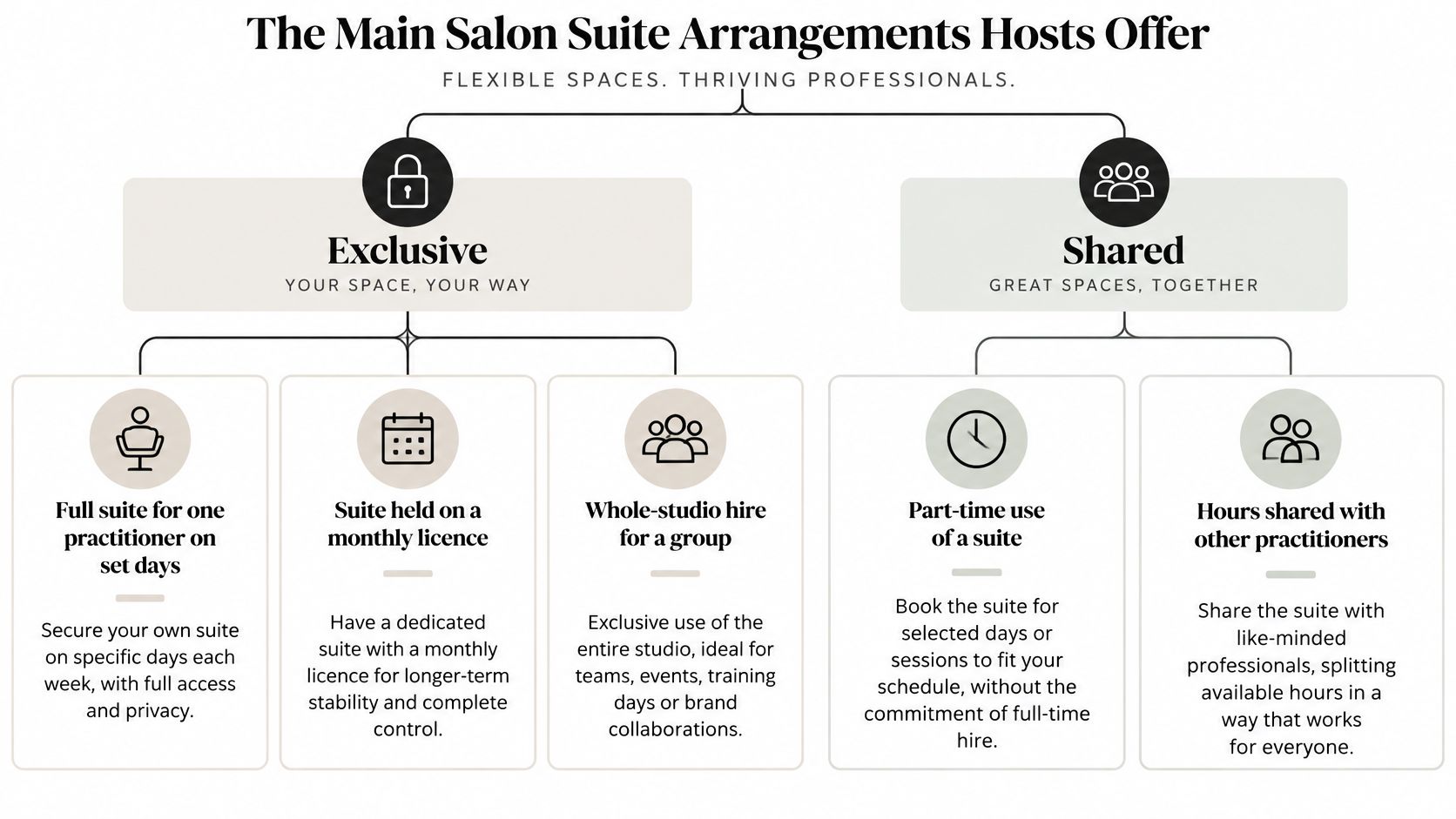
The broadest split is exclusive use versus shared use. Exclusive use means the space is yours during the agreed period, not necessarily that you can enter whenever you like. Shared use means another practitioner occupies it outside your allocated time.
This diagram separates the main arrangements before service levels and payment terms are added.
Decide who uses the room and when
Exclusive arrangements include a suite reserved for your working days, ongoing occupation under a monthly agreement, or whole-studio hire for a team or training event.
For a hypothetical shared week, a lash practitioner might use the room from Monday to Wednesday and a facialist from Thursday to Saturday. That can work well if both need compatible furniture and leave the space ready for handover. It works poorly when either practitioner expects to move appointments freely into the other's allocation.
Session bookings offer another route. If you're considering renting a room by the day, check whether setup, cleaning and client departures must all fit inside the booked window.
Separate service level from contract type
- Space only: You organise bookings, supplies and the client welcome.
- Supported space: Reception, laundry or cleaning may be included, with responsibilities written down.
- Managed arrangements: The host may handle bookings, so agree who controls appointment changes and client information.
Payment may be a flat fee or tied to takings. For a takings-based proposal, establish what revenue counts, how refunds are treated and how the calculation is checked. Don't assume it's a standard feature of salon suite rental.
You may encounter a licence to occupy or a lease. A licence commonly provides permission to use space at agreed times; a lease commonly grants possession for a defined term. However, the document's label alone doesn't settle its legal effect, and neither label guarantees an easy exit.
Read the notice provisions, renewal arrangements and deposit conditions before paying. If the commitment is substantial or the wording unclear, get independent legal advice. The practical test remains whether the promised access lets you complete appointments, reset the room and leave without rushing.
Who Rents Salon Suites and Why
Consider a composite scenario, not a real case: a lash technician has bookings clustered into a few working days, but her long room contract charges for access she rarely uses. A weekly arrangement covering her established treatment days could make more sense, provided she isn't exchanging unused monthly access for unused weekly access.
Her appointment book, rather than the room's appearance, should guide the decision.

The National Hair & Beauty Federation's industry statistics report approximately 50,400 VAT- or PAYE-registered UK hair, barbering and beauty businesses in September 2025, with around 81% employing fewer than five people. Those figures describe a sector of small operators, where tying up cash in premises can restrict spending on equipment, stock and building a client base.
Different diaries need different spaces
These additional examples are also composites:
- The freelance colourist: Needs a chair for Saturday clients, not a private suite throughout the week.
- The mobile facialist: Wants recurring clinic days so clients have a predictable place to attend.
- The salon owner: Has an unused room, but needs a renter whose treatments and working habits suit existing clients.
Renting fitted space lets a practitioner test local demand without first furnishing an entire salon. For the host, a compatible renter can make use of spare capacity, but the arrangement still needs clear boundaries.
Use the video alongside a practical review of your own working requirements.
A suite gives you a private workplace, not automatic control over the whole premises.
A suite is a stronger fit when you have recurring bookings, treatments requiring privacy and clients who expect a closed door. It's less suitable if you need unrestricted control of a salon. If a lender requires an acceptable business address, confirm its requirements and the host's permission before committing.
Hidden Costs Behind the Headline Rent
Two rooms can advertise the same weekly rent and still cost you very different amounts. One includes utilities, laundry and cleaning between clients. The other bills each separately, and the cheaper headline figure ends up costing more once you add what you use.
Work through the charges in order: premises costs first, then operational extras. Ask about business rates or a rates contribution, utilities, service charges, cleaning, laundry, booking systems and card-processing arrangements. Check insurance separately, including public liability and cover appropriate to your treatments.
Understand the business-rates calculation
Business-rates multipliers are set separately for England, Scotland, Wales and Northern Ireland, so the figure that applies depends on where the premises sit. For England in 2025–26, the government's business-rates calculation guide gives a small-business multiplier of 49.9p per pound of rateable value, compared with a standard multiplier of 55.5p. On that basis, a rateable value of £20,000 produces the illustrative calculation £20,000 × 0.499 = £9,980 annually before relief.
The mechanism stays the same wherever the salon is: rateable value multiplied by the applicable multiplier, with relief potentially reducing the bill. What changes is which nation's multiplier and relief scheme applies, so confirm the position for the salon's own location rather than assuming the England figures carry over.
Don't assume you'll owe a separate rates bill, or that the host has absorbed every related cost. Ask how the premises are assessed and whether the agreement includes a contribution.
Get a written answer to the extras
- VAT: Is it included in the quoted amount, or added afterwards?
- Utilities and cleaning: Which services are covered, and who cleans between clients?
- Laundry: Are towels and couch covers supplied, washed and replaced?
- Insurance: What does the host cover, and what must you insure yourself?
- Deposit: When can deductions be made, and when is the balance returned?
- Holidays and closures: Does rent continue when you're away or the salon closes?
- Fit-out and consumables: Who pays for alterations, repairs, products and waste disposal?
A refundable deposit affects the cash you need upfront, even though it isn't automatically a recurring expense. Keep it separate from monthly operating costs so you don't confuse affordability with profitability.
The closure question matters more than it looks. Rent that keeps running through a fortnight's holiday or a salon shutdown raises the true cost of every day you do work, which is why fixed weekly commitments deserve more scrutiny than the same rent charged per booked day.
Cost check: Compare equivalent inclusions. Don't price an equipped, serviced room against bare space as though they're the same offer.
Comparing Real Cost per Booked Day
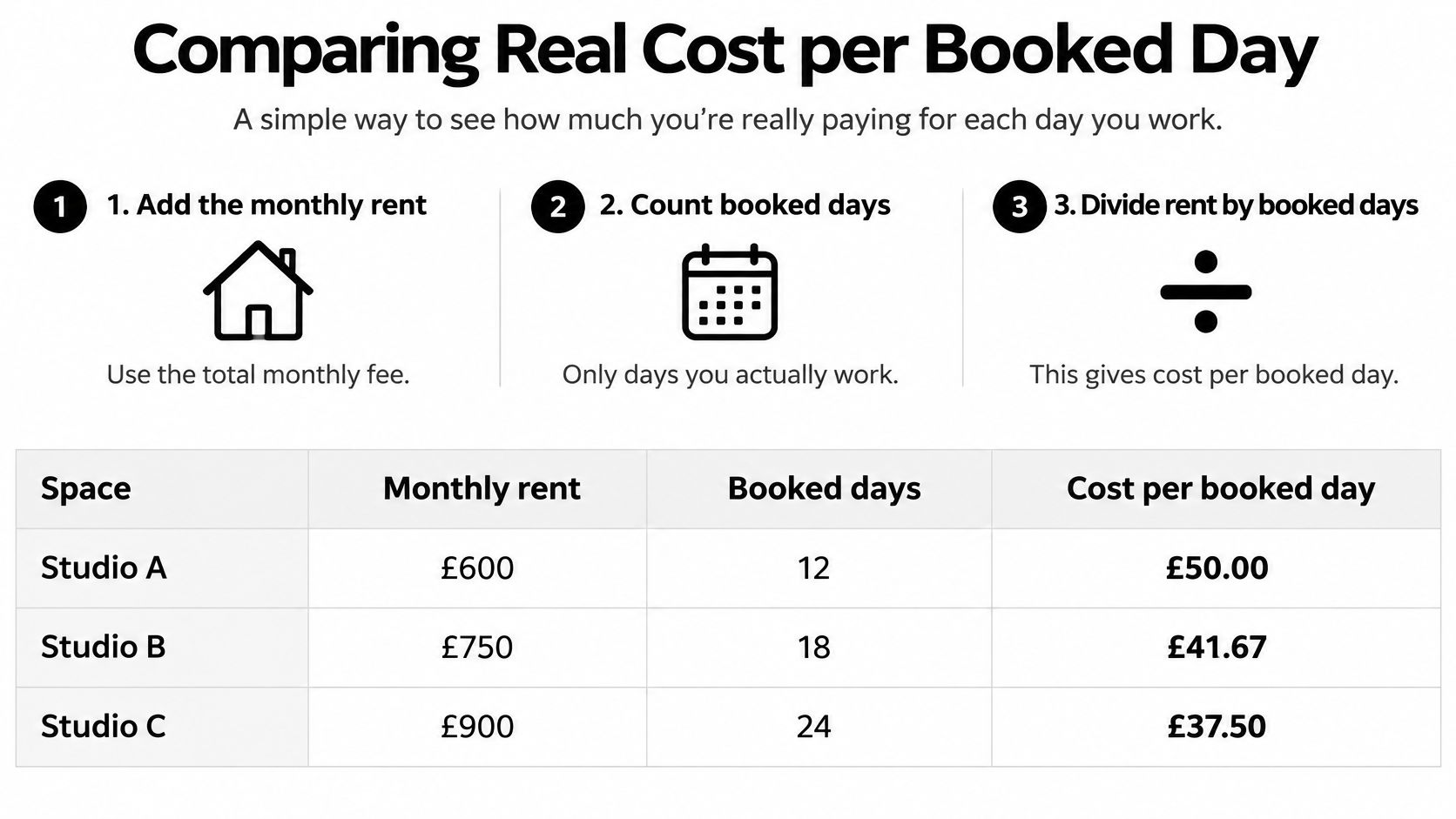
Cost per booked day converts different rental arrangements into a comparable working cost. Use days with client appointments, not every day you're entitled to enter the premises. Otherwise, you'll make unused access look productive.
Use the same calculation for every quote
- Add recurring occupancy costs. Combine the monthly rent with compulsory extras, such as utilities, cleaning and any insurance allocation.
- Count realistic booked working days. Use your diary rather than the number of days you hope to fill.
- Divide the total by those days. This gives the occupancy cost each working day must support.
- Repeat under quieter conditions. Test whether the commitment remains manageable when bookings fall.
The visual gives a compact version of the calculation; include compulsory extras in the monthly total.
Illustrative cost per booked day
All amounts below are hypothetical worked examples, not market averages or advertised quotes. To keep the arithmetic visible, assume the stated monthly totals already include compulsory occupancy extras.
| Option and occupancy | Booked days |
|---|---|
| Treatment room, hypothetical £450 monthly total: £450 ÷ 10 = £45 per booked day | 10 |
| Styling chair, hypothetical £600 monthly total: £600 ÷ 12 = £50 per booked day | 12 |
| Salon suite, hypothetical £900 monthly total, quiet month: £900 ÷ 8 = £112.50 per booked day | 8 |
In the same hypothetical suite example, £900 ÷ 15 booked days = £60 per booked day. Nothing about the room has changed; you're spreading the fixed commitment across more productive days.
A ranking can reverse too. In a separate hypothetical comparison, a flexible room costing £70 per booked day would cost more per day than that busy-month suite, but less than the suite in its quiet month.
Don't stop at occupancy cost. A day containing a short appointment doesn't earn the same contribution as a well-filled treatment day, so check what remains after products, payment fees and other service costs. The guide to pricing a salon chair or room can help you assess the quoted structure before putting your own figures into the calculation.
Choosing Between a Salon Suite, Chair or Room
Choose a suite when recurring demand supports dedicated private space and the commitment remains affordable during quieter periods.
Choose a styling chair when your hair, colour or barbering services benefit from shared-floor facilities and you don't need an enclosed room.
Choose a treatment room when you need privacy for scheduled clinics without taking on more access than your diary supports.
Turn the shortlist into a decision
- Uncertain demand: Start with flexible access and reassess using completed appointments, not enquiries.
- Before committing: Record all charges, permitted treatments, access hours, client rules and notice requirements.
- Before opening: Use the checklist of what to agree before a renter's first day to put responsibilities in writing.
Shortlist a pair of suitable spaces and send both hosts the same questions. Compare their written replies using realistic booked days, and keep enough cash available for the deposit and setup.
With us, browsing and messaging hosts is free, and you deal directly with the salon. The Message host button sends your enquiry straight to the salon owner, who decides whether you suit their space and clients.
FindMy.beauty connects beauty professionals with salons offering spare chairs, rooms and studios, so you can compare suitable workspace without committing to an entire premises. Visit FindMy.beauty, search your location and message hosts about the total cost and access available for your actual working days.
Written with Outrank tool