

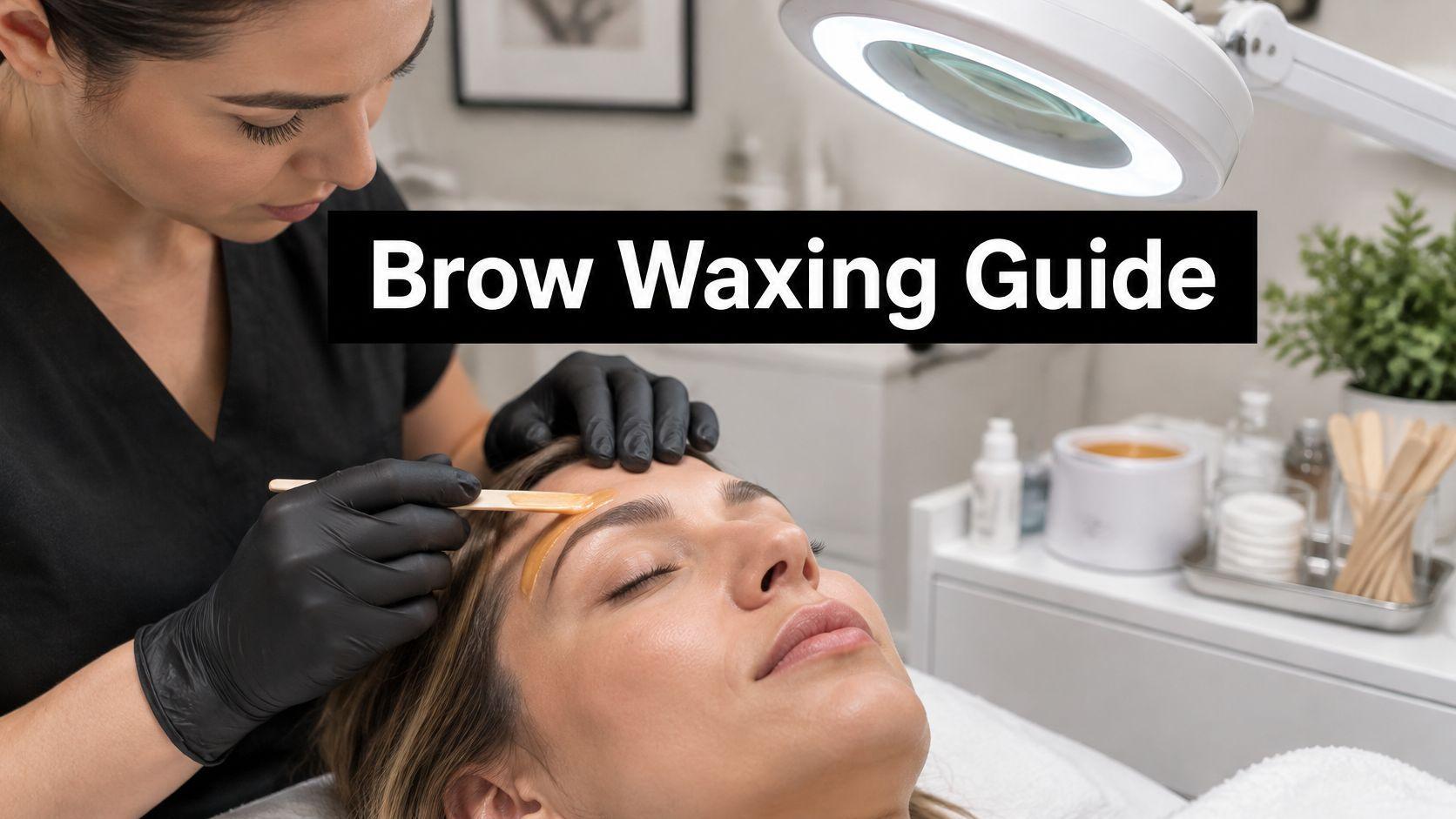
18 million brow service appointments were booked in the UK between January and September 2024, a figure published by Professional Beauty from Vagaro's 2025 Annual Vantage Report. Brow services also accounted for 29% of brow-and-lash searches on that platform.
That's a lot of people lying back with their eyes closed while someone works warm wax within a few centimetres of their eyelids. Which is exactly why the details matter: which wax is being used, whether your skin can take it that day, what the first 48 hours look like, and how to tell an ordinary sting from something that needs a doctor.
Table of Contents
- What Brow Waxing Involves and Why Clients Book It
- Hard Wax, Strip Wax or Sugaring for Brows
- How a Brow Waxing Appointment Unfolds, Step by Step
- When Brow Waxing Is Unsafe and When to Wait
- Aftercare and Telling Normal Redness From a Problem
- Checks to Make Before You Book a Brow Waxing Professional
- What a Brow Waxing Room Needs Before You Rent One
- Confirm the Space, Training and Terms Before You Book
What Brow Waxing Involves and Why Clients Book It
Brow waxing removes unwanted hair from along and around the eyebrows with warm wax. The practitioner lays the wax down in the direction the hair grows, lets it set or presses a strip over it, then pulls it away quickly against the growth so the hairs come out from the root.
Hard wax cools into a flexible film around the hairs and lifts off by itself. Strip wax goes on thinner and comes away with a fabric or paper strip pressed over it. Both are waxing, but they behave differently on fine hair, coarse hair and reactive skin, which is a choice worth understanding before you lie down.
The alternatives each carry a trade-off. Tweezing takes one hair at a time, fine for a small gap and slow across a whole brow. Threading lifts small batches with twisted cotton and suits anyone who'd rather skip wax entirely. Home kits save you the appointment and cost you the accuracy, because you're shaping your own face upside down in a mirror.
Regrowth sets the calendar. Hair returns over several weeks, so most clients rebook somewhere around the four to six week mark, which makes brows a maintenance appointment rather than an occasional one. The habit shows up in the numbers: a survey reported by Professional Beauty, covering 1,763 UK women aged over 18, found that 81% described eyebrow maintenance as essential to their grooming regime, and respondents spent an average of seven minutes a day on brow care, roughly 49 minutes a week.
A useful comparison: a brow appointment is a haircut for the face. The shape gets decided on the day, but what you live with for the next month is the grow-out.
The working moment looks like this, a thin controlled layer of wax laid along the brow line:
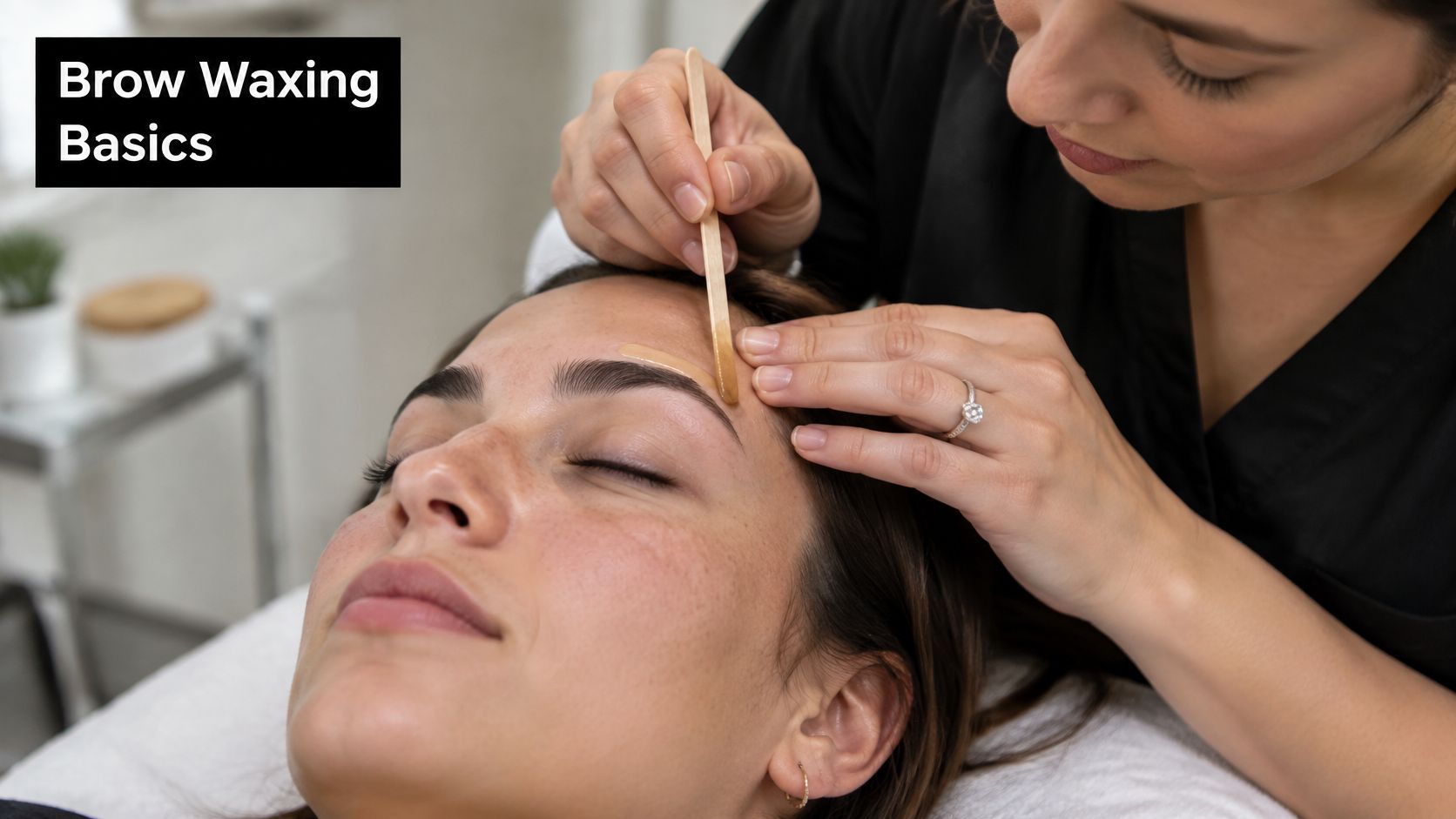
Whether waxing suits your brows comes down to hair type, skin condition and what you want the shape to do. What follows is the practical version: what happens on the bed, who shouldn't be on it, and how to look after the skin the morning after.
Hard Wax, Strip Wax or Sugaring for Brows
Three methods do the same job by different means. Hard wax behaves like warm glue, cooling into a flexible film that grips the hairs and comes away with them, no strip needed. Strip wax works more like sticky tape, spread thin and lifted with a firm, fast pull. Sugaring uses a sugar paste that clings to the hair rather than the skin, and it rinses away with water.
Four things decide which one a practitioner reaches for: how sensitive your skin is, how coarse and how long the hairs are, whether you've been waxed before, and how much time the appointment has. A first-timer with fine hairs and reactive skin is a different job from someone on a six-week routine with strong growth.
| Wax type | Best suited to | Typical feel | Watch for |
|---|---|---|---|
| Hard wax | Sensitive skin and short or coarse hairs | Warm, sets around hair and lifts without a strip | Full removal of residue and careful, skilled application |
| Strip wax | Longer hairs and faster sessions | Quicker, with a firm pull that can sting more | Strip pressed flat and pulled against growth; not ideal for very short hairs |
| Sugaring | Clients who prefer a water-soluble paste | Paste grips hair, often felt as a gentler pull for some skin types | Temperature control and consistent technique |
Read that table as a starting point, not a rule book. The practitioner's assessment on the day, with your skin in front of them and your history on the consultation form, beats any general guide, including this one.
Ask at the consultation: which wax are you using on me, why does it suit my skin, and how will you adjust it if this is my first appointment?
Pain is worth being honest about. Every pull produces a short, sharp sensation, and brow skin is thinner and more sensitive than most areas of the face, so hard wax usually feels less abrupt than a firm strip removal. If you've never been waxed, say so at the start and ask for the gentlest method on offer. Tell the practitioner immediately if the sensation is more than you expected, because that information changes what they do next.
How a Brow Waxing Appointment Unfolds, Step by Step
The whole service takes about fifteen to twenty minutes, and roughly a third of it happens before any wax is warmed. Here's the sequence a careful professional follows.
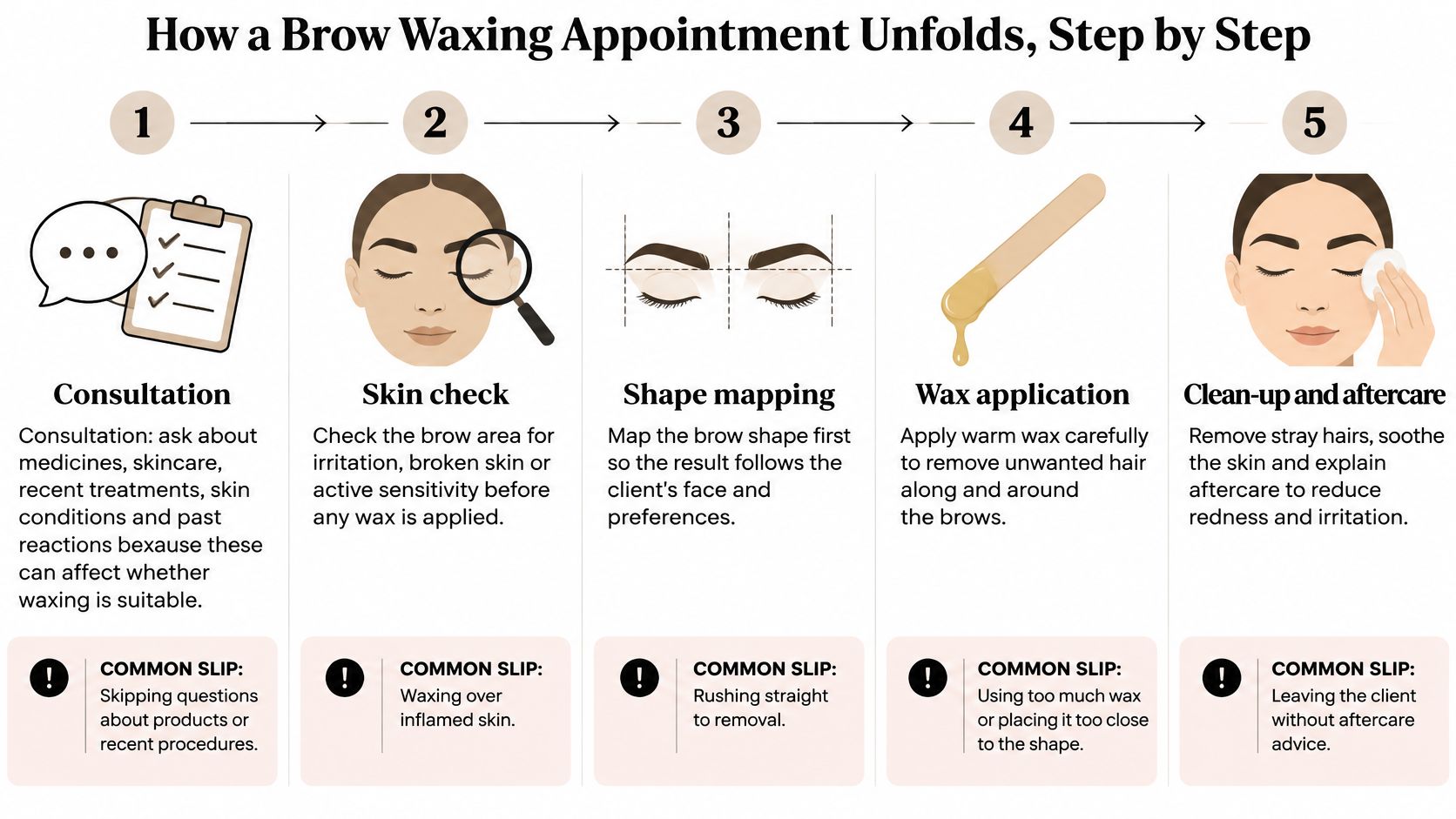
The eight steps in order
- Consultation. You'll be asked about medicines, skincare, recent treatments, skin conditions and any past reaction to wax. None of it is small talk. These answers decide whether waxing goes ahead today, and the most common slip is a client mentioning retinoid use after the wax is already on.
- Skin preparation. The brow area is cleansed and dried, with no oils or creams left on the surface. Wax grips hair rather than residue, and a moisturised brow is a brow the wax slides off.
- Shape planning. Your brows are brushed upward, the arch is mapped, and the target shape is agreed out loud before any wax touches skin. This is the moment to say "keep them thick" or "softer arch", not afterwards.
- Application. A thin layer of warm wax goes on in the direction of hair growth, kept to small sections the practitioner can control, with a fresh spatula for each scoop. Overloading the spatula is what causes wax to spread where it wasn't meant to go.
- Removal. Strip wax is pressed flat with the surrounding skin held taut, then pulled firmly against hair growth in one movement. Hard wax is lifted off without a strip. Repeated passes over the same patch are avoided because each one stresses skin that's already been stripped.
- Clean-up. Residue comes off with oil or a soothing product, and stray hairs are tidied with tweezers. Tweezers here are for precision, not for finishing a job the wax should have done.
- Check. The skin is inspected for lifting, grazing or unusual redness, and the result is compared against the shape you agreed. A practitioner who skips this is skipping the quality control.
- Briefing. You leave knowing what to avoid for the next day or two: friction, heat, strong actives. If that isn't said out loud, ask.
What a good session looks like
Three things tell you it went well. The shape matches what you agreed, the skin looks calm rather than angry, and you can repeat the aftercare back to yourself without guessing.
If you'd rather see the sequence in motion before you book, this short demonstration shows the hands-on side of a brow wax:
When Brow Waxing Is Unsafe and When to Wait
Waxing doesn't only remove hair. It takes a thin layer of surface skin cells with it, so when the skin's barrier is weakened, the same pull that lifts a hair can lift skin, tear it, or leave a mark that lasts months. Around the brows that matters more than on the legs, because the skin is thin, close to the eyelids and highly visible.
The American Academy of Dermatology's guidance on removing unwanted hair is specific here. Avoid waxing if you're taking isotretinoin or have taken it within the previous six months, if you're using prescription tretinoin, or if you're on certain antibiotics, because these make skin more fragile and raise the risk of epidermal tearing. For facial waxing, it recommends stopping prescription retinoids and retinol products for roughly two to five days beforehand.
| Situation | Common guidance | What to do |
|---|---|---|
| Isotretinoin, taken now or within the previous six months | Avoid waxing, as skin can tear more easily | Postpone and check with the prescriber |
| Prescription tretinoin | Avoid waxing | Postpone and ask the prescriber about timing |
| Certain antibiotics | Avoid waxing | Check with the prescriber before booking |
| Prescription retinoids or retinol products on the face | Stop about 2 to 5 days before a facial wax | Rebook once the gap has passed |
| Sunburn, broken, inflamed or unusually sensitive skin | Avoid waxing over the affected area | Postpone until the skin has healed |
| Recent facial, peel or exfoliating acids | Strong actives can leave skin more sensitive, and guidance here is less standardised than for retinoids | Disclose it and let the practitioner set the timing |
The decision rule: disclose every medicine and every active skincare product, postpone when a listed contraindication applies, and accept the practitioner's timing call when you're unsure. Guessing is the only genuinely bad option.
Where the evidence is thinner, say so out loud. Advice on glycolic and salicylic acids, on professional peels and on facials done a few days earlier is far less standardised than the retinoid guidance. That doesn't mean those appointments are unsafe, it means the safe move is to describe exactly what you've had and when, then let someone trained to assess your skin that day make the call.
On the day itself, four things are reason enough to postpone: sunburn across the brow, broken or scratched skin, active inflammation, and skin that feels unusually sensitive to touch.
Aftercare and Telling Normal Redness From a Problem
Some redness and warmth straight after brow waxing is ordinary. The skin has just been pulled, and it settles. What you're watching for over the next day or two is whether it's settling or escalating, and the two look different once you know what to compare.
Normal redness works like the flush after a brisk walk: it appears fast, peaks early and fades. A problem behaves differently. It gets worse with time instead of better.
The British Association of Dermatologists' guidance on hirsutism and hair removal notes that waxing can irritate facial skin and should be used cautiously. It also names pseudofolliculitis, the inflammation that happens when hairs stay trapped under the skin surface, which is one reason the way wax is applied and removed matters, not just how hot it is.
The first 48 hours
Keep the area clean and leave it alone. Skip friction from a heavy scarf or a vigorous face towel, skip heat from a hot shower or a sauna, and skip strong actives, scrubs and anything with fragrance while the surface settles. Don't pick at bumps.
Two questions clients often hold back: is it fine to put a soothing product on, and how soon can the next session be? Patch-test any new soothing product on a small area of skin before using it on freshly waxed brows, since skin that has just been waxed can react to a product it would normally tolerate. For timing the next appointment, follow the manufacturer's or practitioner's instructions on how long to leave between hair-removal sessions, because the right gap depends on the product used and how your skin responded.
| Reaction | What it usually means | What to do |
|---|---|---|
| Short-term redness and mild irritation | Common and usually settles within a short period | Avoid friction, heat and harsh skincare |
| Trapped hair under the skin | Pseudofolliculitis, an inflamed bump | Do not pick at it; tell the practitioner if it persists |
| Persistent swelling or spreading redness | Warning sign | See a doctor or pharmacist |
| Blistering or pus | Warning sign | See a doctor or pharmacist |
| Significant pain | Warning sign | Seek medical advice promptly |
When it stops looking like a wax reaction
Anything that worsens after the first day deserves a second opinion rather than another cosmetic product. Tell the practitioner what you've noticed, because they need to know how their technique is landing on your skin, and take the symptoms to a doctor or pharmacist rather than treating them at home with more product.
Checks to Make Before You Book a Brow Waxing Professional
No single licence settles whether a brow wax will go safely. UK practice rests on risk controls rather than one universal certificate: the National Occupational Standards for carrying out waxing services require preparation that meets legal and organisational requirements and working methods that reduce cross-infection. Regulation is still moving, with proposed UK controls concentrating first on higher-risk procedures and on practitioner and provider oversight rather than treating every beauty service the same way.
That leaves you with observable checks. A careful professional demonstrates these qualities from the outside.
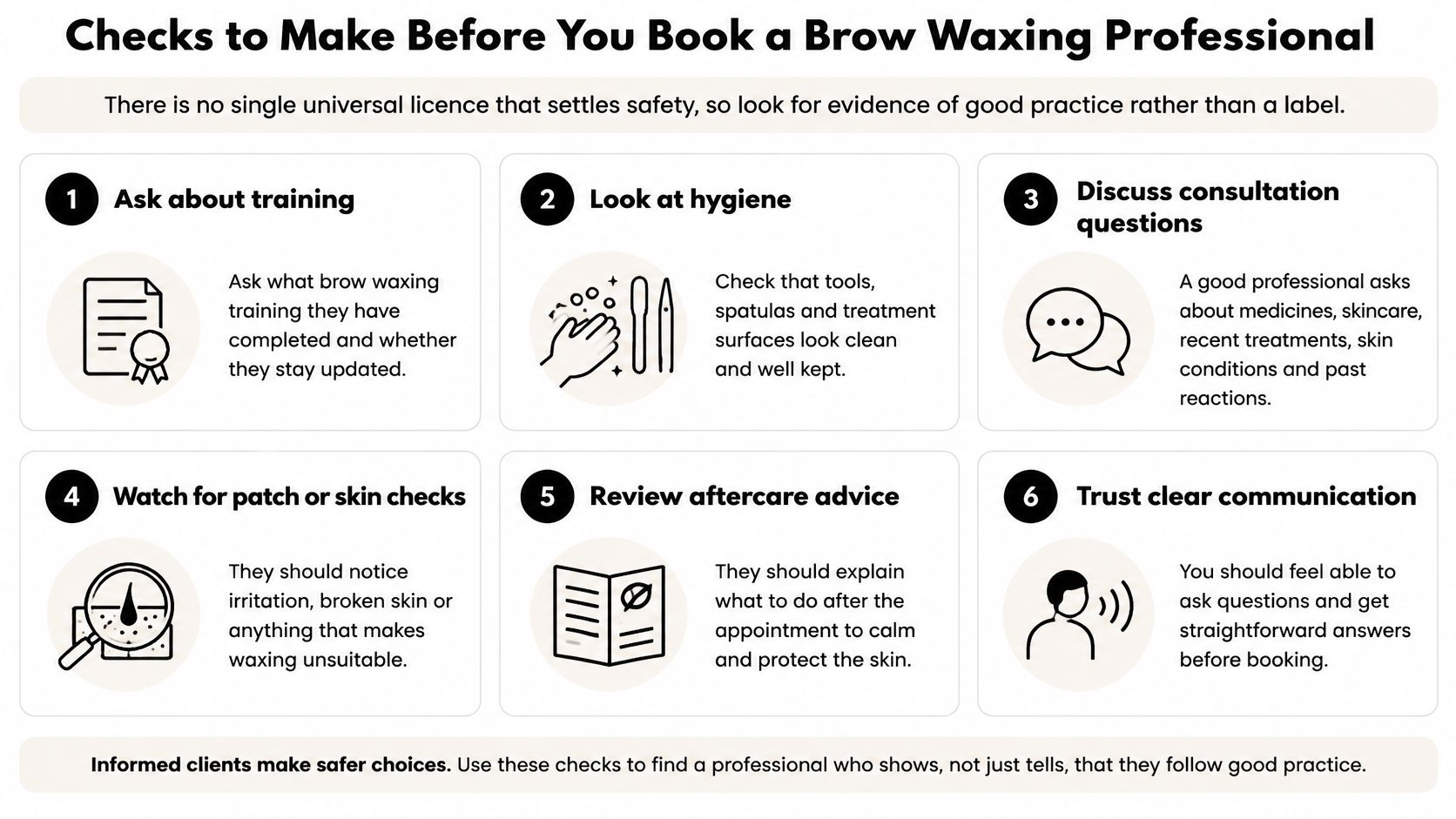
What you can see in the room
- Clean hands or fresh gloves before they touch your face or their tools.
- Single-use spatulas taken from a sealed packet, and none put back into the wax pot.
- A tidy workstation, because clutter is where cross-contamination hides.
- Equipment cleaned between clients, including the bed covering and any tools reused.
- A written consultation that asks about medicines, skincare and past reactions, rather than a signature on a blank form.
What to ask before you book
Ask what training they've completed for brow waxing and whether they keep it current. Ask whether they hold professional insurance and can show evidence of it. Ask how they handle a client on retinoids, and what they do if someone burns or reacts. The answers should be quick and unbothered, not defensive.
A good sign: they ask you more questions than you ask them, and they're happy to postpone.
If you'd rather compare local options first, this guide to eyebrow and waxing appointments near you is a sensible place to start before you send an enquiry to anyone.
What a Brow Waxing Room Needs Before You Rent One
Brow waxing sits inside a large professional base. IBISWorld counted approximately 57,199 UK businesses in the combined hairdressing and beauty treatment industry in 2026, a 13.4% increase on 2025, and its classification for the sector explicitly includes waxing alongside skincare, makeup, facial massage, eyebrow and eyelash tinting, manicures and pedicures (IBISWorld's UK business count). Behind that number sits a room, and the room has to work for each step of the appointment.
- A private room with a lockable door. The consultation and skin checks involve medication history, so they need to happen somewhere a passing client can't hear.
- A hand-washing basin within reach. Hands get washed before each client and between steps, and a basin down the corridor means it won't happen.
- A chair or bed that reclines and adjusts. Your working height needs to put the brows between your shoulders and your eyes, not above your head.
- A magnifying lamp with daylight-quality light. It's for shape planning and for the post-wax skin check, where grazing shows up long before it's visible in a mirror selfie.
- A wax heater on a dedicated socket. Steady working temperature is what stops wax snapping or scalding, and shared sockets invite interference.
- Sealed bins and storage for single-use items. The fresh-spatula rule only holds if there's somewhere to put used ones immediately.
- Wipeable surfaces and ventilation. Cleaning happens between every client, and wax vapour in a sealed box gets unpleasant by the fourth appointment.
Ask a space provider four things: whether the room is shared with other treatments, what hours and rental lengths are available, whether your insurance and training requirements are met by their set-up, and who handles waste collection and cleaning between clients. If you're weighing up a private room for other services too, this overview of massage therapy room requirements covers the overlapping basics.
Confirm the Space, Training and Terms Before You Book
You can run this sequence in a single week.
- Shortlist two or three professionals and note which wax type each one uses, so you're comparing like with like.
- Send the consultation questions ahead, covering medicines, skincare, recent treatments and past reactions, then wait for their timing decision before you book anything.
- Run the hygiene checklist and confirm training, insurance and what happens if a burn or allergic reaction occurs.
- If they rent a space, check the room against the essentials and confirm hours and rental length, with the salon chair rental contract terms worth reading before you sign open in front of you.
- Book only once the medicine and skincare timing rules are met, and keep the aftercare steps where you'll see them the next morning.
For the room side of that list, FindMy.beauty lists beauty rooms for lashes, brows, waxing and makeup, and connects professionals with salons that have a chair or room to spare nearby. Questions about plans can go to hello@findmy.beauty. Once you've found your person and your space, book the next brow appointment around the four to six week mark, so the shape you agreed holds between visits instead of growing out of it.
FindMy.beauty is a UK marketplace for beauty workspace, with listings for beauty rooms suited to brows, waxing, lashes and makeup, plus treatment rooms, nail stations, barber chairs and whole studios. You can search by town or postcode, compare day, week and month rates side by side, and message a host without creating an account, so a brow waxing set-up is a conversation rather than a contract. Visit FindMy.beauty to see what's listed near you.