


You've outgrown doing lashes at the kitchen table, your clients want appointments you can't comfortably accommodate at home, and a treatment room nearby looks promising. The advertised rent seems manageable. Then you discover that towels, heating, insurance and access outside the salon's opening hours aren't necessarily included.
When you search for beauty salons to rent, commitment and total running cost matter more than the headline rate. Choose the space that fits the business you have now, not the diary you hope you'll have once you've signed.
Table of Contents
- Why Renting a Beauty Space Is Not One Decision
- Beauty Space Rental Options at a Glance
- How Much Commitment Each Option Demands
- Working Out Your Real Monthly Cost and Hidden Bills
- Matching the Option to Your Situation
- Check the Terms and Compare Spaces Next
Why Renting a Beauty Space Is Not One Decision
For a lash technician moving out of a home setup, a private room might feel like the obvious next step. But renting that room occasionally, taking exclusive possession of it, and leasing a fitted studio are different business decisions. They change what you owe, what you control and how easily you can leave.
The UK had 50,438 hairdressing and beauty salon enterprises in 2024, generating £5.133 billion in turnover, according to the Institute of Chartered Accountants in England and Wales. More than 80% of businesses employed fewer than five people, according to the National Hair & Beauty Federation's industry statistics. Small operators are central to this sector, so workspace decisions need to work at practitioner scale.
Start with the business decision
A chair inside an established salon gives you a working base without taking responsibility for an entire premises. A room gives you privacy, but may leave you organising everything from laundry to client arrivals. A fitted suite can offer more autonomy, alongside a larger continuing obligation.
Before arranging viewings, answer these questions:
- What are you renting? A workstation, exclusive room, shared room or self-contained premises?
- How long are you tied in? Look at the written exit terms, not the payment frequency.
- What will you pay? Include the services and supplies needed to deliver your treatments.
The common mistake is comparing advertised rents as though every host supplies the same package. They don't. Use the comparison below to identify the arrangement first, then assess whether its terms suit your business.
Beauty Space Rental Options at a Glance
Beauty space rental options compared
| Option | Commitment | Cost basis | Best for | Main watch-out |
|---|---|---|---|---|
| Chair rental in a salon | Monthly or longer where agreed, with notice | Monthly fee or agreed day rate | Stylists and colourists with a client base | Employment status and control of prices |
| Private treatment room | Weekly or monthly arrangements | Fixed rent for agreed room access | Lash, brow, massage and aesthetics practitioners | Permitted treatments and insurance |
| Fitted salon suite | Monthly agreement or longer lease | Fixed rent, with included bills confirmed in writing | Practitioners wanting their own space | Continuing fixed cost when bookings fall |
| Booth rental | Weekly or monthly arrangements | Fee per designated station | Nail technicians, barbers and freelance hairdressers | Restrictions on pricing and branding |
| Day or session hire | Booked day or session, subject to cancellation terms | Per-day or per-session charge | Occasional work or testing demand | Effective hourly cost and limited access |
| Shared beauty studio | Hourly bookings through to monthly arrangements | Hourly, daily or agreed recurring fee | Mobile or part-time professionals | Shared equipment and cleaning responsibilities |
These are arrangements to look for, not guaranteed contract terms. A host can offer a treatment room on a short booking basis or require an ongoing agreement. The listing category alone won't tell you which.
Read the commitment column before the price
The commitment column tells you what to investigate about leaving. Paying weekly doesn't necessarily mean you can leave at the end of that week. Likewise, paying monthly doesn't establish whether you have a rolling agreement or a longer minimum term.
The cost basis tells you how the host charges, not everything the charge includes. For a chair, establish whether you're paying for exclusive use, named working days or access whenever a station is available. For a room, establish whether another practitioner uses it when you're absent.
The watch-out column identifies a discussion you shouldn't postpone until moving day. A beautiful room is no use if the host won't allow your treatment, and a well-equipped station is a poor fit if the branding restrictions undermine your business.
Choose the arrangement, not the label. A chair described as a booth may offer the same practical setup as chair rental elsewhere.
Separate privacy from independence
A private suite gives you a physical boundary. It doesn't automatically give you unrestricted opening hours, permission to install equipment or control over signage. Conversely, a chair inside another salon can support an independent business where the agreement allows it.
Ask to see the actual working area during trading hours. Listen for noise from dryers and conversations, check where clients wait, and walk the route to the toilet and handwashing facilities. These details affect whether you can deliver your service comfortably.
Don't pay for privacy you don't need. Don't accept a shared environment that prevents you delivering the experience your clients book.
How Much Commitment Each Option Demands
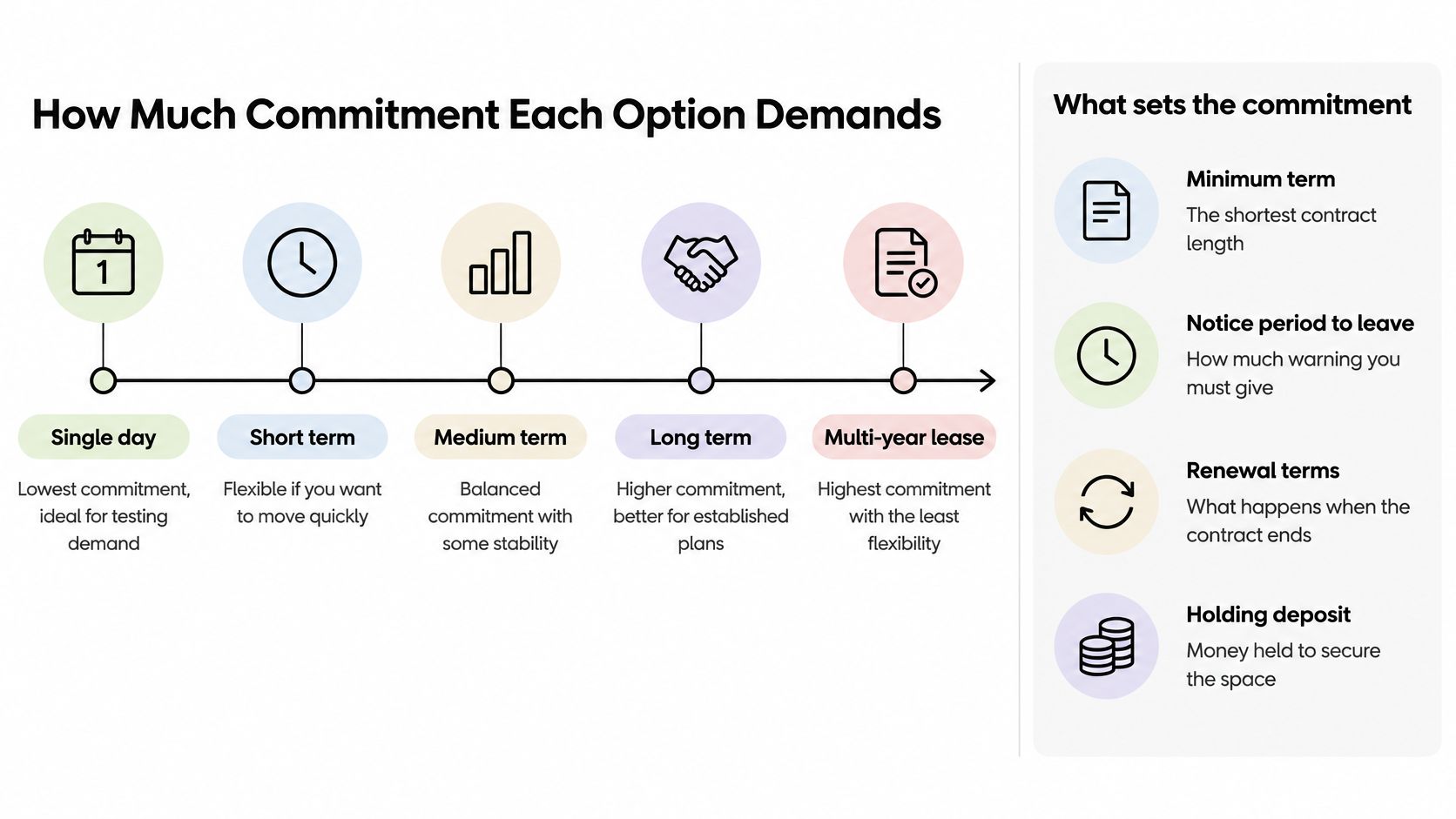
Commitment runs from a booked session to a long premises lease. But the important point isn't where an arrangement sits on a marketing chart. It's what you remain liable to pay when your circumstances change.
Follow the money to the exit
Day hire limits your exposure only if the booking and cancellation terms support that flexibility. Check whether you can cancel unused dates, whether recurring bookings create an ongoing obligation, and whether the host can move you to another room.
A recurring room or station gives you a predictable base. In exchange, you may owe rent during holidays, sickness or quiet periods. For occasional work, the practical questions in our guide to renting a room by the day can help you assess whether short bookings offer enough continuity.
Longer agreements need closer scrutiny:
- Minimum term: Establish the earliest date you can leave without continuing rent liability.
- Notice: Confirm how notice must be delivered and when it takes effect.
- Renewal: Check whether the agreement continues automatically and on what terms.
- Deposit: Get the refund conditions and any deductions in writing.
- Host termination: Find out what happens to prepaid rent and booked clients if the host ends access.
Test the downside before signing
Consider a hypothetical stylist who signs a long agreement, then loses regular clients after moving location. Unless the agreement provides an exit, a thinner diary doesn't remove the rent obligation.
Now consider a nail technician who books Saturdays while testing local demand, then takes a recurring station once clients rebook consistently. She may pay more for each working day initially, but she avoids buying unused capacity.
Neither approach is automatically right. Established demand can justify stability; uncertain demand calls for a smaller obligation.
Practical rule: Write down the minimum rent you must pay before you can leave, then add non-refundable setup costs. Compare that exposure, not just the recurring payment.
Also confirm whether you can arrange cover, leave equipment securely and access the premises when the main salon is closed. A manageable agreement still needs to accommodate how you work.
Working Out Your Real Monthly Cost and Hidden Bills
A £30 day rate sounds cheap until you multiply it by the month and add everything the rate leaves out. Judge each space by the appointments needed to support it, and build the comparison in a spreadsheet with separate columns for the host's charge, external bills and treatment costs.
Build a complete monthly calculation
Calculate the base rent. For a recurring rental, use the agreed monthly charge. For day hire, multiply the rate by the dates you expect to book. Check whether you're charged for reserved days you don't use.
Add the operating extras. Get written answers about utilities and heating, cleaning, laundry and towels, reception cover, storage and waste collection. Specify your waste streams, including sharps where relevant, rather than assuming ordinary rubbish collection covers everything. Add booking software, card-processing charges, consumables and insurance, including public liability and appropriate treatment or professional indemnity cover. Confirm with your insurer exactly which services and premises your policy covers.
Calculate your contribution per appointment. Start with the amount you receive, then subtract treatment products, disposables, transaction charges and other appointment-specific costs. Divide the monthly workspace total by this contribution to estimate the appointments needed to cover it. Skip consumables here if you already counted them in the monthly column.
Compare the result with a realistic diary. Count only appointments you can reasonably expect to complete and get paid for. Leave room for gaps, cancellations, cleaning and consultation time. Covering the workspace still leaves your own wage and every other business expense to pay.
Use a worked example before asking for quotes
Suppose a space costs £30 per day, you work 4.3 weeks in a month and each completed appointment contributes £35 after appointment-specific costs.
Monthly base rent at a £30 day rate
| Schedule | Days per month | Monthly base rent |
|---|---|---|
| 1 day a week | About 4.3 | About £129 |
| 2 days a week | About 8.6 | About £258 |
| 3 days a week | About 13 | About £387 |
| 5 days a week | About 21.5 | About £645 |
At two days a week, base rent alone needs around eight completed appointments before you earn anything. Extra bills push that figure higher. That gap between a modest daily price and the monthly total is exactly what catches renters out.
For massage practitioners, our guide to choosing a massage therapy room covers how to assess the physical setup alongside the money. A lower-priced room stops being a saving once you're hauling a couch, towels and supplies to every booking.
Confirm VAT and inclusions before comparing totals
Ask every host whether the advertised charge includes VAT, and request the total payable in writing. Two quotes with the same headline figure can land differently once tax is added, and the only reliable comparison is the final amount leaving your account each month.
A rate without a written inclusions list is an incomplete quote.
Compare spaces using the same basket of services. An inclusive room with a higher price can cost less overall than a cheaper room that bills heating, laundry and reception separately. Paying for a full service package makes no sense if you already handle those tasks yourself, so the written terms matter more than whatever the listing calls the space.
Matching the Option to Your Situation
Best-fit rental option by situation
| Situation | Likely best fit | Key check |
|---|---|---|
| Testing demand through occasional weekly bookings | Day or session hire | Rental charge against expected completed appointments |
| Full-time with established clients | Monthly chair or treatment room | Notice periods and renewal terms |
| Specialist treatment such as aesthetics or massage | Private treatment room | Host permits the treatment and appropriate insurance is in place |
| Stylist building an independent brand | Salon suite or chair with clear terms | Who controls prices, bookings and branding |
| Nail technician with occasional extra work | Nail station on booth or day basis | Ventilation and waste disposal arrangements |
| Mobile practitioner needing a base | Shared studio, hourly or daily | Storage, access hours and cancellation rules |
Assess the booking setup as carefully as the treatment area.

Match the room to the service
For massage, test whether you can move comfortably around the couch and whether conversations carry through the walls. For lashes, check lighting, socket placement and whether the room can stay comfortable throughout a long appointment. For nail work, investigate ventilation and product storage before judging the décor.
Specialist treatments need a more exact conversation. Give the host your actual treatment list, including equipment and waste requirements. Get confirmation from your insurer that the services and premises are covered, and check applicable local requirements before accepting bookings.
An attractive salon address isn't evidence that every treatment is suitable there.
Mixed schedules need deliberate boundaries
A stylist might use a recurring local chair for regular clients and book occasional days elsewhere for another client group. That can work, but maintaining separate supplies, travelling and explaining different locations to clients all take time.
Compare the whole working pattern. A central base with secure storage may be worth more to a mobile practitioner than a lower-priced station that requires carrying equipment through the salon each visit.
Use the video below as another prompt for thinking through your workspace choice.
A full diary supports a different decision from a promising enquiry list. Before increasing your commitment, look for repeat bookings, reliable attendance and clients willing to travel to the proposed location.
Match the commitment to your confidence in demand, not to the prestige of having a private room. Expansion should solve a business problem, not create a rent target you must chase.
Check the Terms and Compare Spaces Next
Self-employed isn't a status you establish just by putting it in a contract. The written agreement and day-to-day reality both matter. Before signing, examine who controls the work rather than accepting the host's description of the arrangement.
Tax status and employment rights also involve different tests. Employment law includes a worker category between employee and self-employed, so a self-employed tax position doesn't by itself settle someone's employment rights. Get specialist advice if the salon expects employee-like control while placing business costs and risks on you.
Send the host questions that require clear answers
Use this checklist when enquiring, and ask the host to include the agreed answers in the written terms:
- Business control: Who sets my prices, working hours, appointment rules and cancellation policy?
- Bookings and clients: Must I use your booking system, who can access client records, and what happens to those records when I leave?
- Branding: Can I trade under my own business name, display signage and promote my services independently?
- Cover: What happens during holidays or sickness, and what conditions apply to an appropriately qualified substitute?
- Access: Can I enter outside salon opening hours, and who lets clients in?
- Permitted work: Are all my proposed treatments and equipment expressly allowed?
- Insurance and responsibilities: What must I insure, what does the host cover, and who handles cleaning, maintenance and waste?
- Ending the arrangement: What are the minimum term, notice method, renewal provisions, deposit deductions and cancellation conditions?
Our guide to a salon chair rental contract helps turn a verbal discussion into points to resolve before signing. If the agreement contradicts what the host promises during a viewing, resolve that discrepancy first.
Don't rely on an informal assurance that you can sort things out later. Client appointments, prepaid treatments and equipment make an unclear exit much harder to manage.
Compare spaces through direct enquiries
At FindMy.beauty, we list salon chairs, beauty rooms, treatment rooms, nail stations, barber chairs and salon studios to rent. You can search by town or postcode, compare displayed day, week or month rates, and message hosts directly without creating an account.
Browsing and messaging are free, and you deal with the salon directly. We provide the listing and messaging platform only: we aren't a party to the rental agreement and don't handle rent or deposits.
That means your enquiry should establish availability, suitability and written terms, not just whether the space is still advertised. We don't own, inspect or manage listed spaces, so arrange your own viewing and checks.
Take a measured route to signing
- Shortlist three spaces that fit your treatment and working pattern.
- Send the same questions so you can compare the answers fairly.
- Request written terms and a complete breakdown of the amount payable.
- Agree a short trial where available before accepting a larger commitment.
A trial should still have clear payment, access and cancellation terms. Use it to test the working day, from preparing the room to leaving it ready for the next practitioner.
FindMy.beauty brings chairs, rooms and studios into one place so you can compare beauty workspace options and contact hosts directly. Visit FindMy.beauty, shortlist spaces near your clients, and ask for the full cost and written terms before committing.