


You've found a room that looks right: a clean treatment couch, flattering lighting and a rent you think you can manage. Then the questions start. Can clients get in during your evening appointments? Is laundry included? Does the permission to run a beauty business cover the treatment you offer?
Renting a studio space only works when the usable hours, treatment permissions and total cost fit your business. A beautiful room can still be an expensive mistake if you're paying for empty days or can't practise there on the terms you expected.
Table of Contents
- Find Spaces That Fit Your Treatment
- Five Checks to Run Before You Sign
- What a Studio Really Costs Each Month
- Confirm Your Treatment Is Allowed There
- Insurance and Self-Employment Checks
- Contract Terms to Get in Writing
- Book the Viewing and Arrange the Move-In
Find Spaces That Fit Your Treatment
Start with the work, not the photographs. A styling chair suits cutting and colouring; a private treatment room offers privacy for massage or facials; a whole studio gives you exclusive space but leaves more premises management with you.
- Write your working brief. List your treatments, equipment and required bookable hours. Include consultation, setup and cleaning time when deciding how much access you need. Check that there's room to move around the couch or chair without blocking the doorway.
- Search by practical fit. On FindMy.beauty, our listings show space type, location and day, week or month rates, with map-based comparison. Use your town or postcode, then separate suitable spaces from attractive rooms that don't match your work.
- Set a travel boundary. Consider your existing clients as well as your commute. A cheaper room across town won't help if clients struggle with parking, public transport or the journey after work.
- Compare what's included. Record utilities, cleaning and laundry beside each rate. Use the chair-rental benchmark below as context for chairs, not as a valuation of private rooms or whole studios.
Keep your shortlist as a working document. Update it as hosts answer questions rather than treating an appealing listing as a finished offer.
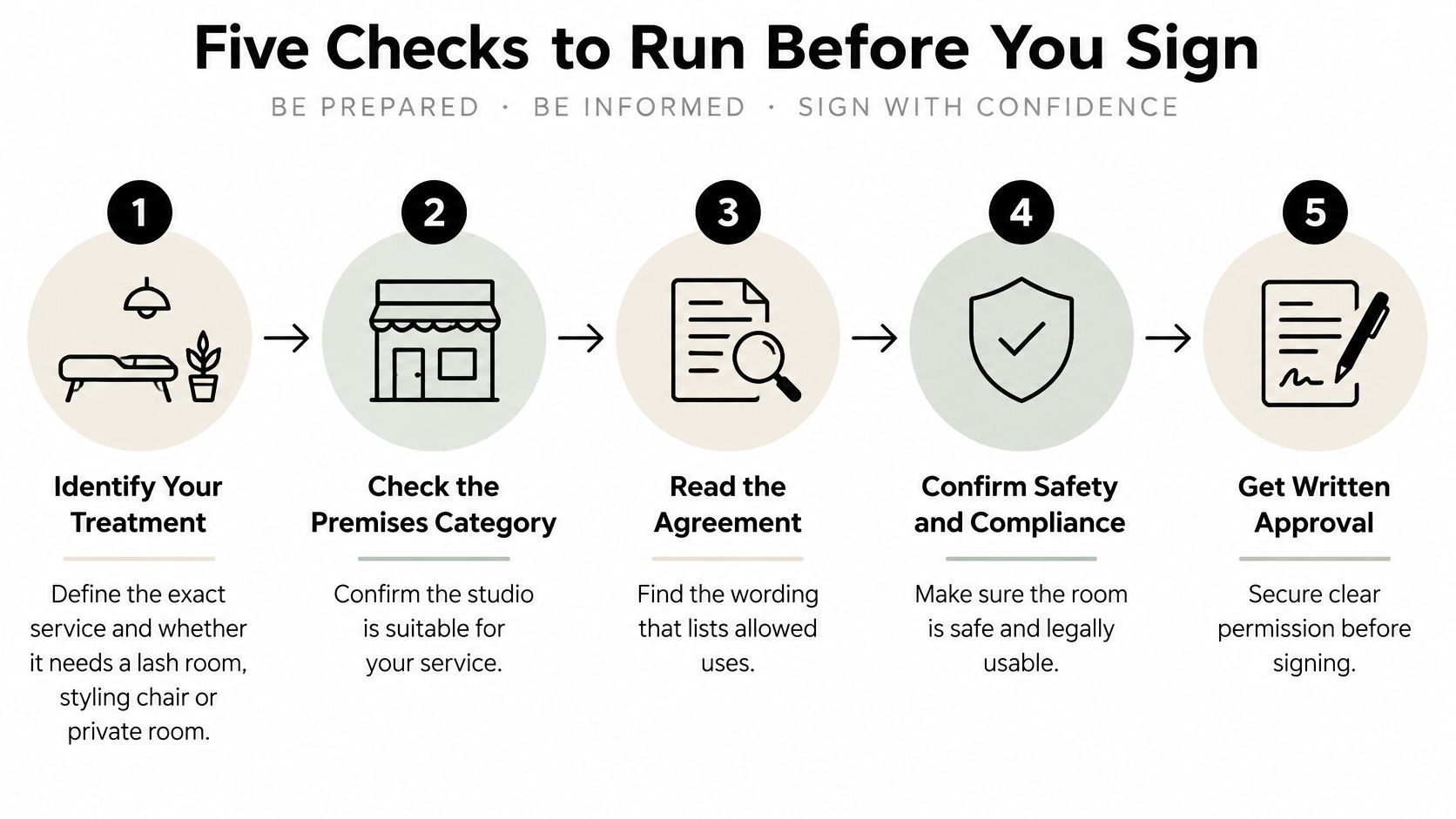
Five Checks to Run Before You Sign
A room can look ready for your treatment and still be unsuitable for the procedure you plan to offer. Confirm permission and practical fit before paying a deposit, ordering supplies or announcing an opening date.
Describe the exact treatment and premises. Tell the host what procedure you'll perform, what equipment you'll use and what the room needs, including water access, ventilation, privacy and storage. A styling chair, lash room and room for electrolysis can raise different questions.
Check requirements with the local council. Ask whether your treatment or premises requires registration, a special-treatment licence or other approval. Requirements vary by location and procedure. Get clear guidance for the specific address before committing to rent.
Confirm the host's premises arrangements. Ask who is responsible for fire-safety arrangements, repairs and shared facilities. Clarify what happens if the washbasin or heating fails, and whether the entrance and room work for your clients. For hands-on treatments, use this massage therapy room layout guide to consider the practical layout.
Work out the cost per bookable client hour. List the rent and any other charges, then divide the total by the hours you can realistically book clients in the space. Include setup, cleaning and time when the room is unavailable. A low headline rate can still mean a high cost per appointment if you use the room for only a few bookable hours.
Have the agreement reviewed before signing. Check the permitted use, payment terms, notice period and responsibility for the premises. A short booking period does not automatically mean you can leave without cost.
Keep the decision in the right order
Use the visual checklist to keep the main checks in view before you commit.
Before agreeing to rent through FindMy.beauty, you're responsible for checking that the space suits your work and agreeing the terms directly with the host. An enquiry starts that conversation. It does not confirm that the premises meets your requirements.
Before you pay, be able to state your treatment, the council's requirements and the agreement's permitted use clearly. If any answer is still uncertain, resolve it first.
What a Studio Really Costs Each Month
Comparing headline rates is the wrong starting point. A monthly room can look cheaper than day hire while costing more for every appointment you deliver.
For context, UK salon chair rental was reported at approximately £200–£600 per week in 2025, according to Lyvi's regional rental research and industry estimates. That's a chair benchmark, not a price guide for every treatment room or studio; our salon chair price guide helps with that specific comparison.
Cost lines to total before comparing rates
Treat the inclusion column as a checking prompt, not a promise about an individual listing.
| Cost line | Usually in the advertised rate? | What to ask the host |
|---|---|---|
| Rent | Yes | Confirm whether the rate is per day, week or month |
| Business rates | Sometimes | Are rates included or billed to you? |
| Utilities | Sometimes | Is there a flat charge or metered split? |
| Service charges | Sometimes | What's the amount, and how is it reviewed? |
| Waste disposal | Often not | Who collects clinical waste, and what does it cost? |
| Insurance | No | What cover must you arrange yourself? |
| Equipment and consumables | No, unless expressly included | Which equipment is provided, and what must you supply? |
| Card terminal and card fees | No, unless expressly included | Is a terminal provided, and which fees apply? |
| Laundry | Sometimes | Are towels, linen and washing included? |
| Booking software | No, unless expressly included | Must you pay for your own system? |
| Downtime between clients | No | Can access accommodate setup and cleaning buffers? |
Calculate the cost of productive time
Use a spreadsheet to total the monthly rent and operating costs. Include insurance, licences, travel, maintenance and the charges in the table, without counting anything twice.
Then calculate:
Monthly operating cost ÷ realistically paid client hours = operating cost per paid client hour.
Hypothetical example: a monthly total of £900, spread over 60 paid client hours, gives an operating cost of £15 per paid client hour. That isn't your treatment price: you still need to pay yourself, allow for tax and retain a profit.
Calculate the cost per bookable hour too, using available appointment time after setup and cleaning. Comparing that with the cost per paid hour exposes how much you're relying on filling the diary.
Cost rule: Don't divide rent by every hour the building is open. Divide by the hours you can use, then test what happens when some remain unbooked.
For a mobile practitioner adding salon appointments, day hire can protect cash while demand develops. Monthly hire becomes attractive when reliable bookings justify the commitment, not merely because its advertised daily equivalent looks lower.
Confirm Your Treatment Is Allowed There
Permitted use is the agreement wording that identifies what you may do in the space. Match it to the council answer you obtained, your qualifications and the actual treatment process. A broad description such as treatment room isn't a substitute for explicit permission.
The parliamentary debate on government policy for the hair and beauty sector highlights the sector's heavily self-employed structure and the complexity of local licensing. For an independent practitioner, that makes a clear allocation of responsibility particularly important.
Use the viewing to inspect documents as well as décor.
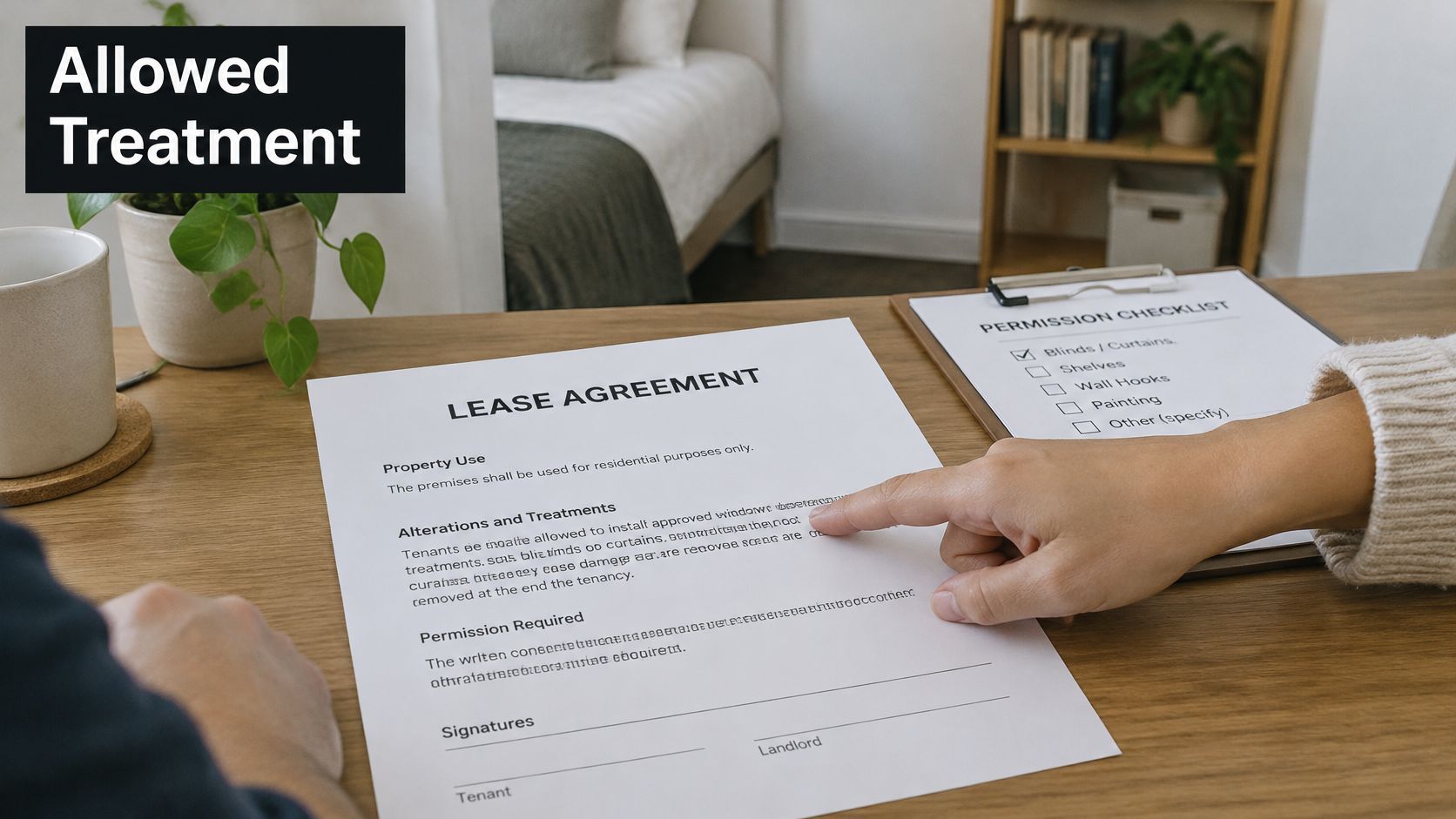
Questions to send before the viewing
Which treatments may I offer? Look for a written treatment list, with any excluded procedures identified. Check that the agreement matches your intended menu rather than a general business category.
What premises approvals apply? Request copies of relevant confirmations, licence conditions and the allocation of application or renewal costs. Resolve any mismatch with the council's answer before proceeding.
Can you rent this space to me? Hosts must confirm they own the space or have the right to rent it out, including any necessary permission from a landlord, freeholder or business partner. Ask for confirmation rather than assuming the person showing the room has authority.
What qualifications and treatment protocols are required? Expect a clear list of qualification requirements and arrangements for patch testing, consent and treatment records. Confirm how you'll manage follow-up appointments when you're not on site.
How are hygiene and emergencies managed? Request the infection-control procedure, waste arrangements, emergency contacts and evacuation instructions. Inspect handwashing facilities and the separation of clean supplies from used equipment.
Who handles incidents and shared resources? Seek written responsibilities for client injuries, equipment failure, keys, security and data protection. Establish how incidents are reported and who can access client information.
A host's permission, a council approval and an insurer's acceptance answer different questions. Don't substitute one for another.
A useful answer names a person, a procedure or a document. Friendly reassurance without those details leaves you to resolve the problem after it happens.
Insurance and Self-Employment Checks
Insurance and employment status are separate checks. You can have suitable cover and still have an arrangement whose day-to-day working practices don't match the contract.
Check your cover against your work
The host's insurance may protect the building or salon contents without covering your treatments, advice, equipment or client claims. Quotezone's hairdresser insurance guidance distinguishes generally voluntary public liability insurance from employers' liability insurance, which becomes compulsory when a business employs people, subject to applicable exemptions.
A host can still require your own public-liability and treatment or professional-indemnity cover as a condition of renting. We recommend that all hosts and renters maintain their own professional liability insurance.
Send your insurer a precise description of the proposed arrangement:
- Treatments and equipment: Include every procedure and any shared or hired equipment.
- Premises and access: Give the address and explain which facilities you'll share.
- Working pattern: State that you'll operate independently from rented space.
- Higher-risk work: Identify procedures that need specific acceptance rather than assuming a general beauty policy includes them.
Obtain written confirmation of cover, exclusions and relevant conditions. Pay particular attention to shared-equipment exclusions, unattended stock and requirements concerning qualifications or treatment records.
Check that independence is genuine
Your working arrangement should reflect control over your bookings, prices, tax reporting and treatment methods. Shared reception, opening hours and hygiene rules can be practical premises arrangements, but the label self-employed doesn't settle employment status by itself.
Compare the written terms with what the host expects in practice. If they intend to direct your work as though you're an employee, seek appropriate advice rather than relying on a rental label.
Before taking clients, build a compliance file containing insurance certificates and endorsements, premises approvals, risk assessments and signed occupancy terms. Keep it accessible during appointments, not buried in a message thread you can't find when needed.
Contract Terms to Get in Writing
A weekly headline price doesn't tell you when money is due. If the host expects payment for a larger period upfront, you need that cash available before appointment income starts arriving.
Ask for the payment schedule in full, not an informal assurance that payment is flexible. Our salon chair rental contract guide can help you organise the terms for review.
Contract terms to request in writing
| Term | What to request | Why it matters |
|---|---|---|
| Payment interval | Monthly or quarterly, written in full, with due dates | Establishes how much rent you must fund upfront |
| Deposit | Amount, return deadline and permitted deductions | Ties up cash and determines how disputes are handled |
| Notice period | Required notice and who must give it | Affects when you can leave or reduce days |
| Break rights | Dates, triggers and conditions for ending early | Provides an exit before the contractual end date |
| Rent reviews | Review frequency and how the new rent is set | Determines exposure to future increases |
| Client-access hours | Exact days, times and access restrictions | Sets the appointment hours you can sell |
| Cleaning obligations | Who cleans each area and how often | Adds working time or extra charges |
| Storage rights | Allocated space and access arrangements | Protects stock and avoids shared-storage disputes |
| Cancellation terms | Notice, fees and treatment of prepaid rent | Determines your exposure when plans change |
Notice and break rights aren't interchangeable. An agreement may require notice but only permit termination at a specified break date. Read the duration, notice clause and break conditions together, including any requirement to have paid all sums due.
Make the arrangement workable
Ask what happens if the host closes unexpectedly, loses access to the premises or cannot provide the agreed room. The agreement should address unavailable space as well as cancellations initiated by you.
Hosts arrange payment terms directly with renters. We facilitate the connection, while hosts retain full control over their financial agreements, so the wording you agree with them must be precise.
Keep the final signed version and any agreed amendments together. If a host won't put a material term in writing, treat that refusal as your answer, not as a detail to sort out after moving in.
Book the Viewing and Arrange the Move-In
A viewing should test whether the space supports your working day. Visit when you'd normally practise, so you can judge noise, parking, reception activity and client access under useful conditions.
- Choose a focused shortlist. Keep spaces that match your treatment, usable hours and realistic budget.
- Send a specific enquiry. Tell the host what you offer, when you need access and which documents you'd like to inspect. To message a host through us, you only need your name and email; no account is required.
- Bring your decision file. Take the cost sheet, council response, insurer's confirmation and unresolved questions.
- Test the client journey. Walk from the entrance to the room, check privacy and inspect the facilities you will use.
- Settle the arrangement. Agree dates and payment directly with the host before bringing clients in.
Maya T., a London lash technician, replaced a six-month room contract she used three days a week with weekly lash-room hire. She messaged two hosts on a Sunday evening and visited one on the Tuesday. The useful lesson isn't speed alone: it's choosing a rental pattern that matches the work.
After signing, arrange keys and security access, walk through shared facilities and waste collection, and record a dated move-in check. Photograph existing damage with the host's agreement and confirm how maintenance issues should be reported.
Key takeaway: Approvals before deposits, written terms before clients.
FindMy.beauty brings chairs, treatment rooms and whole studios into a location-based search, with visible rental rates and direct host enquiries. Visit FindMy.beauty to shortlist suitable spaces, then ask each host for the inclusions, permissions and written terms you need to calculate your real cost per client hour.