

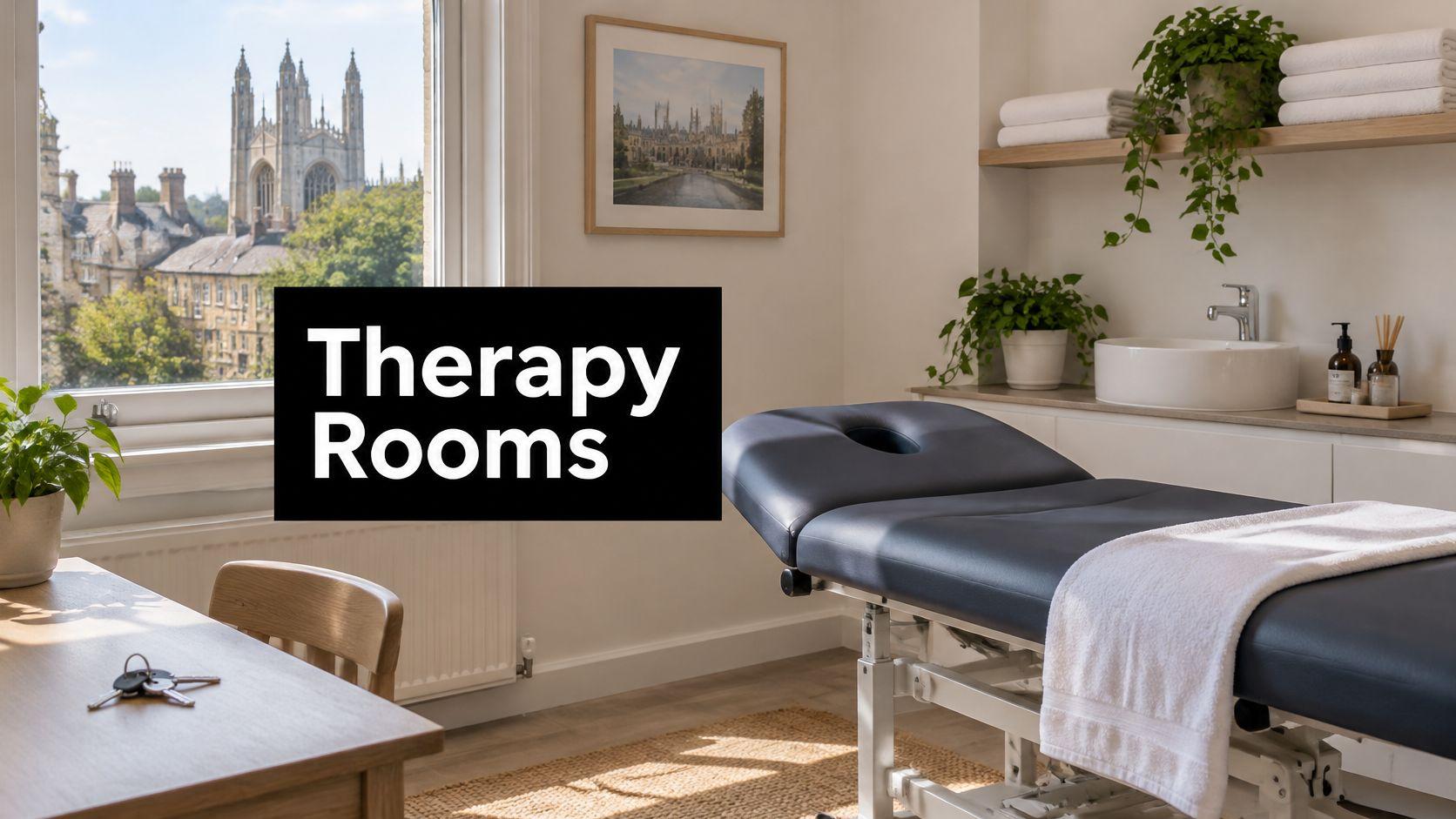
Cambridge added roughly 21,800 residents between 2011 and 2021, a 17.6% increase recorded in the Office for National Statistics 2021 Census area profile. Over the same decade the East of England grew by 8.3% and England by 6.6%. The city is pulling people in faster than the region around it.
More residents means more clients for facials, massage, waxing, lashes and aesthetics, and more rooms advertised to serve them. That's where the difficulty starts. Headline rent is the easiest number to compare and the least useful one, because a cheap room that fails on handwashing, air or paperwork costs more than an expensive room that works. What follows is the order a careful practitioner checks a Cambridge room in, before any deposit changes hands.
Table of Contents
- Room Types Worth Shortlisting in Cambridge
- Surfaces Basins and Waste to Verify
- Air Supply for Heat Odour and Aerosols
- Licensing Insurance and Waste Responsibility
- True Cost of Day Week and Month Hire
- Message a Host With Your Checks Ready
Room Types Worth Shortlisting in Cambridge
| Room type | Best for | Listing must show | Walk away if |
|---|---|---|---|
| Private treatment room | Facials, massage, aesthetics | Basin location, surface materials, ventilation type | Carpeted floor or no handwashing nearby |
| Beauty room | Lashes, brows, waxing, makeup | Couch or beauty chair, waste split, storage | No separate contaminated-waste option for waxing |
| Chair or nail station | Hair, colour, nails, barbering | Day or week rate and client access hours | You must take days you cannot fill |
| Whole studio | Sole use of the premises | Who holds keys, what utilities include | Shared clients or host sets your prices |
The room type decides the rest of the list. A private treatment room is built for facials, massage and aesthetics: a couch, a stool, dimmable light, a door that closes. A beauty room fits lashes, brows, waxing and makeup, usually with a beauty chair rather than a couch, plus storage for trolleys and product. A chair or nail station is the right shape for hair, colour, barbering and nails. A whole studio suits anyone who needs the premises to themselves, whether for privacy, for equipment, or for a second practitioner working alongside.
Each listing should name the space type, the Cambridge location and the rate period. Day, week and month are different products, not three ways of writing the same price. If an advert shows only a monthly figure, ask for the day rate before you visit, because the day rate is the number you can test against your actual diary.
The First Filter Takes One Pass
Three questions eliminate most rooms in under a minute.
- Does the treatment involve skin contact or broken skin? Facials, massage, waxing and aesthetics need a hand basin close to the couch and a stated waste arrangement. A room without them is out, whatever the rent.
- Does the work put heat, odour or aerosols into the air? Spray tan, strong chemical products, steam and aesthetics all do. The ventilation type belongs in the listing, not in a discovery on the day.
- Do you work five days a week or one Saturday a month? Occasional work suits a day rate. A room kept empty from Monday to Thursday is a monthly rent you can't justify.
Answer those three and you're typically down to two or three genuine candidates.
Why Density Matters More Than Postcode Prestige
Cambridge is compact and crowded. It sat among the 20% most densely populated English local-authority areas in 2021, at roughly 25.6 people per football-pitch-sized area, according to the same ONS census profile. That matters for one practical reason: clients weigh travel against appointment length. They won't cross the city for a 30-minute brow tidy. They will for a 90-minute massage with someone they trust.
The pool is the right age for appearance-led and wellbeing work too. 42% of Cambridge residents were aged 20 to 39 in 2021, and the city counted 52,400 households, a 12.2% rise on 2011, per Cambridge City Council's population and household summary. Those households are spread across the city rather than clustered in one quarter, so a room near a bus route or a cycle path into the centre pulls from more postcodes than a room tucked down a residential street.
Cambridge's therapy rooms sit inside a sector that generated £5.8 billion in turnover in 2023 to 2024, according to the National Hair & Beauty Federation's industry statistics. Plenty of practitioners compete for the rooms clients can reach easily.
Narrow to Two or Three, Then Test Them
Keep the rooms that match your treatment list and your real working pattern. Then put each one through the checks that follow: surfaces and basins, air, licensing and insurance, and total cost. Comparing therapy rooms Cambridge has to rent comes down to those four, not to the number in the advert. If you're weighing a room inside a working salon against a studio of your own, this guide to beauty salons to rent explains how shared premises usually operate.
Booking the cheapest headline is how practitioners end up moving twice in a year.
Surfaces Basins and Waste to Verify
Judge a treatment room the way you'd judge a food-prep bench, not a spare bedroom. If a surface can hold wax, oil, skin debris or product, it has to be wiped down completely between clients. Carpet can't be wiped. Nor can a fabric chair or a porous trolley top.
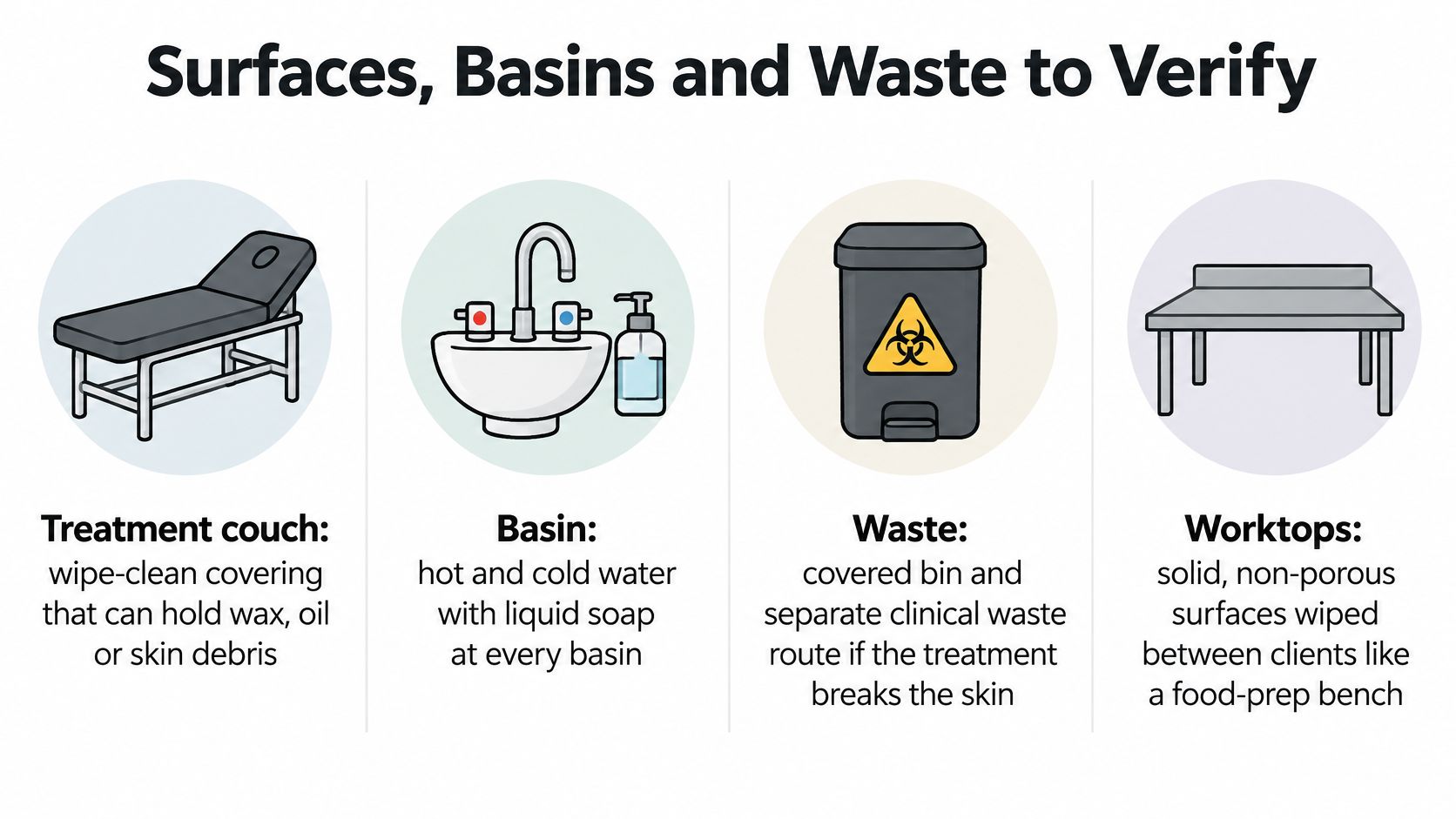
The hygiene in beauty therapy guidance published by Lancaster City Council sets out what that looks like in practice. It recommends solid, easily cleanable flooring instead of carpet, impervious worktops and chair surfaces, hot and cold handwashing facilities close to the treatment area, liquid soap and disposable paper towels. It also calls for dedicated sterilisation capacity where relevant, and separate disposal arrangements for general waste, contaminated tissue or body-fluid waste, and sharps.
Read that as a specification rather than a suggestion, because each item removes a way for contamination to travel.
Why Distance to the Basin Decides the Room
A basin across the corridor isn't a basin. It's a walk your hands take after they've already touched the client, the door handle and the light switch.
Proximity is the whole point of the guidance. A basin two steps from the couch gets used between every client. A basin down the hall gets used when you remember. Carpet behaves the same way in reverse: a hard floor lets you remove what lands on it, while carpet holds it and releases it again with every footstep and trolley wheel.
What the Host Should Put in Writing
Ask for these five points in the listing or in the enquiry reply, not as a verbal yes at the viewing.
- Basin location. Which room it's in, or how far along the corridor.
- Floor and couch materials. Named, not described as "easy to clean".
- The cleaning routine between clients. Who does it, with what, and how long it takes.
- Waste streams. Which bin takes general waste, which takes contaminated tissue, and whether a clinical waste route exists.
- Sharps. Whether there's a collector, who pays, and where the box lives.
The Five-Minute Check on the Day
Look at the floor first. Then run the hot tap, find the soap and the paper towels without being shown, and open the bin to see what's inside it. Ask which bin takes what, and watch whether the answer comes quickly or after a pause. Note any gaps in writing afterwards, in your own records rather than in a photograph of a room.
A beautiful room that fails this list isn't cheaper. The hygiene risk lands on you: your insurance, your reputation, your client's skin.
Air Supply for Heat Odour and Aerosols
A room's rent says nothing about how it handles heat, smells or airborne products. Match the ventilation to your treatment: a massage creates different demands from spray tanning or work with strong chemical products.
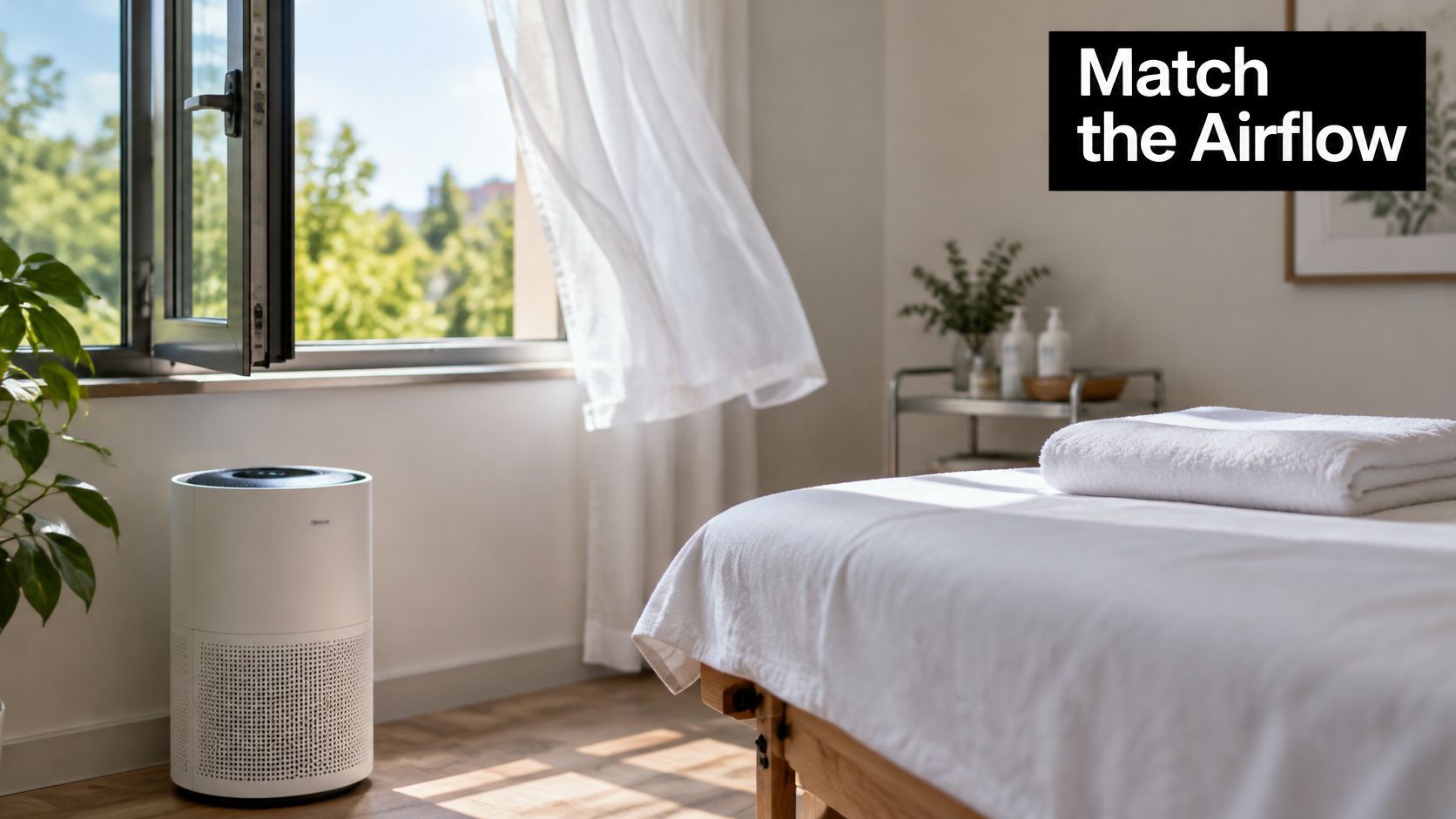
A window, fan or air purifier is not enough information on its own. Ask how fresh air enters, where it leaves, and whether the setup suits the products and procedures you plan to use. Treat any ventilation figures in a listing as context, not as proof that a room meets your needs.
Where Your Treatment Sits on the Scale
A facial or massage may need less control than a procedure involving strong products or airborne particles. If odours linger, or your treatment carries an aerosol risk, a window that barely opens onto a busy Cambridge street may not be adequate. Ask the host which treatments they do not allow. Their answer can reveal where they believe the room's limits lie.
Practical rule: If the listing does not describe the ventilation, ask before booking. Do not assume the room suits treatments that release strong fumes or aerosols.
The Questions That Get a Useful Answer
Ask these before arranging a viewing:
- Natural or mechanical ventilation? “There's a window” does not explain how the room is ventilated.
- Where does air enter and leave? Clarify whether there is both a supply and an extract.
- Does the fan run during appointments? Check whether it stays on while clients are present.
- Is there local extraction? Ask whether fumes are drawn away from the treatment area, rather than relying only on a distant ceiling vent.
- Which treatments does the host decline? This helps you compare their room rules with your own work.
A written, specific answer is more useful than general reassurance.
The Two-Minute Test in the Room
Close the door and sit for a couple of minutes. Notice heat, lingering product smells and whether street noise would interrupt a relaxing treatment. Then ask the host to show you how the ventilation operates. A purifier may help with some airborne particles, but it does not tell you whether fresh air enters and stale air leaves.
Licensing Insurance and Waste Responsibility
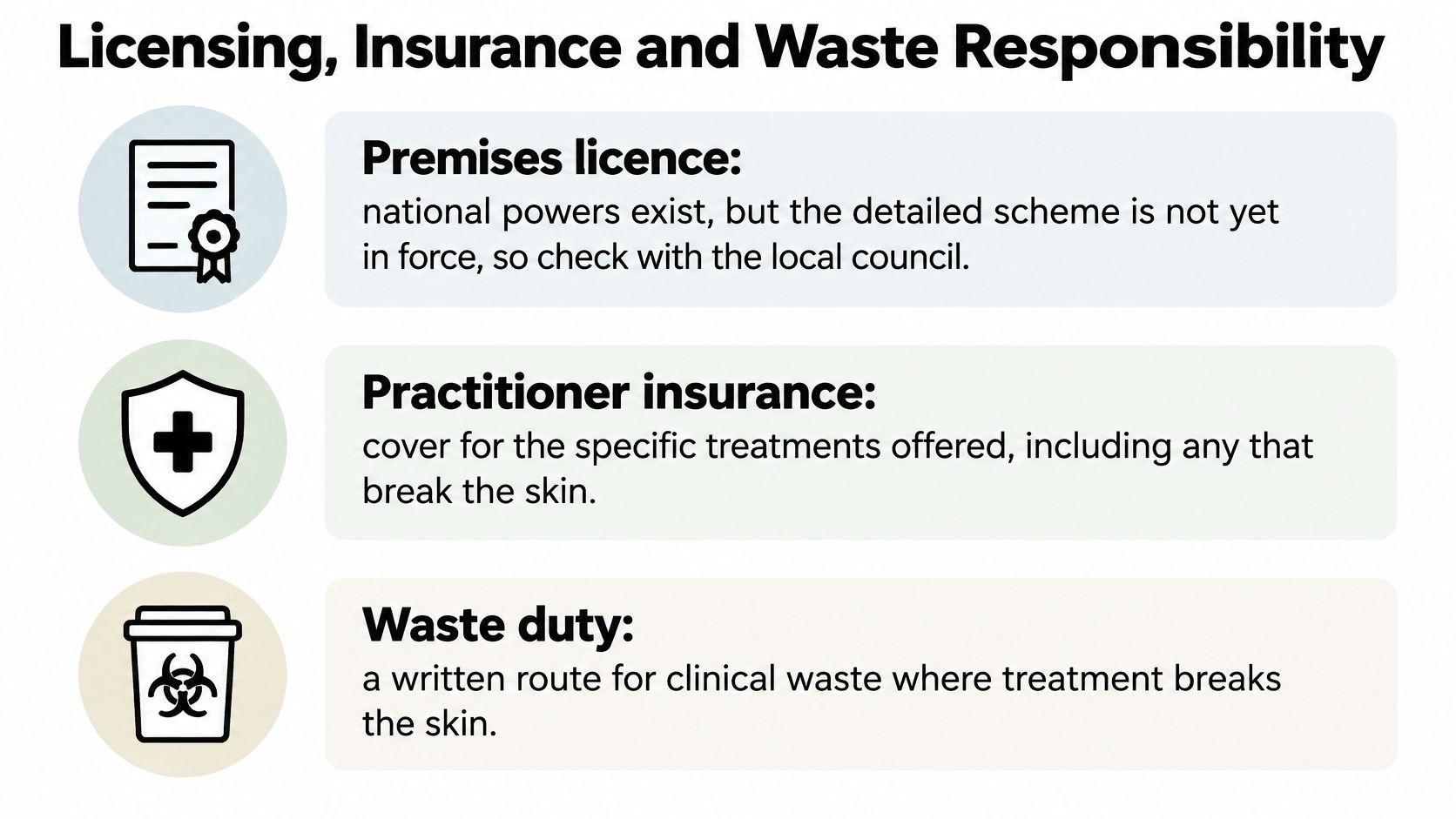
This is the part room adverts skip, and the part that costs most to get wrong. National powers to license premises and practitioners exist in the UK, but the British Beauty Council's guide to aesthetics regulation explains that the detailed licensing scheme has not yet been implemented. Requirements vary by treatment and by local authority, so the answer for a Cambridge room isn't a single national rule you can look up once.
The Scheme Is Planned, Not in Force
Planned regulation is expected to require evidence of qualifications, insurance and premises standards before licensing. That changes what a host will ask you for. A casual arrangement made this month can turn into a paperwork problem at the point the rules tighten, and the practitioner without a certificate folder is the one who loses bookings.
Treat the gap as a reason to over-document, not a reason to relax.
The Questions to Settle Before the First Booking
- Who registers the premises? The host, you, or nobody at present. Get the actual name.
- Is this room permitted to host your treatment? Some rooms are fine for a facial and not for anything that breaks the skin.
- Whose indemnity policy covers an independent renter? Yours should, and you need to confirm the host's does not exclude you from cover you assumed you had.
- Who pays for sharps and clinical waste collection, and for any inspection? If the answer is "we'll sort it", ask for the contract.
- Which certificates and consent records does the host expect to see from you?
Ask for it in writing. A verbal yes about sharps collection is worth nothing on the day the box is full.
Your Cover and the Building's Cover Are Different
The building's insurance protects the building and the host's business. It does not automatically protect a freelance practitioner treating clients in the room, and a policy written around employed staff may leave a renter outside its scope. Your own indemnity cover needs to name the treatments you offer, including any that break the skin, and it needs to be in force from the first booking rather than the first claim.
The Document Pack to Request
Before terms, ask the host for the insurance schedule, the waste contract or a plain statement that none exists, and a written list of permitted treatments. Add a line confirming who sets your prices and your hours. Cambridge City Council is the local authority to check for premises rules, since local requirements can differ from those a practitioner met in another city.
If those answers stay vague, don't fill the diary. A written agreement is worth more than a friendly chat, and this walkthrough of a salon chair rental contract shows which clauses to look for before you sign.
True Cost of Day Week and Month Hire
The most flexible room is not automatically the safest or the cheapest. Sometimes it's the most expensive way to work, and sometimes it's the arrangement most likely to attract an unwelcome tax question.
UK hair and beauty work is heavily self-employed. An industry profile reports that 58% of workers were self-employed in 2024, while ONS estimates for April 2025 to March 2026 counted 87,000 self-employed hairdressers and barbers and 63,200 self-employed beauticians and related workers, according to the ONS freedom of information release on self-employment in hairdressing and barbering.
Renting a Room Is Not Automatically Self-Employment
HMRC can examine who controls working hours, prices, client relationships and how the service is delivered. A Cambridge room rented by the day can be genuine self-employment. The same chair can look like employment if the salon sets your prices, keeps your client records and tells you when to turn up.
The question that settles it: if the salon closed tomorrow, whose clients would call whom?
Add the Extras Before You Compare
| Item | Daily hire | Weekly block | Monthly room |
|---|---|---|---|
| Headline rent | Pay only for days booked | A set run of days | Fixed even if the diary is quiet |
| Utilities and laundry | Often inside the day rate | Ask what is extra | Commonly extra |
| Cleaning between clients | Per visit or your job | Confirm who does it | Often your job or a fee |
| Clinical waste | Rarely included | Sometimes shared | Agree who pays the collection |
| VAT | Ask if the host adds it | Ask if the host adds it | Ask if the host adds it |
| Deposit and notice | Usually forfeit the day | Check the notice period | Deposit at risk if you leave early |
| Control of prices and hours | You should keep both | You should keep both | Risk rises if the salon directs your work |
A Worked Sketch With Your Numbers In It
Take a hypothetical room at a day rate of £55, used on three days a week you can fill. That's £165 a week, and a month of four working weeks comes to £660 before any extras. Now compare a monthly room at £520 with four empty Tuesdays you paid for anyway, plus utilities, cleaning and a non-refundable deposit. The cheaper headline lost.
Run that arithmetic with your own bookings rather than someone else's. A day rate only wins if you fill the days. A monthly rent only wins if your diary is steady enough to cover the quiet weeks, and only if you keep control of your prices and schedule.
The period to choose is the one that matches your booked days and leaves you in control of pricing, client records and hours. Not the one with the smallest advertised figure. If you're still working out which format fits, this guide to finding a therapy room for hire sets out the options.
Message a Host With Your Checks Ready
A good enquiry works like a viewing checklist: it gives the host enough detail to answer quickly, and it shows you are screening the room rather than asking to be chosen. Start from the days you already have clients for, then test each room against hygiene, air and self-employment before money is mentioned.
- Write your treatment list and your fillable days. Use the days you already have clients for, and mark the treatments that need a basin, couch space, extraction or privacy.
- Search listings by town or postcode. Enter a town or postcode to see nearby rooms and chairs, then keep only the space type that matches your list from the first table.
- Note every rate shown: day, week and month. Add the extras from the cost table, including VAT, deposit, utilities, cleaning and clinical waste, before you compare totals.
- Message two or three hosts with one short list. Ask about basin and floor, ventilation type, permitted treatments, waste and sharps arrangements, insurance for an independent renter, and who sets prices and hours.
- Visit the host who answers clearly and in writing. Run the hot tap, look in the bins, shut the door and check the air.
- Pay no deposit until every answer is in writing. Browsing spaces and messaging hosts is free, and you deal with the salon directly on availability, dates and terms.
A useful first message is plain: "I offer these treatments on these days. Does the room have a basin and hard floor, what ventilation is fitted, are my treatments permitted, how are waste and sharps handled, does your insurance cover an independent renter, and do I keep control of prices and hours?" If a Cambridge postcode returns little, widen the search area rather than lowering the checks.
FindMy.beauty lists private treatment rooms, beauty rooms, salon chairs, nail stations and whole studios across the UK, with space type, location and rent on each listing and a town or postcode search to narrow the field. Browsing and messaging are free, and you deal with the host directly, so these questions can go straight into your first enquiry before any deposit is agreed. Start with FindMy.beauty and shortlist two or three rooms worth visiting in person.