

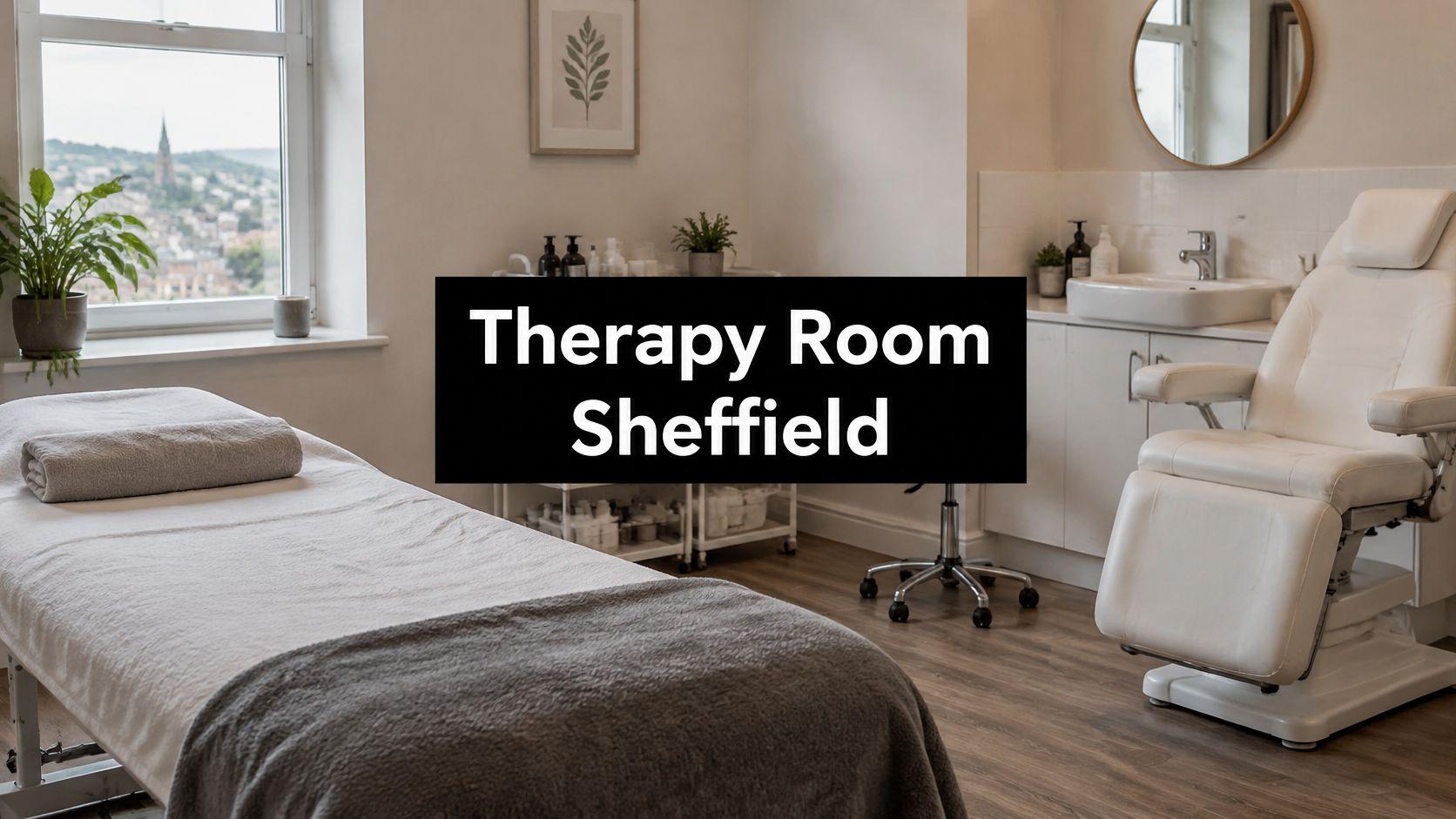
You've got a client booked in Sheffield next week and three rooms open in your browser. Each has a treatment couch, tidy shelves and an appealing rental rate. None makes it clear whether you can wash your hands properly, hold a confidential conversation or carry out your treatment under your own insurance.
That's the difficulty with comparing rooms online. The cheapest therapy room is still an unfinished option until its practical and legal suitability is confirmed. Start with what you'll do there, then compare the cost of a space you can use.
Table of Contents
- What a Therapy Room in Sheffield Actually Means
- Room Types Rates and Locations to Compare
- Room Standards to Confirm Before You Treat
- Ventilation That Makes a Room Usable
- Insurance and Licensing Before the First Client
- Matching the Room to the Client
- Enquire and Act This Week
What a Therapy Room in Sheffield Actually Means
A therapy room in Sheffield can mean quite different workspaces. A private treatment room suits facials, massage and aesthetics. A beauty room supports lashes, brows, waxing and makeup. A counselling or wellbeing room prioritises confidential conversation rather than treatment equipment.
Say your appointment is for massage. A quiet office might look welcoming, but it isn't automatically suitable for hands-on treatment. Equally, a well-equipped salon room may be distracting for someone attending counselling if conversations carry through the door.
Sheffield's active enterprises increased 15.1%, from 14,555 in 2015 to 16,755 in 2025, according to the Sheffield Economic Evidence Base. That provides context for a growing network of potential hosts and clients, not proof that any particular room will fill your diary.
A useful shortlist contains rooms you could treat clients in, not just rooms you like the look of.
Match the service and rental period first. Then establish physical suitability, insurance and treatment permissions, followed by the client's privacy and access needs. Only then can an enquiry move beyond asking whether the room is available.
Room Types Rates and Locations to Compare
Start by identifying the workspace that fits your actual appointments. This comparison separates the room itself from the rental commitment, so a low day rate doesn't distract you from an unsuitable setup.
Sheffield therapy room types and how to compare them
| Room type | Suited to | Rate period that fits | Listing must show |
|---|---|---|---|
| Beauty room | Lashes, brows, waxing and makeup | Day or week if not full-time | Area or postcode, dedicated or shared use, day, week or month rate, photos. Total cost: rent plus your cover, applicable licence and travel costs |
| Private treatment room | Facials, massage and aesthetics | Week or month once the diary is regular | Basin, privacy, floor area, access hours and rate period. Total cost: rent plus your cover, applicable licence and travel costs |
| Styling chair | Hairdressers and colourists at a salon station | Day for a Saturday column, week or month for a regular column | Chair photos, product storage and day, week or month rate. Total cost: rent plus your cover, applicable licence and travel costs |
| Nail station | Nail technicians | Day or week, with extraction confirmed | Ventilation or extraction, desk layout and rate period. Total cost: rent plus your cover, applicable licence and travel costs |
| Whole studio | A renter who needs the space alone | Month, or week if exclusive days are agreed | Exclusive use, key access, full rate and inclusions. Total cost: rent plus your cover, applicable licence and travel costs |
| Counselling or wellbeing room | Confidential talking therapy and wellbeing appointments | Day or evening slots, or a weekly block | Sound privacy, step-free access, evening availability and location. Total cost: rent plus your cover, applicable licence and travel costs |
Match the rental period to booked work
A day rate makes sense for an occasional Saturday clinic. Check whether the quoted day includes preparation and cleaning, rather than assuming you can arrive early or leave equipment behind.
A weekly arrangement can suit a diary spread across regular working days. Ask whether you're paying for the whole week, named days or a recurring block of access. Those arrangements aren't interchangeable, even when the advert describes each as weekly rent.
Consider a monthly commitment only after comparing its full cost with the days you realistically expect to work. Include empty days, holiday periods and any charge for storage or access outside normal opening hours. A lower nominal daily cost doesn't help if you're paying for unused space.
Compare the location clients will use
Look beyond the word Sheffield. An area or postcode lets you check the journey from your existing client base, the route from public transport and the practicalities of arriving with limited mobility.
A useful listing should show the layout, basin and opening hours, not just decorative close-ups. If you're deciding between a room within a salon and a larger commitment, our guide to beauty salons to rent helps distinguish the options.
Treat the table as a shortlisting tool, not a booking confirmation. The host chooses who rents, and the rental terms are agreed directly. Choose the service fit first, the client journey second and the rate period third.
Room Standards to Confirm Before You Treat
Treat a treatment-room listing as incomplete until the host has described the working space, not merely photographed it. Practical local-authority benchmarks give you a useful screening test, although they shouldn't be presented as universal Sheffield licensing conditions.
The Thurrock Council guidance for massage and special-treatment premises provides a benchmark of at least 5 m² of usable floor area, alongside a fully plumbed hand-wash basin with hot and cold running water, impervious cleanable flooring, and adequate heating and ventilation.
Use the following visual checklist when reviewing a room's layout.
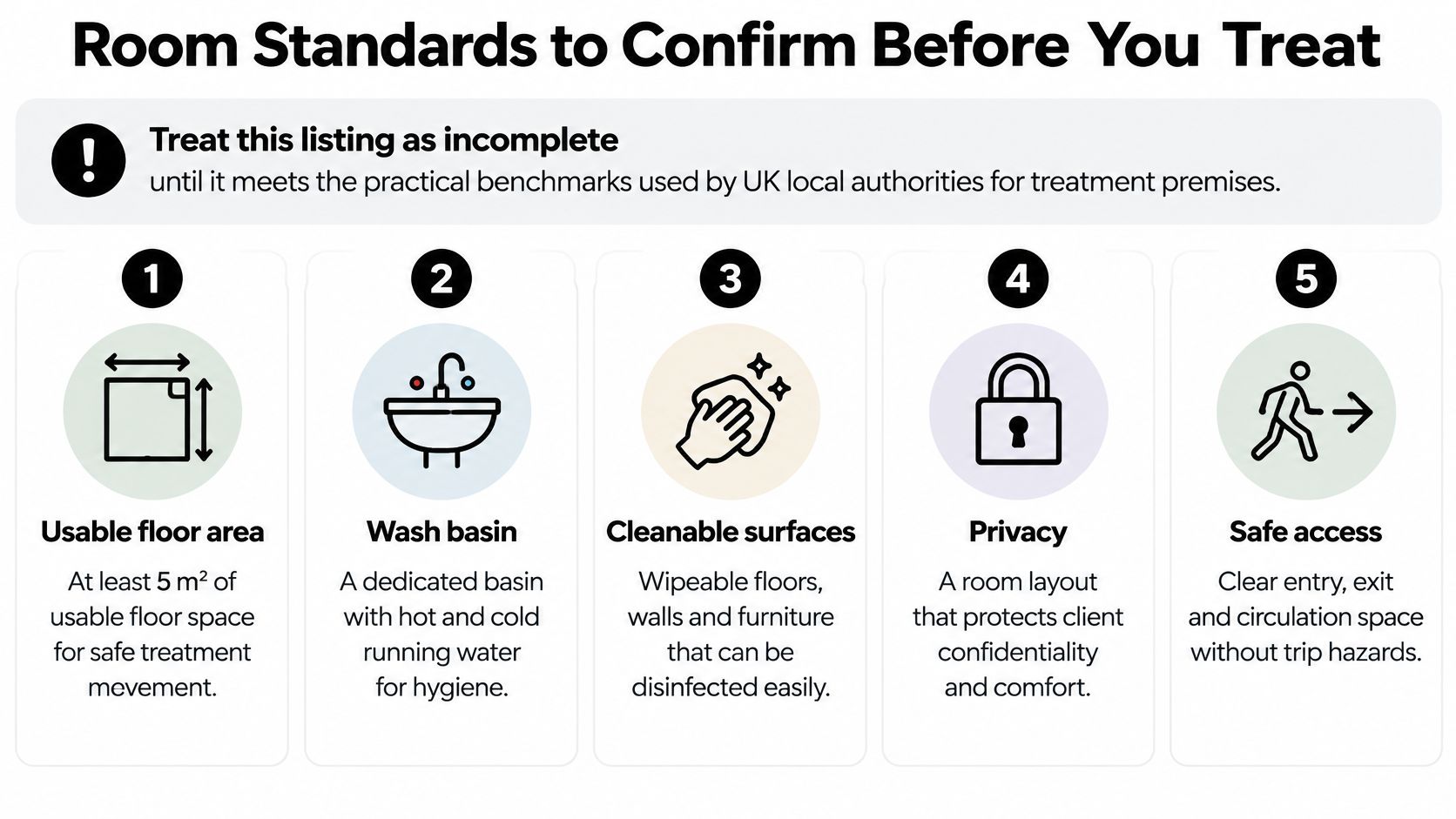
Check the working space in order
Begin with usable floor area. Ask for dimensions and a layout showing the couch, storage and door swing. A floor plan is more useful than a wide-angle photograph when you need to judge whether you can move around a client without squeezing past furniture.
Next, establish where you'll wash your hands. A bowl carried from a kitchen isn't equivalent to a plumbed hand-wash basin. Ask whether access remains available throughout appointments and whether you'd have to leave the treatment area or cross a busy salon.
Inspect the floor finish. Oils, wax and product spills need a surface that can be cleaned appropriately. A carpeted back room may look comfortable but create an avoidable cleaning problem for hands-on treatments.
Finally, ask how the room is heated and ventilated during use. A portable heater in a photograph doesn't explain how the room performs with the door closed.
Pass or fail checks before enquiring
| Check | Benchmark | What the listing states |
|---|---|---|
| Usable floor area | Meets the treatment-space benchmark described above | Room dimensions and usable layout |
| Hand-wash basin | Fully plumbed with hot and cold running water | Basin location |
| Flooring | Impervious and cleanable | Floor finish |
| Heating and ventilation | Adequate for the treatment | Ventilation method and service status |
| Room use | Dedicated or shared use clearly identified | Whether others use the room |
| Council conditions | Confirmed for the intended treatment | Position checked with Sheffield City Council |
Confirm the local position
Hosts should document dimensions, basin location, floor finish, ventilation method and shared-use arrangements before inviting someone to commit. Renters should then confirm the requirements relevant to their work with Sheffield City Council, particularly for massage, special treatments, aesthetics, IPL, laser or skin piercing.
Don't negotiate a better price around missing information. If the host can't establish the basin arrangement, floor finish or usable space, pause the enquiry until they can.
Ventilation That Makes a Room Usable
Under the model described in the Chartered Institute of Environmental Health salon guidance, one air change may remove about 63% of airborne contaminants, while five changes can leave less than 1% of the original contamination. Those figures explain why ventilation capability matters, but they don't establish a safe waiting time for an unidentified room.
An air change isn't the same as opening a window briefly. You need to understand how outdoor air enters, how air leaves and whether the system works while the room is occupied.
This distinction helps separate comfort from control of airborne droplets, vapours and dust.
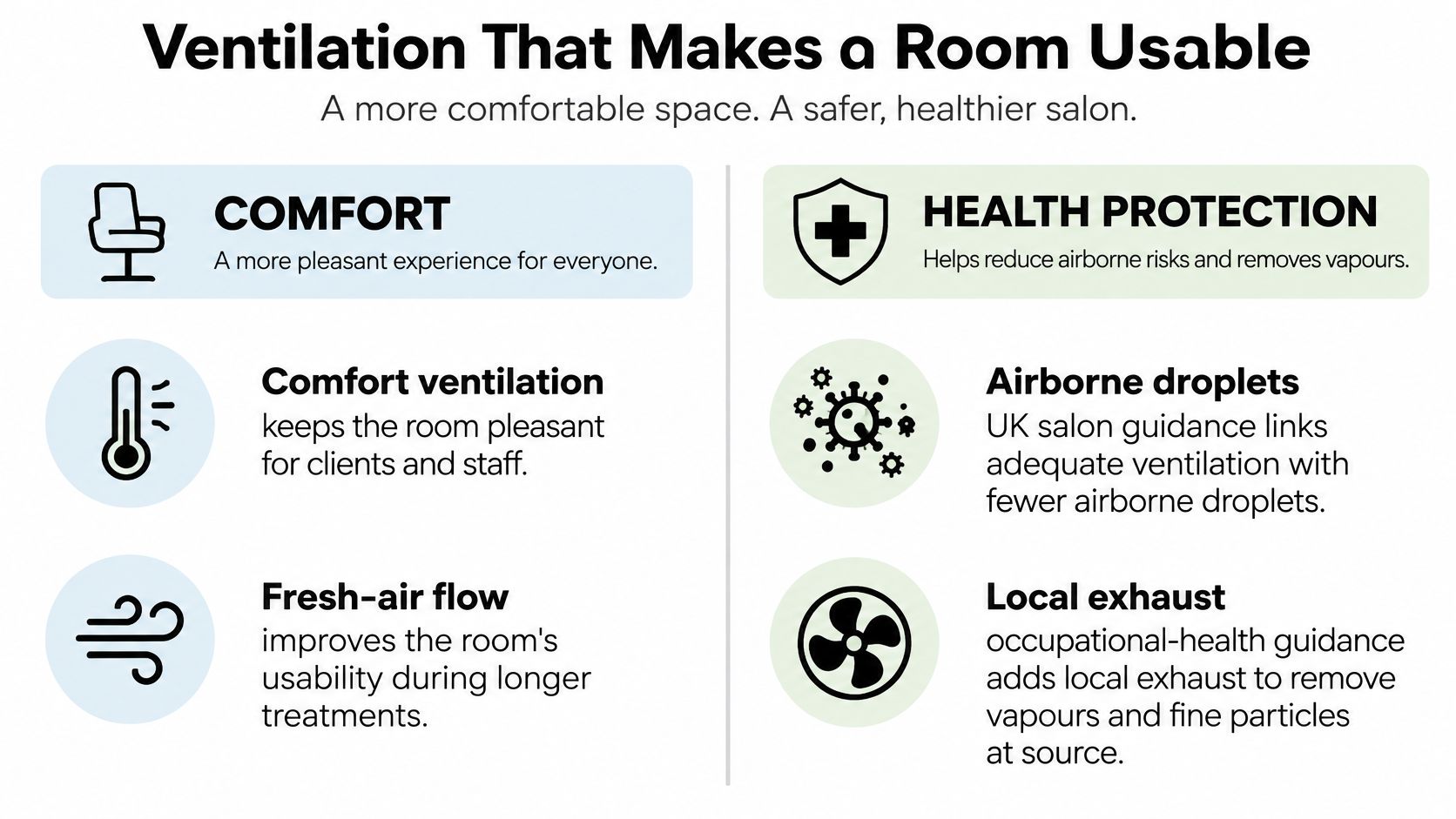
Ask about the system, not just fresh air
You don't need to perform a building survey. Ask the host for practical information they can explain or obtain from their maintenance contractor:
- Ventilation type: Is it natural, mechanical or a combination?
- Operating condition: Is the system in service, and is maintenance information available?
- Airflow route: Are inlets or outlets hidden behind curtains, shelves or furniture?
- System capability: Can the host provide the specification rather than guess an air-change rate?
For massage or facials, assess whether general ventilation remains effective with the door closed. Leaving the door open may undermine the privacy you're renting the room to provide.
Recognise when extraction is needed
Nail work introduces a different question: how are vapours and fine dust captured near the task? Where products generate these contaminants, ask for a suitable downdraught table or movable extraction hood, rather than accepting a window as the whole answer.
Some aesthetic activities also require treatment-specific controls. Check the equipment and product requirements instead of assuming that a room described as suitable for aesthetics covers every procedure.
Use this video alongside, rather than instead of, the host's explanation of the actual setup.
Put the ventilation type and any extraction requirement into your enquiry. That gives you a concrete way to distinguish similarly priced rooms.
Insurance and Licensing Before the First Client
A low rent isn't the lowest cost if you're uninsured or your treatment isn't permitted in that room. A friendly owner's assurance that the salon is covered doesn't establish that your independent business is covered too.
APEX Insurance Brokers' beauty and wellness guidance distinguishes treatment-related harm from premises-related injury and explains why self-employed renters usually need their own cover rather than relying on the host's policy. Ask your insurer to confirm public-liability and treatment-liability cover for your specific services and rented working arrangement.
Keep the commercial risk in view while checking the paperwork.
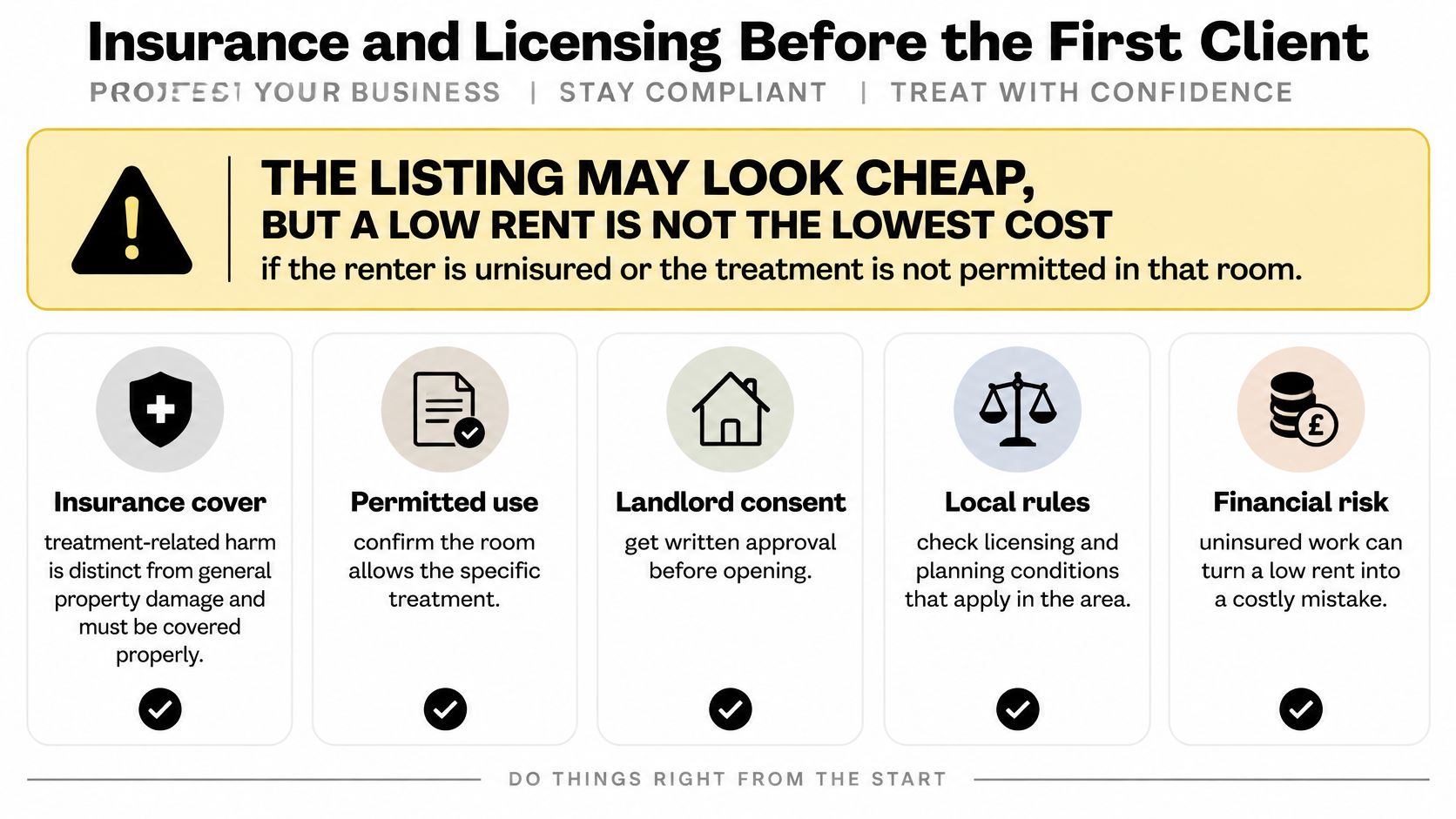
Allocate responsibilities in writing
A client slipping in a shared corridor raises different questions from a client experiencing harm during treatment. Responsibility depends on what happened, who controlled the relevant activity or area, and the applicable agreement and insurance. Don't assume either party automatically carries every claim.
Both parties should be ready to show appropriate certificates before agreeing dates. Check the insured name, activities, exclusions and premises arrangements, and ask the insurer about anything unclear. A certificate alone may not explain the policy's limits.
Before committing: Replace “the salon is insured” with written confirmation of what your policy covers and what remains the host's responsibility.
Your pre-enquiry checks should also establish:
- Permitted treatments: Written agreement covering the actual services you'll provide, with landlord consent where relevant.
- Waste arrangements: Who supplies containers and arranges appropriate collection, including clinical or sharps waste where generated.
- Client protection: Safeguarding arrangements, emergency contacts and a clear response if someone becomes unwell.
- Records and access: Secure storage for confidential material and control over who can enter the room.
Record the agreed handwashing and ventilation arrangements alongside these responsibilities. For a service-specific view of the rental setup, use our massage therapy room guide.
Treat aesthetics permissions as procedure-specific
The planned direction for aesthetics in England described in the insurance guidance would introduce local-authority licensing for practitioners and premises carrying out lower-risk procedures. Higher-risk procedures would be restricted to qualified healthcare professionals in premises registered with the Care Quality Commission.
That is a planned framework to verify, not a blanket statement that those arrangements are already in force. Establish the current position for the exact procedure before taking bookings, including whether practitioner qualifications and premises permissions are appropriate.
For massage and special treatments, confirm Sheffield City Council's applicable conditions rather than relying on another renter's arrangements. Skipping these checks can leave both practitioner and host facing uninsured claims, enforcement risk and reputational damage.
Matching the Room to the Client
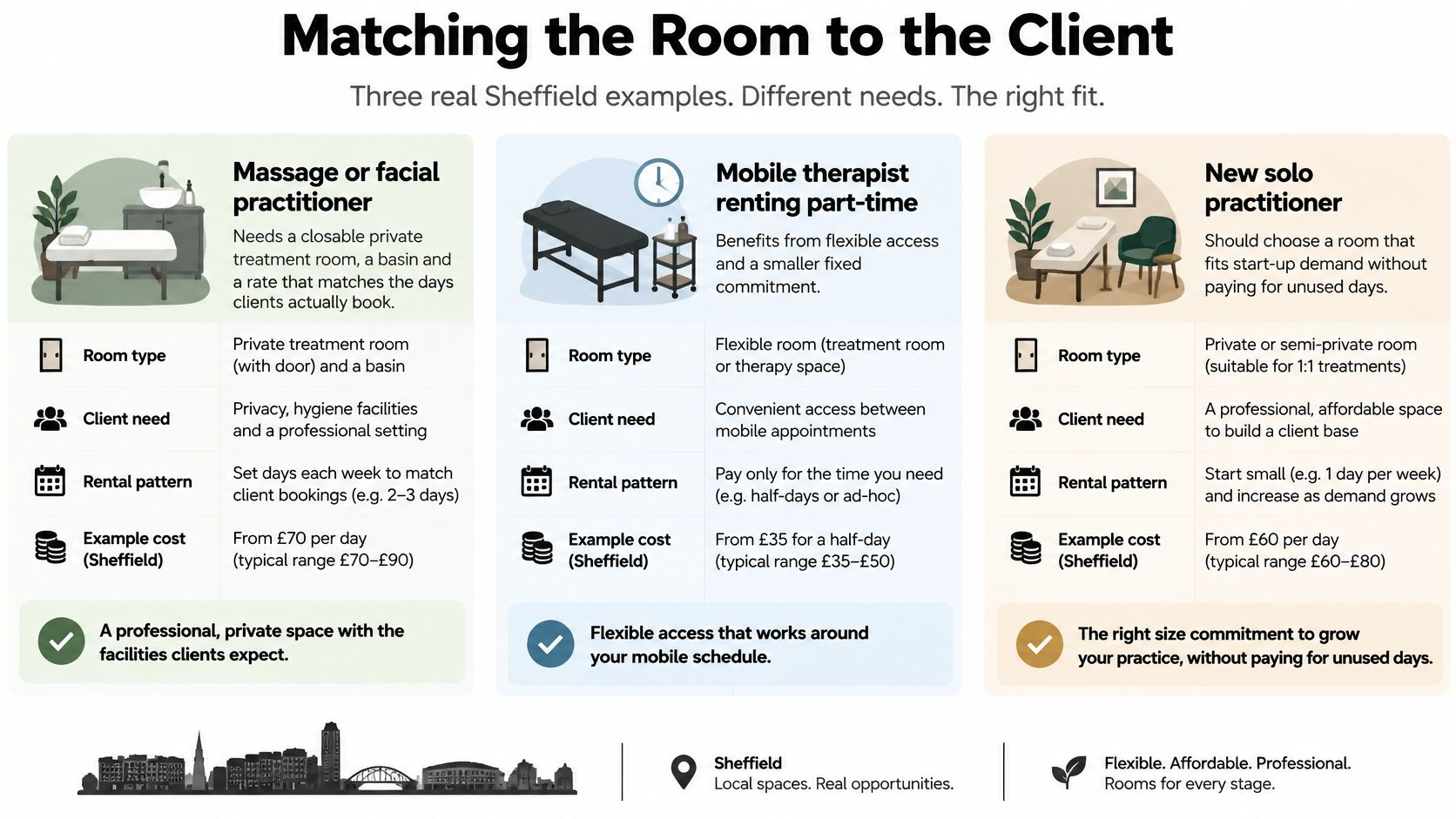
Consider a massage practitioner arranging a regular Sheffield clinic. The room needs to support treatment, changing and a calm arrival, but the rental pattern must also fit when clients book. Paying for permanent access won't solve a diary concentrated into occasional sessions.
A lash, brow or waxing practitioner has a different workflow. Check whether the photographed setup is what you'll receive, whether another renter's equipment must be moved and whether you can prepare clean materials without mixing them with used items.
For a counsellor or wellbeing practitioner, the decisive feature may be what can't be heard outside the room. A beautiful interior won't compensate for conversations reaching the waiting area.
The rental pattern should fit the practitioner as well as the treatment.
Test the client's whole visit
For counselling, visit while neighbouring spaces are occupied. With permission, ask someone to speak normally inside while you listen from the corridor. This isn't a formal acoustic assessment, but it can reveal an obvious privacy problem.
Check the journey from entrance to seat, including steps, doors, toilets and waiting arrangements. Evening availability only helps if clients can enter safely and the agreed facilities remain accessible after reception closes.
For trauma-informed work, consider how much control the client has over their surroundings. Explain the layout beforehand, avoid unnecessary interruptions and make the exit route clear. Proximity to GP or community services may be useful, but it doesn't establish a referral relationship.
Keep demand claims in proportion
The Sheffield Partnership annual report reports that Sheffield Talking Therapies treated 6,476 people over a 12-month period, while describing demand for mental-health and related services as likely to rise. This concerns NHS-funded services, not the size of Sheffield's private therapy market.
A private room doesn't clear an NHS waiting list or guarantee paying clients. The useful question is whether the space supports prompt, confidential and accessible appointments for the people your practice serves.
Similar rent doesn't make rooms interchangeable. A bright beauty room can be wrong for counselling, and a quiet office can be wrong for waxing.
Choose for the appointment the client will experience, not the category name attached to the advert.
Enquire and Act This Week
Search near your clients. Enter Sheffield or a Sheffield postcode into FindMy.beauty. We accept town and postcode searches, so you can start with the area your clients can realistically reach rather than browsing unrelated locations.
Keep the workable rental patterns. Retain rooms whose type and day, week or month rate fit your diary. If your work is occasional, our guide to renting a room by the day can help you assess a smaller commitment.
Send a focused enquiry. You can contact a host with your name and email address, without creating an account. Introduce your service, intended working pattern and preferred start date so the owner can assess suitability.
Ask only what remains unanswered. Request confirmation of availability and any unresolved details about dedicated or shared use, insurance, licensing, the basin, ventilation, access or waste. A targeted message is easier to answer than a generic request for more information.
Visit before your first client. Check the room in its normal working condition, then agree dates, payment in pounds sterling and house rules directly with the salon owner. Don't treat an encouraging reply as confirmation that every condition has been settled.
Understand what happens after sending
Your enquiry reaches the salon owner by email and in their account. The owner decides who suits their space and existing clients. We don't automatically assign you a room or make that decision on the owner's behalf.
Rent is agreed directly between you and the host, in pounds sterling. We don't set the rent or sit in the middle of the rental agreement, so keep a written record of the terms you both accept.
That record should identify the space, agreed access, payment arrangements, cancellation terms and responsibility for shared facilities. If the visit reveals a mismatch, ask for it to be resolved before you transfer money or direct clients to the address.
Make a manageable decision this week
Shortlist two suitable rooms and send both enquiries this week. Visit the option whose owner gives clear answers about the basin, cover and privacy, rather than choosing purely on who replies fastest.
Don't pay a month upfront for a room that failed the visit. A smaller, suitable commitment is more useful than a cheap arrangement you can't safely use.
FindMy.beauty connects beauty professionals with salons offering spare chairs, stations and rooms, with location-based search and direct enquiries to owners. Visit FindMy.beauty to compare Sheffield workspace options, then contact suitable hosts with your treatment, working days and outstanding room checks.