

You've got a client list that outgrew the spare room months ago. Maybe you're driving between clients with a couch in the boot, or renting three days a week somewhere that's forty minutes from the people who book you. Someone suggests King's Cross, because the trains are good and the offices are full of people who want their lashes done at 6pm on a Thursday.
Then you open the listings and every description is written for a design agency. Breakout areas, hot desks, natural light for collaboration. Nothing tells you whether the room has a sink, whether the door closes, or whether the landlord will let you wax a client's legs in it.
That gap is what this guide fills. Studios Kings Cross and the streets around the station hold real options for a self-employed therapist, but the useful questions are beauty-specific: plumbing, extraction, privacy, permitted use, and whether you can rent the room only for the days you work.
Table of Contents
- Studio Types You Can Rent Near King's Cross
- Matching a Space to Your Treatment
- Is King's Cross Right for Appointment-Based Work
- Rental Terms to Confirm Before You Agree
- How to Check Availability Step by Step
- Enquire About a Space Before You Commit
Studio Types You Can Rent Near King's Cross
Spaces within walking distance of the station fall into six shapes, and the shape decides more about your working day than the postcode does. Whole studios hand you a room, a lock and nobody else's clients in the corridor. Private treatment rooms do the same job on a smaller scale, usually with a couch already in place for facials, massage and aesthetics. Beauty rooms are fitted for lashes, brows, waxing and makeup, with a client chair and a work surface instead of a bed.
The other three sit on shared floors. A styling chair gives a hairdresser or colourist one salon station inside a working shop. A nail station gives a technician a desk and a lamp, and very little else. A barber chair puts you at a station where hygiene routines and the waiting area belong to the shop, not to you.
Space types near King's Cross and who they suit
| Space type | Best for | What you typically get | Main limit |
|---|---|---|---|
| Whole studio | Renters who need a space to themselves | Entire room for their own bookings | Higher commitment and more to maintain |
| Private treatment room | Facials, massage and aesthetics | Closed door and couch space | Water and ventilation may be limited |
| Beauty room | Lashes, brows, waxing and makeup | Client chair and a work surface | Confirm which treatments are permitted |
| Styling chair | Hairdressers and colourists | One salon station | Shared floor and client flow |
| Nail station | Dedicated nail work | Desk and lamp space | Little room for storage or privacy |
| Barber chair | Barbers and barber-style cuts | Chair at a barber station | Shared hygiene and waiting area |
What the Unit Sizes Tell You
Size benchmarks in this area are worth knowing, because they show the range a single operator is competing for. The King's Cross workspace completed by Squire & Partners provides 7,344 m² of gross internal workspace for small and medium-sized creative businesses, in individual units from 150 to 680 m², at a reported construction cost of £22 million, or roughly £2,999 per m², according to the Architects' Journal report on the workspace.
Read that range as a map rather than a warning. A compact specialist room sits at the small end. A multi-station studio shared by two or three renters sits at the large end. The same report records openable windows on every floor for cross-ventilation, plus cycle storage, showers, lockers, a reception café and breakout areas. For work involving adhesive, wax or colour, a window that opens changes what the room can legally and practically be used for.
If you work alone, shortlist the private treatment room or the whole studio first. Both give you a door, and a door is what turns a room into a treatment space. Our beauty salons to rent listings show which of these six shapes hosts advertise by day, week and month, so you can compare like with like before ringing anyone.
Matching a Space to Your Treatment
A room that photographs beautifully can still be the wrong room for your treatment list. Work out what the service physically demands before you look at a single rate.

Renters in this market typically run the entire business themselves. 58% of UK hair-and-beauty workers were self-employed in 2024, and 96% of registered UK hairdressing, barbering and beauty businesses employed fewer than 10 people in September 2025, according to ICAEW's hairdressing and beauty industry profile. One practitioner, one treatment at a time, one room. That's the model the space has to serve.
Room requirements by treatment
| Treatment | Water and sink | Ventilation | Privacy | Lighting |
|---|---|---|---|---|
| Lash extensions | Hand wash point | Good airflow for adhesive | Private room preferred | Daylight helps placement |
| Brows and makeup | Hand wash point | Standard ventilation | Mirror and seating | Daylight or task lighting |
| Waxing | Hand wash point and bin | Strong ventilation | Private room | Task lighting |
| Facials and massage | Hand wash point, sometimes a sink | Standard ventilation | Closed door essential | Soft, adjustable lighting |
| Hair colour | Basin for rinsing | Strong ventilation for chemicals | Open station can work | Daylight helps shade matching |
| Nails | Hand wash point | Extraction for dust and fumes | Limited desk privacy | Task lighting |
Permitted Use Comes First
The most expensive mistake in this market is assuming a well-designed creative studio can host clinical or wet work. Permission is a separate question from suitability. A room can have the couch, the light and the location and still be closed to waxing, massage, aesthetics or hair colour, because the permitted use, the plumbing, the extraction or the landlord's rules don't allow it.
Non-negotiable: if a space fails one requirement for your treatment, walk away. Changing your service to fit a room is how good practitioners end up offering a worse version of what they're known for.
The Four Checks That Decide a Fit
Water, ventilation, privacy and lighting are the four lines that decide a fit, and each one gets tested physically rather than from a photograph. Turn the hot tap on and let it run: you need warm water reaching a basin within seconds, not a cold trickle in a shared WC down the hall. Open every window and locate the extractor, because adhesive, wax fumes and nail dust all need somewhere to go.
Stand where your client would sit or lie and see who can see them, including through any glass panel in the door. Then check where light falls at the hours you'll work, and whether there's a socket and surfaces for a task lamp and a magnifying lamp. Before you visit, ask the host two things in writing: which treatments are permitted in the room, and what changes to the room they allow, from a folding couch to a bin, a trolley or a nail extractor.
Is King's Cross Right for Appointment-Based Work
A location only matters if it changes who can book you and when. The estate around the station carries roughly 4.25 million sq ft of office space and about 30,000 workers, and independent London office-market analysis rates Euston and King's Cross as having the strongest digital-connectivity rating in Central London, according to Ramboll's King's Cross project overview. In practice that means a large weekday population, clients who can book and pay online without friction, and a walkable mix of offices, homes, shops and squares.
Residential demand has grown alongside the desks. Studios Kings Cross sits inside a 67-acre former railway and goods-yard site where redevelopment began in 2008. By 2020, around 12,200 residents lived on or around the site, against approximately 7,900 a decade earlier, an increase of about 54%, according to the Centre for Cities analysis of King's Cross regeneration. Office workers can book before work, at lunch or after work. Residents can book evenings and weekends.
Say a lash technician works Tuesdays and Thursdays only. Her regulars come from two nearby offices and three residential blocks within a ten-minute walk, and the days hold because the geography holds. The same people pass the same door on the same commute every week.
Strong transport and a full office estate are reasons to test an area, not proof it will work. Footfall outside a station isn't footfall at your door, and a busy postcode doesn't guarantee a rent your diary can carry.
Answer three questions before you open any listing:
- Who are my clients, and when can they travel to me? If they're office workers, your days are Tuesday to Thursday. If they're local residents, evenings and Saturdays carry the diary.
- How many days a week do I need the room? Two days in a space you're paying for five is the most common way to lose money on a rental.
- What can I afford if the rate rises at renewal? Set a ceiling now, so a price rise doesn't force you into a worse room or an unfinished notice period.
Rental Terms to Confirm Before You Agree
The rate on a listing is the start of the arithmetic, not the answer. Three booking patterns cover almost every self-employed arrangement, and each one asks something different of a host.
Booking patterns and what to confirm
| Booking pattern | Suits | Confirm before agreeing |
|---|---|---|
| Day rental | One-off treatment day or testing a local client base | Cancellation terms, access hours and cleaning |
| Weekly rental | Regular days each week | Deposit, utilities and who pays for repairs |
| Monthly rental | Steady, ongoing practice | Business rates, insurance and notice period |
The Costs Beyond the Rent
Deposits, utilities, business rates, insurance, cleaning and access hours are the six lines that turn a headline rate into a real cost, and they're the six most often left out of a listing. Ask each one directly, in writing, before money moves.
- Deposit: how much, whether it's refundable, and what condition the room must be in to get it back.
- Utilities: whether power, water and heating are inside the rent or billed separately, and how usage is measured.
- Business rates: who is liable, and whether your occupation pushes the property into a higher band.
- Insurance: whether the host's policy covers your treatments or you need your own public liability cover.
- Cleaning: what's expected between clients, who supplies products, and whether a cleaner's schedule restricts your hours.
- Access hours: the times the room is open, and what happens if a client runs late past closing.
Then cover the terms that aren't costs at all. Cancellation windows, notice periods, who pays for repairs and how payment is handled decide whether a rental is flexible or unexpectedly expensive. Above all, ask whether the host permits independent client bookings, because a room that only accepts the host's own walk-ins isn't a room you can build on. If you're moving from a chair to a room, the salon chair rental contract guide sets out the clauses to read before you sign.
Before you pay: a day rate that looks cheap costs more than a weekly rate the moment you add cleaning, utilities and a notice period you never use.
Demand for this kind of space is broad. The National Hair and Beauty Federation's 2025 industry statistics put the sector at 50,400 VAT- or PAYE-registered businesses in September 2025, of which 40,740 employed fewer than five people, and it records growth in self-employed, chair-renting and hybrid working. Those are precisely the renters who need a day or weekly arrangement instead of a lease.
So treat the first figure a host quotes as an opening position. Request five things in writing before any payment: the dates and hours you're booking, the rate basis and what it includes, the deposit and refund conditions, the treatments you're cleared to deliver, and the notice period on both sides.
How to Check Availability Step by Step
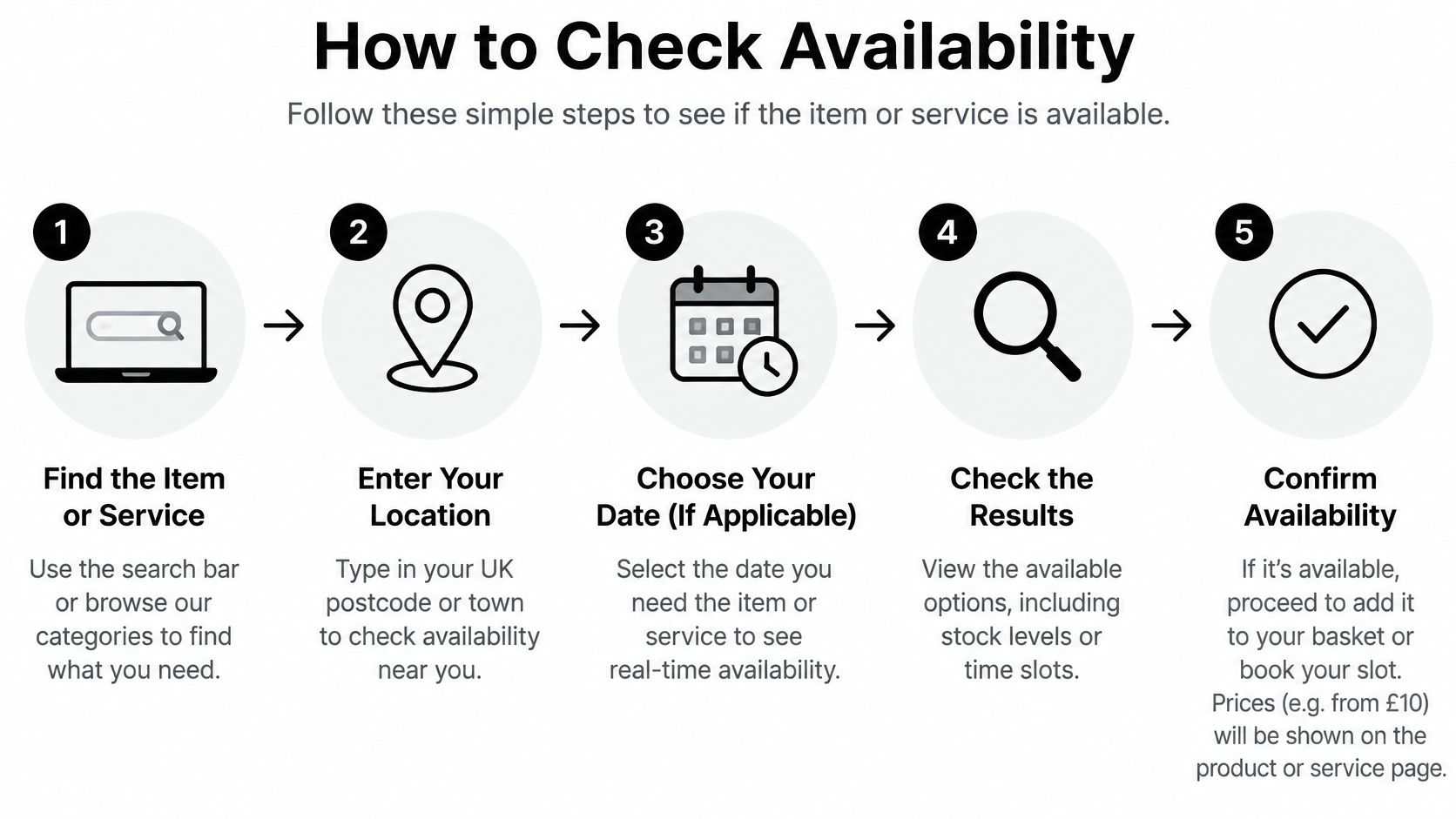
Start with the diary rather than the decor. A treatment room that suits your service but is occupied on your only working day is unavailable in the only sense that matters.
- Search by town or postcode. Enter the area around King's Cross that your clients can reach. Keep the shortlist tight enough that you can contact and visit every credible option.
- Match the space to your diary. Ask which days and access hours are free, including early starts, evenings and weekends. Occasional work needs a room available on your specific dates, not one listed for rent.
- Run the rate maths. Compare day, week and month rates against the number of sessions you can realistically book. If you work irregularly, this guide to renting a room by the day explains what to weigh before choosing that basis.
- Send a specific enquiry. Provide your name, email address, required dates and access hours. A precise question gives the host something concrete to answer.
- Ask both permission questions. Confirm that independent client bookings are allowed and that your treatments are permitted in the room. Keep the replies with the listing rather than relying on memory.
- Visit before you pay. Turn on the taps, test ventilation, check privacy, storage and client waiting space. A waxing or aesthetics booking exposes problems that a photograph will not.
- Confirm the arrangement directly with the host. Agree payment, deposit, cancellation terms and notice in writing before the first session. Corridor assurances are difficult to enforce if another renter wants the space.
What a Confirmed Booking Looks Like
A booking is confirmed when you hold six details in writing: dates, access hours, the rate basis, the deposit paid, the treatments you can deliver, and the name of the person who confirmed them. Anything missing is a gap you may have to resolve on your first morning, with a client waiting and the couch half-unfolded.
Enquire About a Space Before You Commit
Turn the guide into a plan for this week. Write down three things first: the treatment you're delivering, the days you need, and the room features you won't compromise on. That list comes straight from the requirements table, and it stops you being talked into a lovely room that can't take wax.
Then search. FindMy.beauty lists salon chairs, beauty rooms, treatment rooms, nail stations, barber chairs and salon studios to rent, and you can search by entering a town or postcode to see what's within reach of King's Cross. Shortlist three spaces that fit your requirements rather than three you like the look of.
Send each host an enquiry with your name and email address, asking about dates, access hours, permitted treatments and independent client bookings. Rent, dates and payment are agreed directly between you and each host, in pounds sterling, so ask every one of them to confirm the terms in writing before you commit.
Keep a short note per shortlisted space covering the rate basis, water supply, ventilation, privacy and how quickly the host replied. That keeps the comparison objective on the day you visit, when the nicest room tends to look like the right one. Book a viewing at the best fit, run the terms checklist, and only then sign or pay.
FindMy.beauty lists beauty rooms, styling chairs, nail stations, barber chairs and whole studios to rent across the UK, with day, week and month rates shown on each listing so you can compare a Tuesday-only booking against a full week before you message anyone. Search by town or postcode, shortlist three spaces near King's Cross, and send your enquiry straight to the host, who agrees the dates, rent and terms with you directly. Start at FindMy.beauty and put one viewing in the diary this week.