


You've got a full Saturday book and nowhere of your own to cut it. The salon you trained in wants you on the payroll, yet a chair by the window sits empty midweek, and the owner would rather see it earn than stay cold. That spare station is the whole market in miniature. The National Hair & Beauty Federation recorded more than 63,800 hair-and-beauty businesses in 2023–24, up nearly 1,900, or 3.1%, on the year before, with turnover of about £5.8 billion. Nearly 64% turned over less than £99,000, more than 80% employed fewer than five people, and 95% employed fewer than ten. Most hosts are small shops with one empty chair, not chains with a recruitment desk.
Table of Contents
- What Renting a Salon Chair Really Involves
- Chair Rent Models Compared at a Glance
- Turning Quotes into Like-for-Like Rates
- The Hidden Costs Behind the Headline Rent
- How to Find and Vet a Host Salon
- Premises and Health Checks Before You Sign
- Confirm the Terms Before You Sign
What Renting a Salon Chair Really Involves
A self-employed colourist with a loyal book and no premises of her own pays a fixed amount to work from a station in someone else's salon. She keeps her clients and sets her prices. The salon supplies the space, the sinks and the waiting room. The arrangement works like a freelancer renting a desk in a shared office: you pay for a defined place and a defined stretch of time, not the whole building.
In chair hair salons that deal comes in a few plain forms. Styling chairs are chairs at a salon station for stylists and colourists. Barber chairs are chairs in a barbershop for barbers building their own book. Beauty rooms suit lashes, brows, waxing and makeup, where a door matters more than a mirror and a trolley.
Chair rental is a mainstream route into self-employment. The ICAEW industry profile for hairdressing and beauty treatment puts 232,700 people in UK hair and beauty salons in 2024: roughly 145,200 self-employed, about 62% of the sector, against 86,800 employees, about 37%. Other sector data tracks the same direction, with self-employment climbing steadily over the past two decades and industry bodies agreeing that independents now make up most of the workforce.

Before you chase a rate, answer three questions.
- Station or room: Do you need a fixed chair on the floor, or a private room with a door?
- Real days: How many days a week will you work, not the days you hope for once the book fills?
- Whose clients: Do you want to hold your own list, or do you want the salon to fill the diary and set the prices?
If you want your own list and your own prices, a rented chair matches that pattern. If you want the salon to carry quiet weeks, employment is the cleaner fit.
Whatever a salon quotes you, convert it to one monthly figure before you compare it with anything else. Then run three checks before you sign: whether VAT sits on top of the rent, whether the premises suit your treatments, and whether the agreement treats you as self-employed. A cheap day rate can hide a dead month, and a contract that works like employment in everything but name can leave you with the wrong tax treatment.
Chair Rent Models Compared at a Glance
A headline figure is a price for a pattern of use. Name the model before you argue about the amount, or you'll compare a weekend shift with a full-time commitment and call it a bargain.
| Rental model | How it is billed | Best suited to | What to check |
|---|---|---|---|
| Day rate | Per working day | Freelancers covering a few clients or busy weekends | Whether reception, laundry and products are included |
| Weekly rate | Per week, often for set days | Stylists with a regular part-time book | Whether the days are fixed or can move |
| Monthly fixed chair | Flat fee per calendar month | Full-time self-employed stylists with a stable client base | Notice period and what happens in quiet months |
| Commission or revenue share | Percentage of your takings | Newcomers who cannot yet commit to fixed fees | Which services count and who handles card fees |
| Room or booth rental | Per room, per day or per month | Lash, brow, massage and aesthetics practitioners | Shared cleaning, storage and room access |
Day rates suit a freelancer covering a wedding party or a packed Saturday. They rarely lock you in, which is useful while the book is still lumpy. You pay only for the days you stand there, so a cancelled Saturday costs you the clients, not a month of rent.
Weekly rates suit a part-time book with the same two or three days every week. Ask whether those days are nailed down or can slide when a client can only come on Thursday. A "flexible" week that isn't written down becomes the owner's busiest days, not yours.
A monthly fixed chair suits a full-time self-employed stylist whose diary already covers the fee in a normal month. You get a home base and, usually, a notice period. The cost of that certainty is a quiet January that still wants the full fee.
Commission, or a revenue share, suits someone who cannot yet promise a fixed sum. You hand over a percentage of takings, so the bill grows when the book is strong and shrinks when it isn't. Pin down which services count, and who pays the card fee, before you agree a split that looks kind on paper.
Room or booth rental is the usual shape for lash, brow, massage and aesthetics work. The arguments are less about the chair and more about who cleans, where stock is locked, and whether you can get in when the floor is shut. If you need a private treatment room rather than a station on the floor, look at beauty salons to rent the same way you would a chair, by days and by what the fee covers.
Practical rule: Fixed fees give you certainty and cost you when clients dry up. Commission gives you flexibility and costs you more when you're busy.
Read any quote by naming the model first, then the figure. A cheap day rate taken five days a week is a monthly commitment wearing a different label.
Turning Quotes into Like-for-Like Rates
A quote of £40 a day and a quote of £600 a month look like different conversations until both sit on one monthly line. Until you do that conversion, the lower number wins for the wrong reason.
Use the days you will realistically work, not the days you hope to fill. Convert a weekly rate with about 4.3 weeks in a month. Take a monthly fee as quoted, then add extras you know you'll buy. Work commission off forecast takings, not off a dream month.
| Quote | Monthly figure | How it is converted |
|---|---|---|
| Day rate: £40 a day for 12 working days | £480 | Day rate times realistic days, not a full diary |
| Weekly rate: £140 a week | £602 | Weekly fee times about 4.3 weeks |
| Monthly chair £600, plus £40 of products you supply | £640 | Quoted fee plus extras you already know about |
| 40% commission on £2,000 of takings | £800 | Your percentage times a cautious forecast |
Say you're choosing among those three live options, and treat the commission line as the fourth check rather than a fourth salon. Twelve real days at £40 comes to £480. The £140 week lands near £602. The £600 chair plus £40 of colour product you still have to buy is £640. If a host instead wants 40% of £2,000 in takings, that month costs £800, even though no rent figure was ever advertised. The cheapest number on the advert is the day rate. Once a normal book is counted, commission is the dearest of the four.
These figures are illustrative. Swap in your own days, your own weekly fee and your own takings before you treat any total as a decision.
Habits that stop a false bargain
- Write the next three months: Note the working days you expect in each, including holidays and the week you always lose to half-term.
- Stress-test a quiet month: Recalculate every quote on your thinnest realistic diary, not your best Saturday run.
- Compare the lowest realistic figure: Rank salons on that stressed total, then decide whether the dearer room is worth the sinks, the light or the postcode.
A model only wins after it survives the quiet month. If it only looks good when every hour is booked, it isn't a rate you can live on.
The Hidden Costs Behind the Headline Rent
The advertised chair price is the visible part of the bill. Everything that makes the chair usable can sit beside it, inside it, or on a separate invoice you only see after you've moved your kit in.
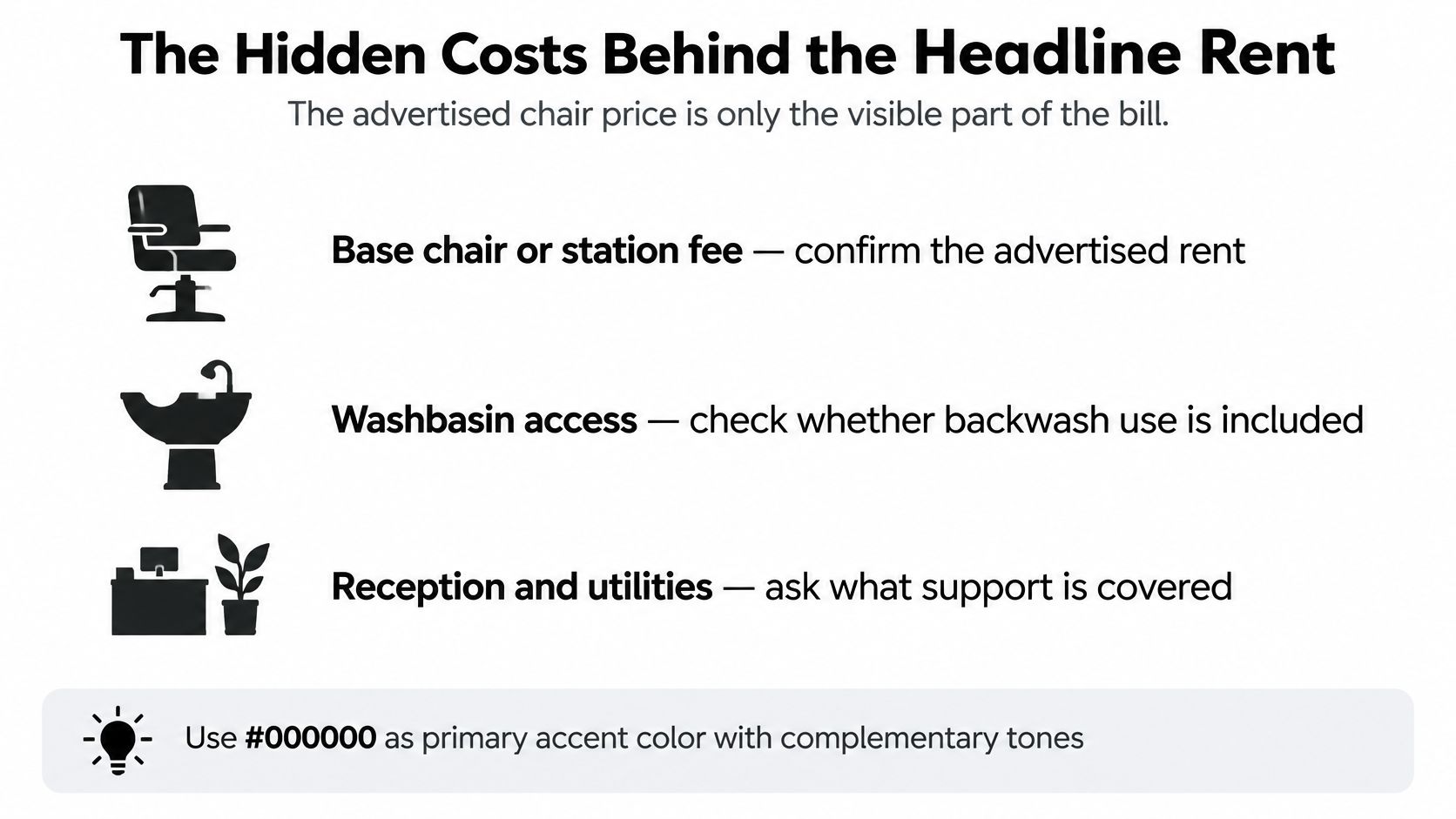
Before two salons go into the same monthly column, pin down every line that can move the total.
- Base chair or station fee: The advertised rent, and whether it is per day, per week or per month.
- Washbasin access: Whether backwash use is in the fee or charged per client.
- Reception and waiting: Who books, who greets, and whether you may use the front desk.
- Laundry and towels: Included, capped, or your own bag every morning.
- Utilities and heating: Especially if you rent a room that runs its own heater.
- Cleaning of shared areas: Floors, mirrors, bins, and who pays if it slips.
- Consumables: Gloves, foils, capes and cotton, which add up on colour days.
- Card or booking fees: A percentage skimmed off every payment.
- Parking: A daily bay charge that often matches a cheap day rate.
- VAT: Whether the quote is net, and which extras attract it.
VAT is the quiet line that changes cash. A bare station can be treated differently from a chair bundled with basin access, reception, laundry or utilities, and the boundary depends on how the arrangement is put together. HMRC's land and property guidance is the reference point for that boundary, not a substitute for the host's own position. Ask whether the quote is net or gross, which extras attract VAT, and get the answer in writing; if the host is unsure, an accountant should confirm before you sign.
A £500 quote that isn't cheaper
Take a £500 monthly quote. If VAT at 20% is added on top because reception, basins and other services are bundled into the deal, the bill becomes £600. A £550 chair that is only the station can cost less in cash even though the advert looked dearer, provided the host confirms no extra service charges sit outside it. I would not rank either figure until the host has said, in writing, what is included and whether VAT is on top.
Ask for every included service and the VAT position in writing before you compare totals. If the host can't explain it, an accountant can, and that hour is cheaper than a year on the wrong fee.
The lowest advertised rent can still be the priciest month. Value sits in what the salon supplies, and in whether those extras are taxed, capped or billed on the side.
How to Find and Vet a Host Salon
Price is the last filter, not the first. A clear brief stops you touring rooms that cannot hold your work.
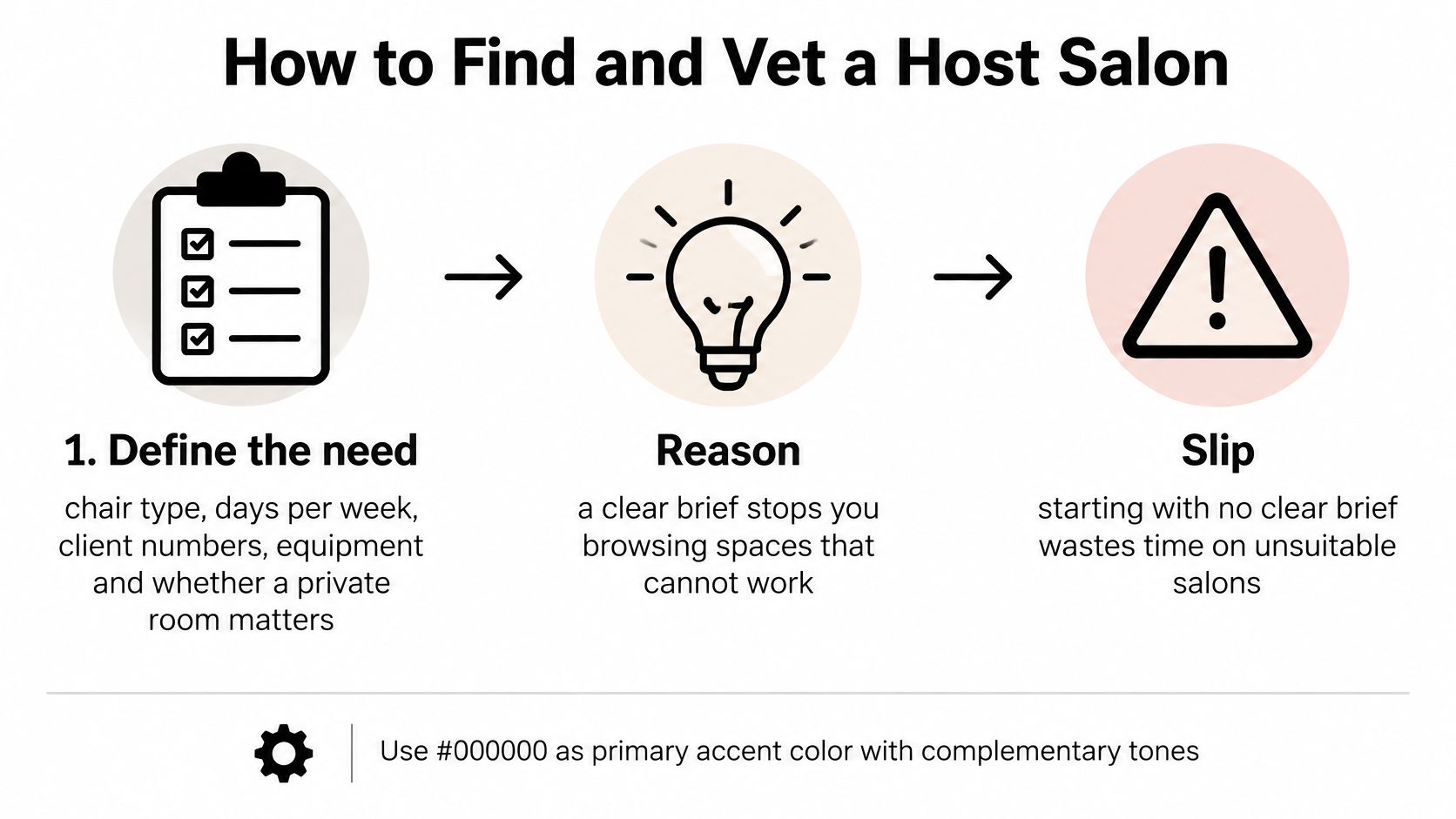
Seven steps, and the slip at each one
1. Define the need. Write chair type, days per week, client numbers, the kit you must plug in, and whether a private room matters. A colourist who needs a backwash and a barber who needs a lineup chair are not shopping for the same thing. Slip: starting with price alone, then discovering the cheap chair has no basin you can use.
2. Search by town or postcode. On FindMy.beauty we list styling chairs, barber chairs, beauty rooms, nail stations, treatment rooms and studios, with day, week or month rates on the listing, so you can compare before you travel. Search the postcodes your clients already use. Slip: searching only one town when your book is spread across two.
3. Shortlist three to five. Keep them inside a journey your regulars will still make, and note the bus, train or parking, not just the drive you'd do once. Slip: falling for a smart room your Tuesday clients won't cross town for.
4. Read the listing properly. Photos, the rate period, stated availability, and whether the space matches your specialism. A nail desk photographed as a "styling chair" wastes a visit. Slip: trusting a rate line that never says what it covers. That check belongs with the cost questions, not with a hunch.
5. Enquire in your own words. Browsing spaces and messaging hosts is free, and you deal with the salon directly. Use the Message host button. It sends the enquiry straight to the salon, and you only need your name and contact details. Every enquiry goes to the owner, who decides who suits their space and clients. Say what you do, which days, and how established the book is. Slip: one vague note copied to a dozen hosts. Owners can tell, and they don't reply.
6. Ask the money and premises questions out loud. What is included, what the notice period is, who cleans, who insures the public areas, and when the chair is free. Don't rebuild the whole checklist here. Use the cost list and the room checks, and get the answers on email. Slip: accepting "yeah, that's all in" at the basin and having nothing to point at later.
7. Visit when the floor is busy. You want sinks in use, client flow, noise, and whether there's a shelf that isn't already full. A quiet Tuesday morning flatters every salon. Slip: signing off a corner you only saw empty.
A good fit is a host who answers specific questions in writing and shows you the actual station, not a similar one "down the other end".
If they won't put the fee, the days and the cleaning split in an email, you don't have an offer yet. You have a conversation.
Premises and Health Checks Before You Sign
Judge the room, not only the rate. A cheap chair beside a basin you can't safely use is not a saving.
HSE guidance on hairdressing identifies frequent water and shampoo exposure as a dermatitis risk. Persulphates, henna dust and some sprays can trigger or worsen asthma. The controls HSE points to are ordinary and specific: good ventilation, non-latex disposable gloves for shampooing, colouring and bleaching, thorough hand drying, moisturising, and a fresh pair of gloves between clients. If the host shrugs at gloves and extraction, the rate is beside the point.
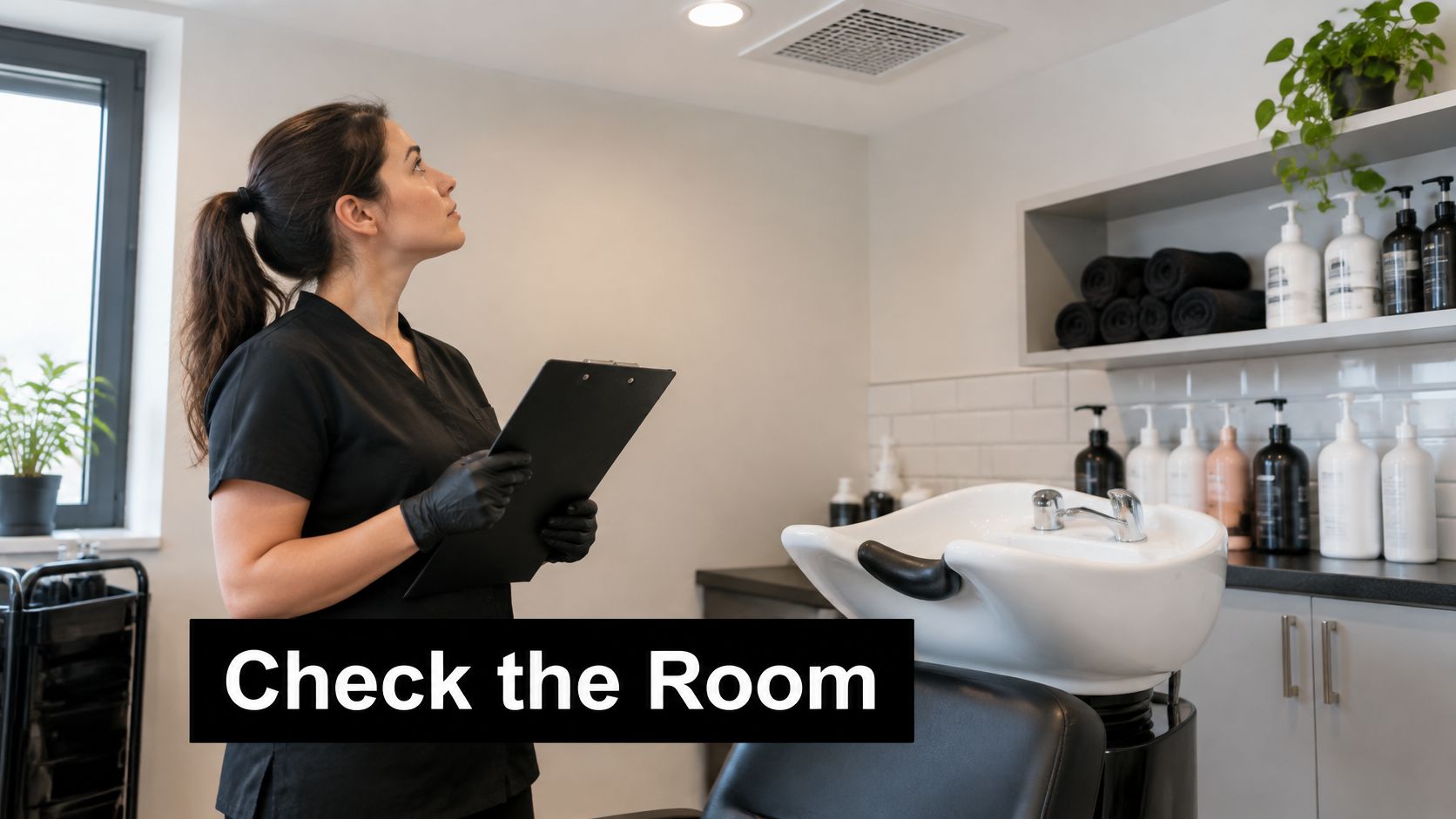
What to look at on the visit
Walk the station the way you'd work a colour day. Hot water at the basin you would use. Ventilation where colour, bleach or solvents sit, including an extractor if fumes can build up in a corner. A cupboard for dyes and developers that isn't the same shelf as the coffee mugs. A bin route for foils, gloves and used product, not a carrier bag behind the towel pile. A place for your own gloves and disposables so you're not borrowing a box that runs out at 11.
Where several independents share a floor, the host should hold a COSHH assessment covering dyes, bleaches, perming products and cleaning chemicals, say who is exposed, and say who trains people and who deals with an incident. Local authority guidance also notes that extractor fans may be needed where solvents or chemicals could accumulate. Ask where the fan is, not whether "the room feels airy".
- Latest COSHH assessment: Ask to see it, and check it names the products in use now, not a generic salon sheet from years ago.
- Shared sinks: Ask who cleans them and how often during a busy Saturday, not just at close.
- Extractor fan: Ask whether the room has one, where it extracts, and whether it runs while colour is on.
- Public liability: Ask who holds it for the premises, and what you are expected to hold for your own work.
Say a colourist is offered a room shared with a barber who mixes strong bleach in a poorly ventilated corner. One question about extraction, asked while both of you are standing there, shows the risk before any deposit changes hands. The same logic applies if you're weighing rooms to rent in Preston or any other town. The postcode doesn't change the basin, the fan or the cupboard.
Vague answers are a warning, not a detail to tidy up later. "We all just muck in" is not a cleaning rota, and it is not a COSHH assessment.
Confirm the Terms Before You Sign
Paying rent for a chair does not, by itself, make you self-employed. HMRC's hair and beauty status guidance says status follows the whole working arrangement. Who sets prices and hours. Who supplies equipment and products. Whether you find your own clients. Whether you carry real financial risk, including a quiet month you still fund. The government gives paying a salon owner for use of a chair as an example of self-employment, not as an automatic rule. If the owner sets your prices, fills your column and tells you which days to attend, a rent payment doesn't rewrite that.
Anyone working independently has to register for Self Assessment, report the income and pay tax and National Insurance on profits. That duty sits with you even when the salon feels like an employer from the pavement. Employment-law status and tax status are related, and they are not the same conversation. Get both clear before you rely on the rent payment to do the legal work.
You've already built the monthly figure, the VAT position, and the room checks. Fold those into the written terms, and add the points that decide status and risk. Who finds the clients. Who owns the book if you leave. What happens on a cancellation. Who carries a thin month. A salon chair rental contract is where those answers belong, not in a handshake at the desk.
Aisha R., a freelance colourist in Birmingham, found a chair for Saturday colour clients because day rates were shown on every listing, and she sorted it in an afternoon without signing up. That only works when the listing is honest and the follow-up email matches it.
Do these three things, then stop shopping.
- Rebuild one cost sheet with a single monthly figure and the VAT position written on it.
- Shortlist two or three chairs that match your working days and survive the premises questions.
- Send the enquiries and ask for the terms in writing before you pay a deposit.
Check the tax position with an accountant, or against HMRC's own guidance, before you sign. I would not treat a host's reassurance as the ruling.
FindMy.beauty lists salon chairs, beauty rooms, treatment rooms, nail stations, barber chairs and studios, with day, week or month rates you can compare before you enquire. You message the salon directly, and the owner decides who suits the space. When you're ready to put a real quote on one monthly line, start with the chairs near your clients on FindMy.beauty.