

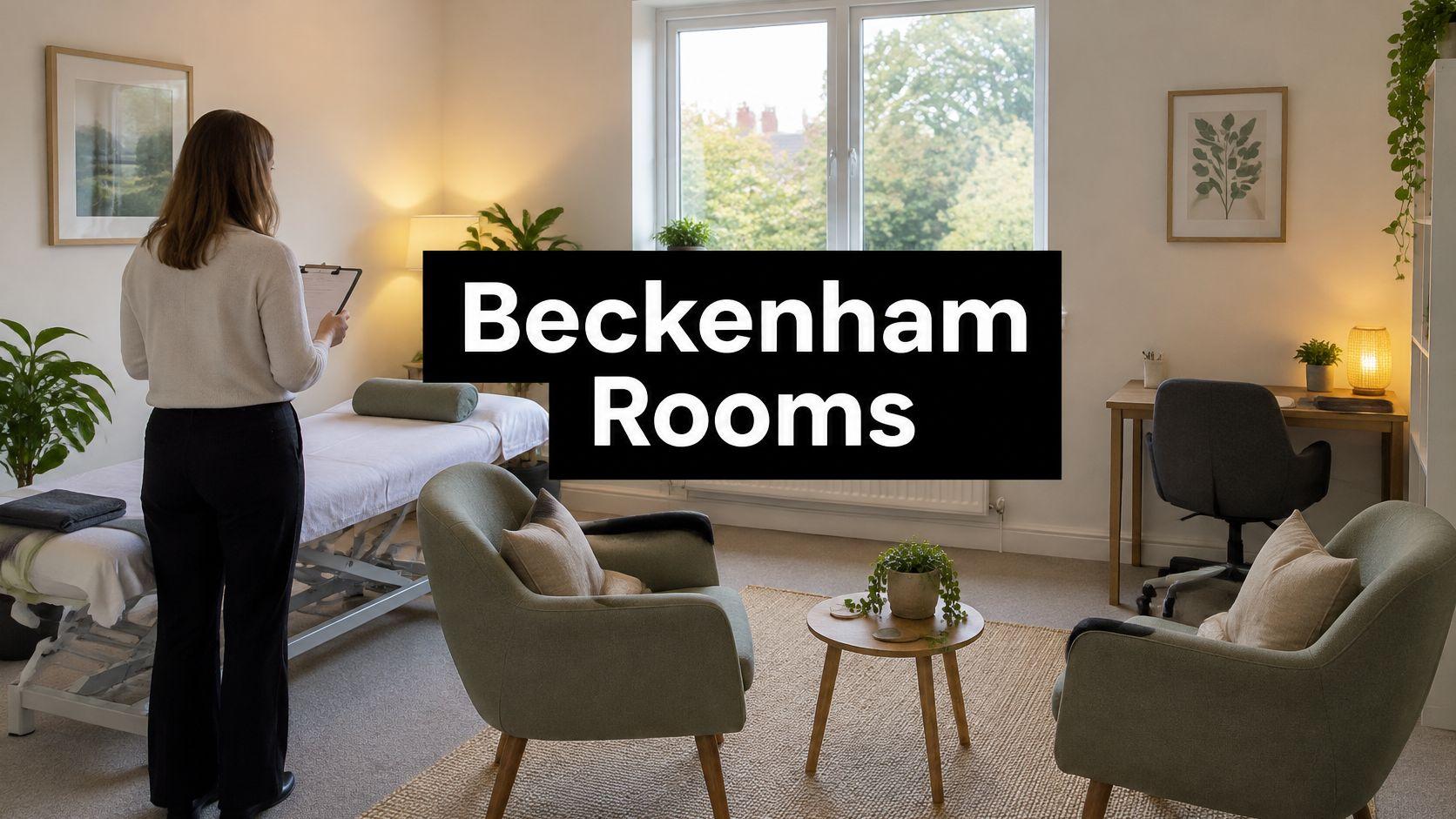
You've built a small client list from home, a friend's salon, or occasional rented days, and now you're looking at Beckenham therapy rooms and finding very different spaces under the same label. One listing shows a couch and a sink, another shows two armchairs, and a third is really a nail desk in an open salon. That's confusing because therapy room doesn't describe one standard space.
Don't start with price or postcode. Start with your treatment, its risk, and what your clients need from the room, then check whether Beckenham gives you enough local clients to sustain it.
Table of Contents
- Which Room Type Matches Your Treatment
- Why Beckenham Works as a Client Base
- Ventilation and Hygiene Checks by Treatment
- Licences and Checks to Confirm with Bromley Council
- Privacy and Access Checks for Client-Facing Rooms
- Search Beckenham Listings Then Enquire
Which Room Type Matches Your Treatment
| Treatment | Room type to search for | Search wording to use |
|---|---|---|
| Lashes, brows, waxing and makeup | Beauty room | beauty room, lash room, waxing room |
| Facials, massage and aesthetics | Private treatment room | private treatment room, massage room, aesthetics room |
| Nails | Nail station or nail desk | nail station, nail desk |
| Hair colour or cutting | Styling chair | styling chair, colour chair, rented chair |
| Barbering | Barber chair | barber chair, barber station |
| Talking therapy and counselling | Consulting room | consulting room, therapy room, counselling room |
| Multi-treatment or whole-salon work | Salon suite or studio | salon suite, studio to rent |
Why the wording matters
Searches mix up two different needs. Treatment rooms are private spaces for facials, massage and aesthetics, where a client may undress, lie on a couch, and need a door that closes properly. A beauty room serves lashes, brows, waxing and makeup, so it needs strong task lighting, a suitable couch or chair, and close storage for small tools and products.
A consulting room is different again. It doesn't need a couch or basin in the same way, but it does need comfortable seating, low background noise, and enough sound privacy for a conversation. If you search only for Beckenham therapy rooms, you'll get all three types mixed together and waste enquiries on rooms built for another job.
How to use the table
Pick your main treatment first, even if you offer add-ons. A lash technician who also offers brows still needs the lash setup to work for long appointments, while a massage practitioner offering facials needs privacy, couch access from both sides if possible, and space to clean between clients.
Hosts don't all use the same labels. One salon may call the same space a beauty room, another may call it a treatment room, and a standalone operator may list it as a studio. That's why the table gives you two or three search terms for each type. Use them in turn rather than assuming the first search shows everything.
First step: Write down your treatment, the matching room type, and your search terms before you open any listing.
If you work across several treatments, check the highest-need one first. For example, nails plus lashes means you need extraction for nail products and a couch setup for lashes, not just a desk. Multi-treatment work may suit a salon suite or studio, and the guide to beauty salons to rent as whole spaces helps you compare that option with renting a single room.
Don't let a good photo override the match. A bright consulting room won't become suitable for waxing without the right surfaces and handwashing, and an open nail station won't give a massage client privacy. Your shortlist should only contain rooms that match the treatment row you've chosen.
Why Beckenham Works as a Client Base
A lash client who books every three weeks is really buying a short, predictable journey. Beckenham suits that pattern because it is a residential catchment rather than a passing-trade location: the town divides into distinct neighbourhoods, including Beckenham Town and Copers Cope, Clock House, Kelsey and Eden Park, and Shortlands and Park Langley, each with its own routines and local high street.
That shape matters for repeat treatments. A client who can reach you in ten minutes after work rebooks more easily than one facing a long trip home from central London. Evening and Saturday appointments become realistic rather than tolerated.
The wider catchment
The wider Beckenham and Penge area is densely populated and has grown steadily over the past decade, with a large base of households within a short bus or train ride. Treat that as context, not proof of demand for your specific treatment.
A dense area can support many practitioners, but it can also mean several competitors on the same parade of shops. Population tells you a local base exists. It does not tell you whether those residents want semi-permanent makeup, sports massage or talking therapy at your price. This is why the room match comes first: settle the treatment and room type from the previous section, then use the catchment to judge whether demand plausibly exists here before you compare locations and rents.
Turning population into a practical check
- Map your existing clients: plot postcodes, with permission in your normal records, and see which neighbourhoods they already come from.
- Check nearby competition: search your exact treatment in Beckenham and count the established providers within a short walk of the room.
- Test the journey: travel the route at the times you would work, including early evenings and Saturdays.
- Confirm the authority: check the address sits inside the London Borough of Bromley, so any licensing questions go to Bromley Council rather than a neighbouring council.
If most of your booked clients already live around Clock House or Kelsey and Eden Park, a room near those neighbourhoods beats a cheaper room that adds a difficult journey. If you have no local clients yet, be honest about that gap. Referrals, the host salon's footfall or your own marketing will fill the diary, and a flexible day arrangement is safer than a long commitment while you build demand.
Ventilation and Hygiene Checks by Treatment
A room can look clean and still fail for your treatment. Ventilation and hygiene aren't finishing touches, they're part of whether you can work safely, especially when several practitioners share the same space across a week.
The UK HSE ventilation guidance for enclosed workplaces states workplaces need sufficient fresh or purified air, with a normal minimum fresh-air supply of 5 to 8 litres per second per occupant, and some commercial-building guidance uses 10 litres per second per person. Don't accept a listing that only says well ventilated. Ask what system provides that air.
Ventilation questions to ask
Ask for the occupant capacity, whether air is mechanically supplied or extracted, and whether fresh air is introduced when air conditioning recirculates. A small internal room with a closed door, a wax pot, and two people inside builds heat and odour quickly. Opening a corridor door isn't a proper answer if it destroys client privacy.
Nails and volatile products need a separate check. Look for local exhaust ventilation close to the source, such as a downdraught table or movable hood. Extracted air should discharge safely outside, away from doors, windows and air inlets, and local exhaust ventilation needs a thorough examination and test at least every 14 months. Ask for the latest test date in writing.
Hygiene you can inspect
Look for smooth, impervious, cleanable surfaces that are in good repair. Cracked couch vinyl, porous worktops, carpet under a waxing couch, and damaged sealant around a basin all make cleaning harder. Good lighting matters too, because you can't clean what you can't see properly.
Check for a separate hand basin with hot and cold or mixed water, soap and hand drying facilities. Then ask how couches, linen, reusable tools, bins and touch points are cleaned between practitioners, not just between your own clients. Treatments that break the skin or involve close person-to-person contact raise cross-infection risk, so documented routines matter more as risk rises.
| Treatment | Ventilation check | Hand-washing and cleaning check | Extra check |
|---|---|---|---|
| Lashes, brows and makeup | Fresh air of 5 to 8 litres per second per occupant | Hand basin with hot and cold water, soap and drying | Smooth, cleanable surfaces and good lighting |
| Waxing | Fresh air as above, heat and product fumes assessed | Separate hand basin with hot and cold water | Confirm contaminated waste bags and collection route |
| Nails | Local exhaust ventilation at the source, discharged safely outside | Hand basin as above | Local exhaust ventilation tested at least every 14 months |
| Facials and massage | Fresh air as above, occupant limit stated | Hand basin, couch and linen cleaning routine | Privacy enclosure and cleanable couch surfaces |
| Aesthetics and skin-breaking treatments | Ventilation assessed for the treatment and stated in writing | Hand basin, documented cleaning routine | Confirm infection control records and sharps disposal |
| Talking therapy | Fresh air for the stated occupancy | Confirm basin access nearby for hand hygiene | Confirm sound insulation and confidential entry in writing |
Use the table row for your treatment when you enquire. A practitioner comparing options in the massage therapy room guide still needs to confirm these details for the exact Beckenham room, because hosts maintain systems differently.
If a host can't explain how fresh air gets in, how used air leaves, and who cleans what between bookings, treat that as an unresolved risk rather than a minor detail.
Take photos on a viewing of the basin, flooring, couch surface, storage and any extraction unit. Note the model position, not just its presence. A hood stored in a cupboard doesn't control fumes at a nail desk.
Licences and Checks to Confirm with Bromley Council
Price and privacy are easy to judge on a viewing. Licensing is the check that decides whether you can start work at all. A room may suit your couch and your diary, but if its licence, permitted activities and hygiene arrangements don't cover your exact treatment, you can't practise there.
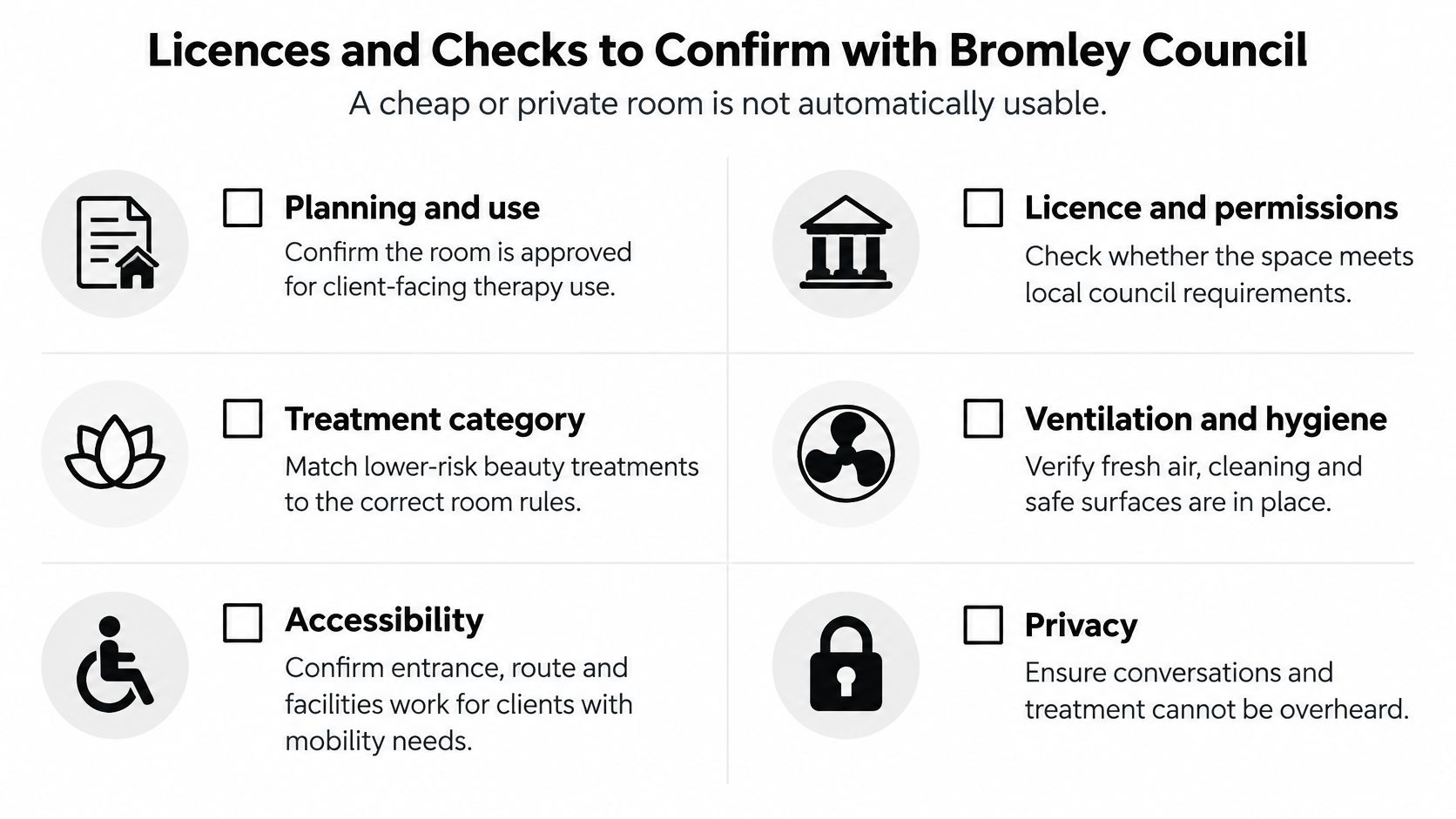
Treatments sit in different risk categories, so a room that is legal for massage may not cover electrolysis or skin-breaking aesthetics. A guide to policies for beauty and aesthetics clinics explains that in London, councils can require special-treatment licensing for services such as massage, laser and IPL, while some treatments also require premises and practitioner registration under separate rules. Where two layers apply, the host's permission to use the room does not replace the registration your treatment needs in its own right.
Your Bromley checklist
Beckenham sits under Bromley Council, so verify each point for your exact service at that exact address before you sign or pay a deposit:
- Premises licence: Does it cover the exact treatment you plan to offer, at that address? Ask to see the licence itself and check that your service appears by name, not under a broad description.
- Practitioner qualifications: Do you hold the treatment-specific qualifications the host and council expect?
- Equipment cleaning: Are cleaning and disinfection procedures written down and practical in that room?
- COSHH assessment: Is there an assessment for the products and chemicals you'll use and store?
- Consent process: Can you document consultation, consent and aftercare without exposing client records to others?
- Insurance and waste: Are your insurance, the host's cover, and clinical or general waste arrangements in place?
- Permitted activities: Does the listing or agreement allow your service, hours and client access route?
Work through the list in order, because the first two items gate everything else. If the premises licence or your own registration doesn't cover the treatment, the cleaning and consent questions never come into play.
Hosts should request this evidence before approving you. That's a good sign, not bureaucracy for its own sake. A host who asks for certificates and insurance is protecting their premises licence and their existing clients. A host who waves away every question leaves you carrying the risk if there's a complaint or inspection.
Privacy and Access Checks for Client-Facing Rooms
A client who could have stayed home and booked an online session is making a choice when they travel to your room. What they gain in return has to be worth the journey: a private, discreet space where they feel looked after rather than observed.
That standard applies across treatments. A counselling client expects not to be overheard. A massage or intimate waxing client expects not to be seen or interrupted while undressed. A facial client expects a calm, closed room rather than a cubicle in sight of the salon floor. Treat privacy as part of what the room sells, and test it the way a client experiences it.
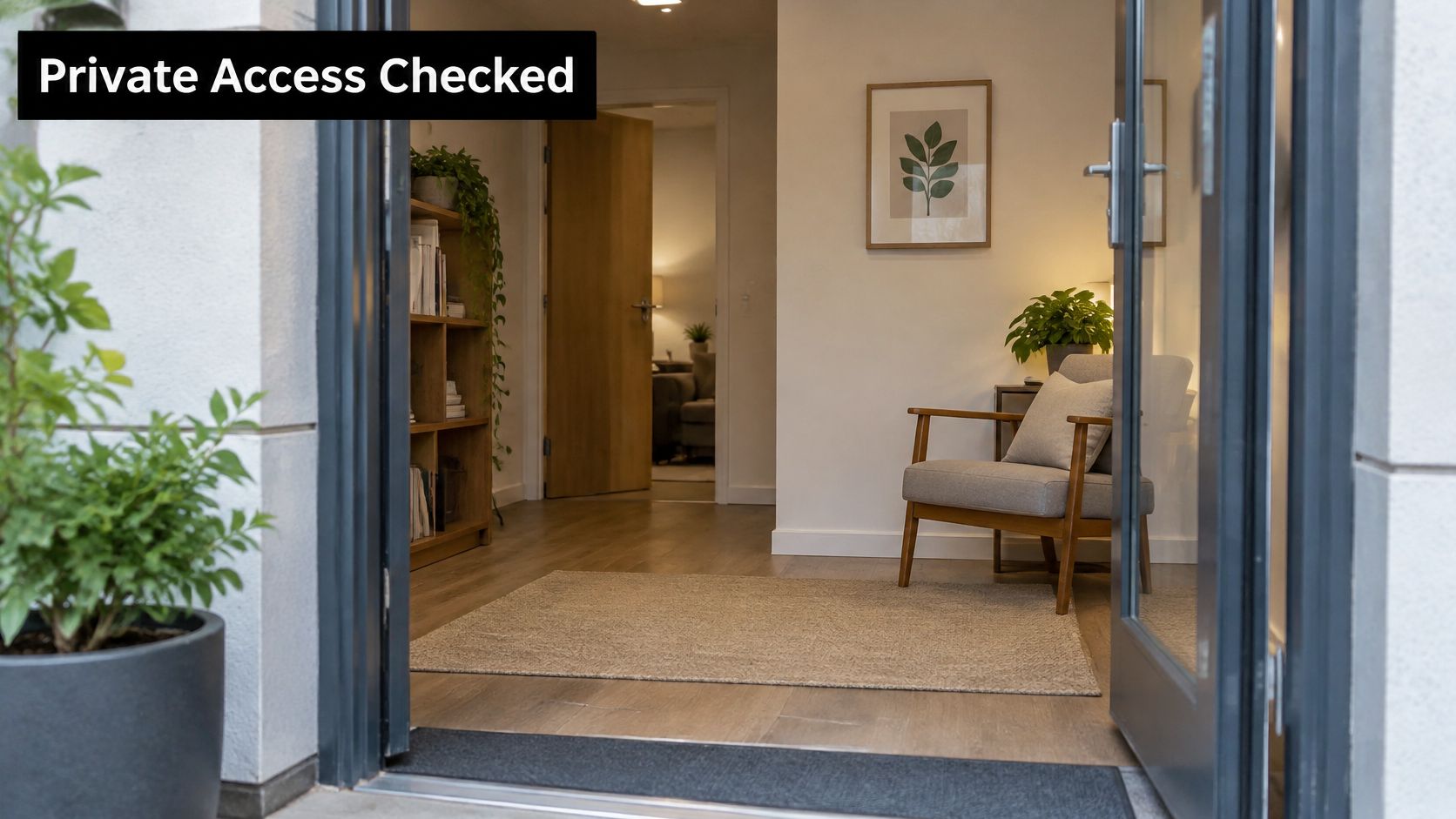
Inspect privacy like a client
- Sound insulation: Stand outside the closed door while someone speaks at normal volume inside. Check gaps under the door and shared vents, and visit at the salon's busiest hour rather than a quiet weekday morning.
- Discreet entry: Can a client arrive and leave without crossing a busy salon floor or explaining their appointment at a loud reception?
- Waiting space: Is there a seat that doesn't put clients face to face with the previous person leaving?
For beauty and massage rooms, also check sight lines when the door opens, window coverings, and whether there's a screen or private area for changing. A lockable door helps only if staff respect booked sessions and don't enter for stock stored in your room, so ask who holds a key and what the rule is during a treatment.
Inspect access before you advertise it
Check step-free access from pavement to room, door widths, turning space for mobility aids, and whether there's an accessible toilet nearby. Ask about lifts, including what happens if the lift is out of service on the day of a booking. Don't describe a room as accessible because it has one ramp at the front if the toilet is down narrow stairs.
Send clear arrival instructions with a landmark, an entrance photo, the buzzer name and what to do if the client arrives early. For evening work, walk the route from the station or bus stop yourself and check the lighting, any isolated stretches and where a client would wait if you're finishing a previous appointment.
Writing test: If the host won't confirm access, privacy and arrival arrangements in writing, don't promise them to clients in your booking information.
Practitioners who mix online and face-to-face work often need a room only for selected clients, such as those whose mobility or treatment needs rule out remote sessions. Flexible sessions can suit that pattern better than a full-time lease, provided the room is consistently available at the times those clients can attend.
Search Beckenham Listings Then Enquire
Search last, not first. Once you know your room type and must-haves, you can scan Beckenham therapy rooms quickly and reject attractive spaces that don't fit. The steps below keep the same order for every enquiry, so replies are easy to compare.
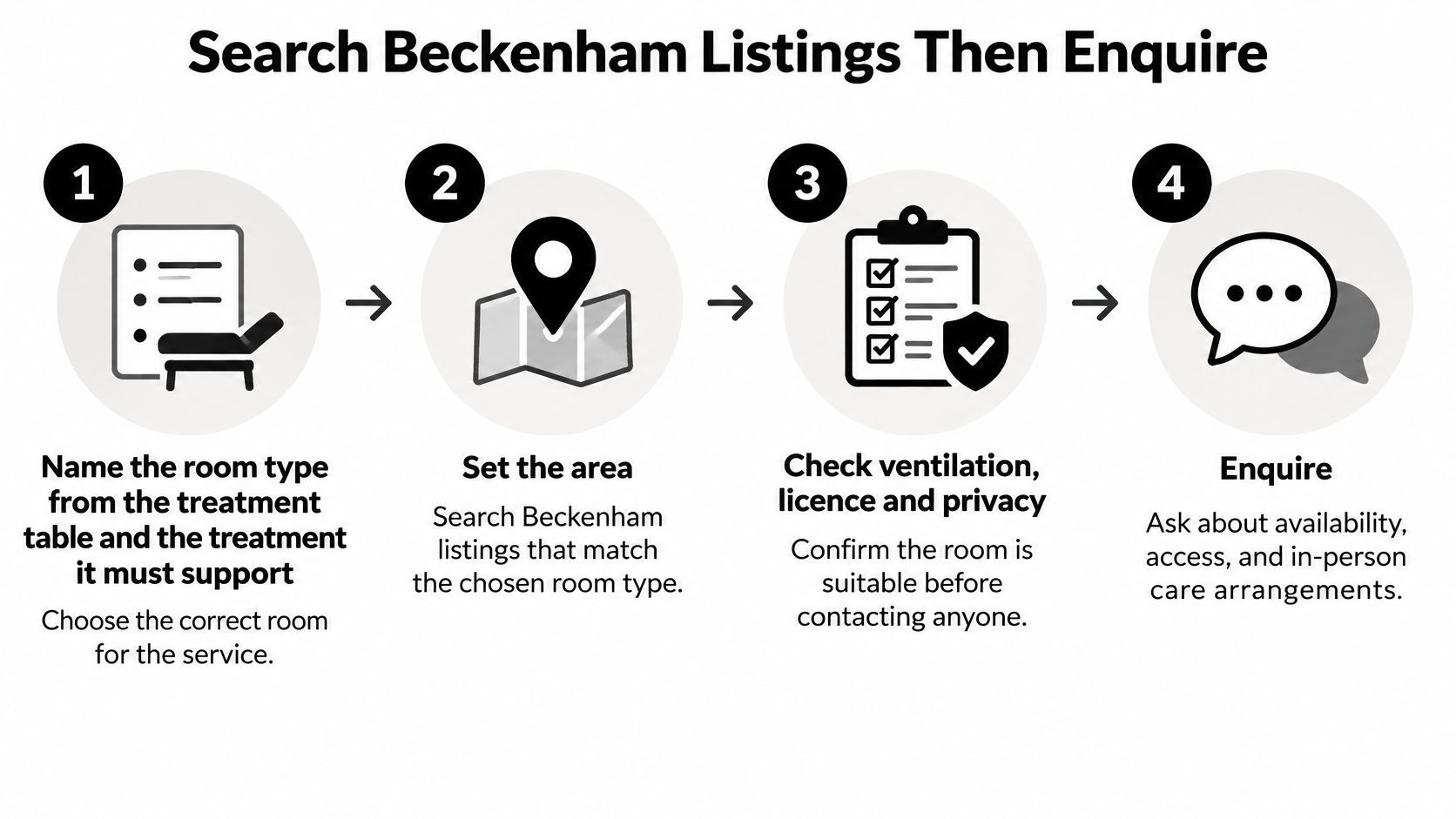
Step 1 and 2 name the room and set the area
- Name the room type: Write your treatment and matching type at the top of your notes, for example aesthetics in a private treatment room, or counselling in a consulting room.
- Set the area: Start with Beckenham and BR3, then widen to Bromley, Penge in SE20, and Catford in SE6 if the Beckenham search is thin.
Be candid with yourself here. A current listing inside Beckenham itself may not be available when you search, and forcing a poor match helps no one. Nearby areas can work if your clients will travel, and a direct approach to local clinics or salons with a spare room is a sensible backup.
Step 3 and 4 search and scan
- Search by town or postcode: Use each search term from your table row. We list spaces across London and other English towns and cities, including Manchester, Birmingham, Leeds, Liverpool, Bristol, Sheffield, Newcastle, Nottingham, Leicester, Bradford, Bournemouth, Coventry, Brighton and Milton Keynes, so the same search method works if you widen your area.
- Scan the essentials: Check room type, location, rent and map position first. Open a listing only if the space type and journey look plausible, then look for basin, extraction, privacy and access clues in photos and wording.
An enquiry needs only your name and email, with no account. Questions about plans can be sent to hello@findmy.beauty. We don't set your rent or manage your agreement. Rent for a space is agreed directly between you and the host, in pounds sterling, so confirm what's included rather than assuming utilities, linen, reception or cleaning come as standard.
Step 5 match the rate to your week
- Choose the rate pattern: Use a day rate for occasional sessions or a test period, and a monthly rate only when steady bookings already justify it.
Say you see online clients all week but need in-person sessions on Tuesdays. Paying for five days wastes margin. The advice on how to rent a room by the day fits that pattern. Say instead you have facials booked four days a week. A monthly arrangement may give you storage, consistent setup and lower cost per working day, provided the licence and cleaning checks pass.
Do simple maths in pounds. Divide the monthly rent by the days you'll use, then add travel, products, linen, insurance and any licence costs. If the room only works when every slot is full, it's too fragile for a starting diary.
Step 6 and 7 shortlist, enquire and compare in writing
- Shortlist three to five rooms: Keep only spaces that match your treatment row, ventilation and hygiene checks, licence checklist and privacy needs.
- Send the same enquiry to each host: State your treatment, preferred days and hours, client profile, expected occupants, and questions on ventilation, cleaning, basin access, licence evidence, waste and step-free access.
A copy-ready enquiry could say you're a qualified massage practitioner seeking Tuesdays and Thursdays, you'll bring your own linen, and you need a lockable private room, basin access, stated occupancy, and confirmation the premises licence covers massage. Ask what cleaning happens between other practitioners and what storage is included.
Compare written replies, not photos. Put rent, included items, access hours, licence position, cleaning duties, cancellation terms and notice period into one table in your notes. If a host answers price but avoids ventilation or licensing, follow up once. If they still avoid it, remove the room.
Book two viewings within a week of shortlisting, while details are fresh. Visit at a time close to your planned working hours, test sound privacy, run the taps, check mobile signal for payments, and walk the client route from street to room. Get final conditions in writing before paying, including who holds keys, how clients are admitted, and what happens if the room is unavailable on a booked day.
Search Beckenham therapy rooms by treatment type, check each host's rent and location, and send a direct enquiry with your ventilation, licence and access questions included from the start. Visit FindMy.beauty to compare beauty rooms, private treatment rooms, nail stations, chairs and studios near Beckenham and widen your search if local choice is limited.