


The usual advice for finding a cheap barber chair is to sort listings by price and contact the cheapest host. That can leave you paying for days you won't work, equipment you thought was included, or a commitment your client book can't support. A search for “barber chair cheap” should end with the lowest viable cost for your actual working diary, not the smallest figure on a listing.
Table of Contents
- Why the Lowest Advertised Chair Rent Misleads
- Day Week and Month Rents You Can Compare
- What a Higher Weekly Rent Can Already Include
- How Many Clients Cover the Chair
- Which Rental Period Fits Your Week
- Checks and First Message Before You Enquire
Why the Lowest Advertised Chair Rent Misleads
The smallest daily figure isn't necessarily the cheapest chair. Here, a barber chair means a working station inside someone else's barbershop, rented by a barber building their own book, rather than a piece of furniture to buy.
A daily price tells you what access costs for that period. It doesn't establish whether you can serve your clients there, whether the equipment suits your services, or what you'll owe when appointments disappear.
The distinction matters in a market with more premises but pressure on staffing. The National Hair & Beauty Federation's industry statistics count 14,805 UK barbershops in 2020 and 19,976 in 2025, while the wider hair and beauty workforce fell by around 7.5% during 2024. That combination helps explain why an owner might have productive space available, but it doesn't establish whether a particular chair has customers waiting for you.
Separate access from earning potential
A host can offer an inexpensive station because they want unused space occupied. You still need to establish whether your clients can reach it, whether your preferred hours are available, and whether the shop's services complement yours.
For owners, our guide to pricing a salon chair or room helps frame the other side of that negotiation. A sustainable arrangement needs to work for the premises as well as the renter.
The distinction between the headline and the working cost is the useful starting point.

Buying rule: Compare the cost of serving your booked clients, not the cost of occupying an empty chair.
Treat a listing as an opening offer for workspace, not a complete business budget. Before accepting it, establish the rental period, the usable station, the included services and the amount you're committed to paying if your diary changes.
Day Week and Month Rents You Can Compare
Published UK chair rents by period in 2026
| Place | What is listed | Period | Rent | Status |
|---|---|---|---|---|
| London | Salon spaces including chairs | Day | £50–£150 | Listed range, October 2026 |
| London | Salon spaces including chairs | Week | £125–£450 | Listed range, October 2026 |
| London | Salon spaces including chairs | Month | £400–£2,500 | Listed range, October 2026 |
| Glasgow | Styling, barber or nail chair at Chesne Hair & Barbershop | Day | £30 | Only listed Glasgow rent, October 2026 |
| Brighton | Salon chair at AMOR Hair & Beauty | Month | £1,500 | Only listed Brighton rent, October 2026 |
| Illustrative UK shop | Fixed chair rent | Week | £100 | Worked example, not a national average |
| Takings share | Percentage of your takings | Agreed accounting period | No fixed rent | Used by some shops; confirm the percentage |
The lowest published figure in this comparison is Glasgow's £30 a day, but that's one host's daily offer, not evidence that Glasgow is the cheapest city. London's weekly and monthly ranges are broad enough that no rental period wins automatically.
These are our listed workspace prices, not a representative survey of UK barber rents. The illustrative weekly figure is a calculation input, not a market benchmark.
Read the product before comparing the price
Chesne Hair & Barbershop's listing describes styling, barber or nail-chair space. Before treating it as a barber station, confirm the exact setup available for your services: a suitable chair, mirror, accessible sockets, equipment storage and enough room to work around the client.
The Brighton listing is for a salon chair, while London's ranges include salon spaces rather than exclusively barber stations. A nail desk, treatment room and barber chair aren't interchangeable products because they appear in a workspace search.
Compare offers using a short list:
- Same use: Can you perform your actual service menu at the station?
- Same access: Are opening, setup and clearing times included?
- Same period: Is the quote for a booked day, a recurring week or continuous monthly access?
- Same commitment: Can you stop booking, or must you give notice and continue paying?
A daily rate buys flexibility only when the terms let you book the days you need. A weekly rate buys useful access only when those days and hours are available.
A share of takings is a different proposition
With takings share, the host receives an agreed percentage instead of a fixed pound rent. Ask what counts as takings, how refunds and discounts are handled, and whether the calculation includes retail sales or tips.
Don't compare a percentage directly with a weekly price. Apply the percentage to your own expected receipts, then test both a quiet diary and a busy one.
The useful shortlist isn't just the cheapest rows. It's the stations that provide comparable access, suitable equipment and a commitment you can support.
What a Higher Weekly Rent Can Already Include
A higher weekly rent can cost less overall than a bare daily chair, but only if it replaces expenditure you'd otherwise incur. A long inclusion list isn't a saving when you won't use the services.
The ICAEW hairdressing and beauty treatment industry profile provides context for a cost-sensitive comparison: labour represents about 60% of businesses' expenses, and the accompanying rental discussion uses an illustrative £100 weekly chair rent, not an official UK national average. Some shops use takings-based arrangements instead, so there's no single national rent against which every offer can fairly be judged.
A higher rent is cheaper only when it replaces bills you would otherwise pay.
Inclusions that change a cheap chair
| Item | Often inside a higher rent | Often extra on a bare chair | Confirm before enquiry |
|---|---|---|---|
| Chair, mirror and floor space | Station as photographed | You bring tools; additional furniture may be extra | Photos match the chair you would use |
| Backwash and water | Shared access in the rent | Pay per use or no access | Slots and product rules |
| Towels and laundry | Host laundry | You supply and wash | Who pays and turnaround time |
| Heat, light and water | Included where agreed | Separate or metered charges | Whether VAT sits on top |
| Card machine and booking | Host system where offered | Your reader and software | Transaction fee and who controls the book |
| Capes, blades and products | House stock where specified | You buy consumables | Storage and brand rules |
| Walk-ins | Shop referrals where agreed | Your own clients only | How walk-ins are allocated |
| Deposit and minimum term | Still payable if required | Same commitment risk on a low rent | Refund and cancellation conditions |
Treat these as possible contract structures, not a standard package or a promise that dearer chairs include everything.
Put a replacement value against each inclusion
For towels, use your laundry spending and the time needed to collect, wash and return them. For booking software, count a saving only if you can actually stop paying for your own system. For card processing, establish whether access to the terminal includes transaction charges.
The visual comparison highlights services to check, not guaranteed packages.
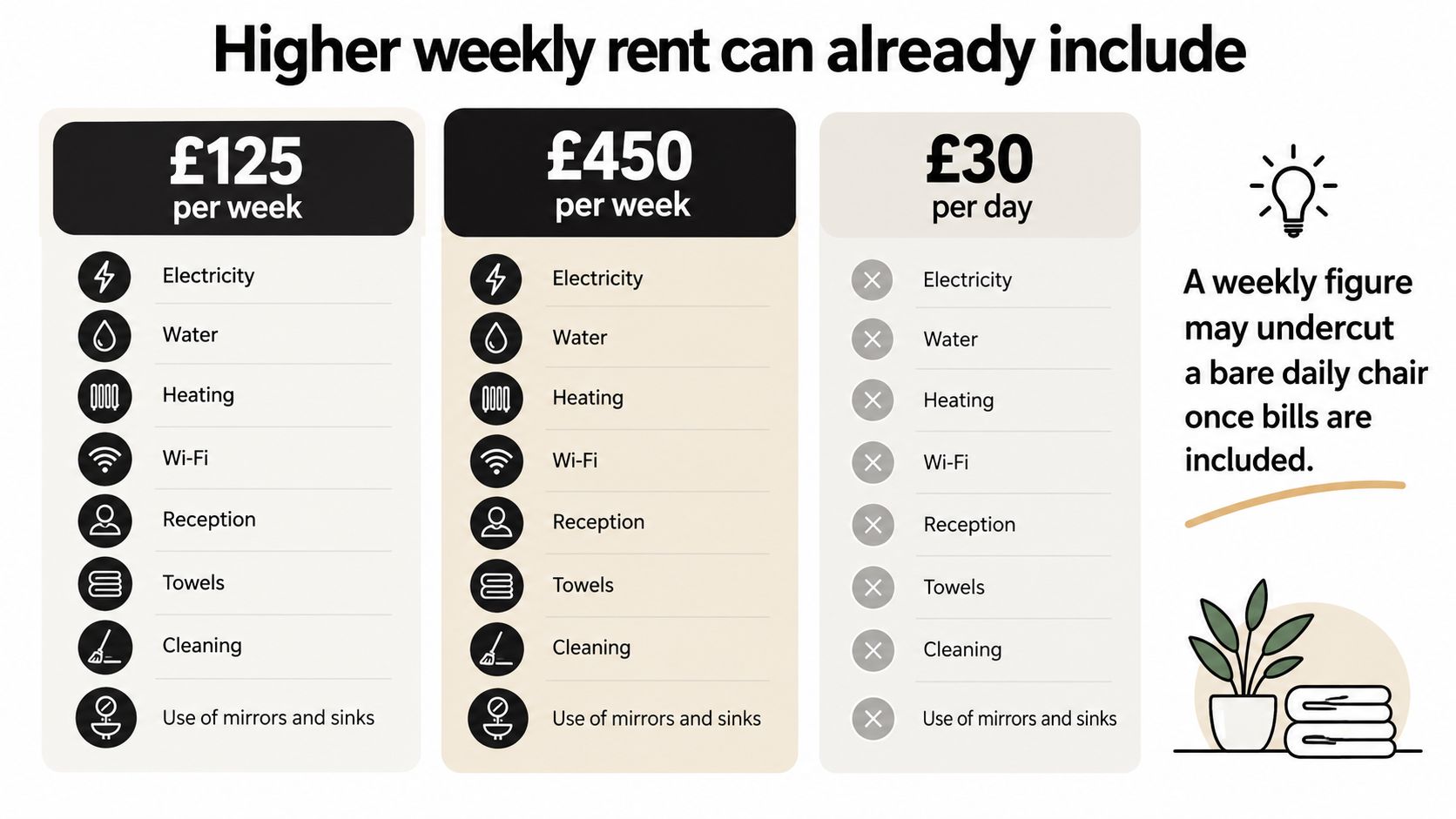
Ask whether the advertised rent is the amount that leaves your account, including VAT if charged. Keep a refundable deposit separate from ongoing expenses: it ties up cash, but it isn't necessarily money you've spent permanently.
Client records deserve the same attention as equipment. If referrals remain entirely on the shop's booking system and you can't retain an appropriate client relationship when you leave, you're paying for access to demand, not acquiring a transferable book.
Owners preparing an offer can use our salon-chair listing information to present the space. For renters, written inclusions matter more than photographs of a well-equipped shop.
How Many Clients Cover the Chair
What each rent costs in a working month and in a quiet week
| Arrangement | Advertised cost | About a working month | If the week is quiet | When it is the cheap option |
|---|---|---|---|---|
| Glasgow day example | £30 a day | £120 for four booked days; £240 for eight | Only booked days are paid, subject to cancellation terms | Occasional days or a test booking |
| Illustrative week | £100 a week | About £433 | Full £100 | Regular attendance with enough contribution |
| London week, low | £125 a week | About £542 | Full £125 | A book that uses the available days |
| London week, high | £450 a week | £1,950 | Full £450 | Included services justify the premium |
| London month, low | £400 a month | £400 | Monthly obligation continues | Sustained use of the available station |
| Brighton month example | £1,500 a month | £1,500 | Monthly obligation continues | Full-time use supported by the book |
| Takings share | Percentage, not fixed | Agreed percentage multiplied by takings | Lower charge if takings fall, absent a minimum | New or uneven book |
These are worked calculations, not additional advertised prices or earnings forecasts. Weekly-to-monthly equivalents use an annualised month, multiplying the weekly rent by the weeks in a year and dividing by the months, rather than treating every month as exactly four weeks.
For the illustrative weekly arrangement, four paid weeks cost £400, whereas the annualised monthly equivalent is about £433. For the Glasgow-style daily calculation, the cost follows booked attendance, provided the agreement doesn't impose a recurring minimum.
The contrast is easier to see when booked days and continuous weekly access are kept separate.
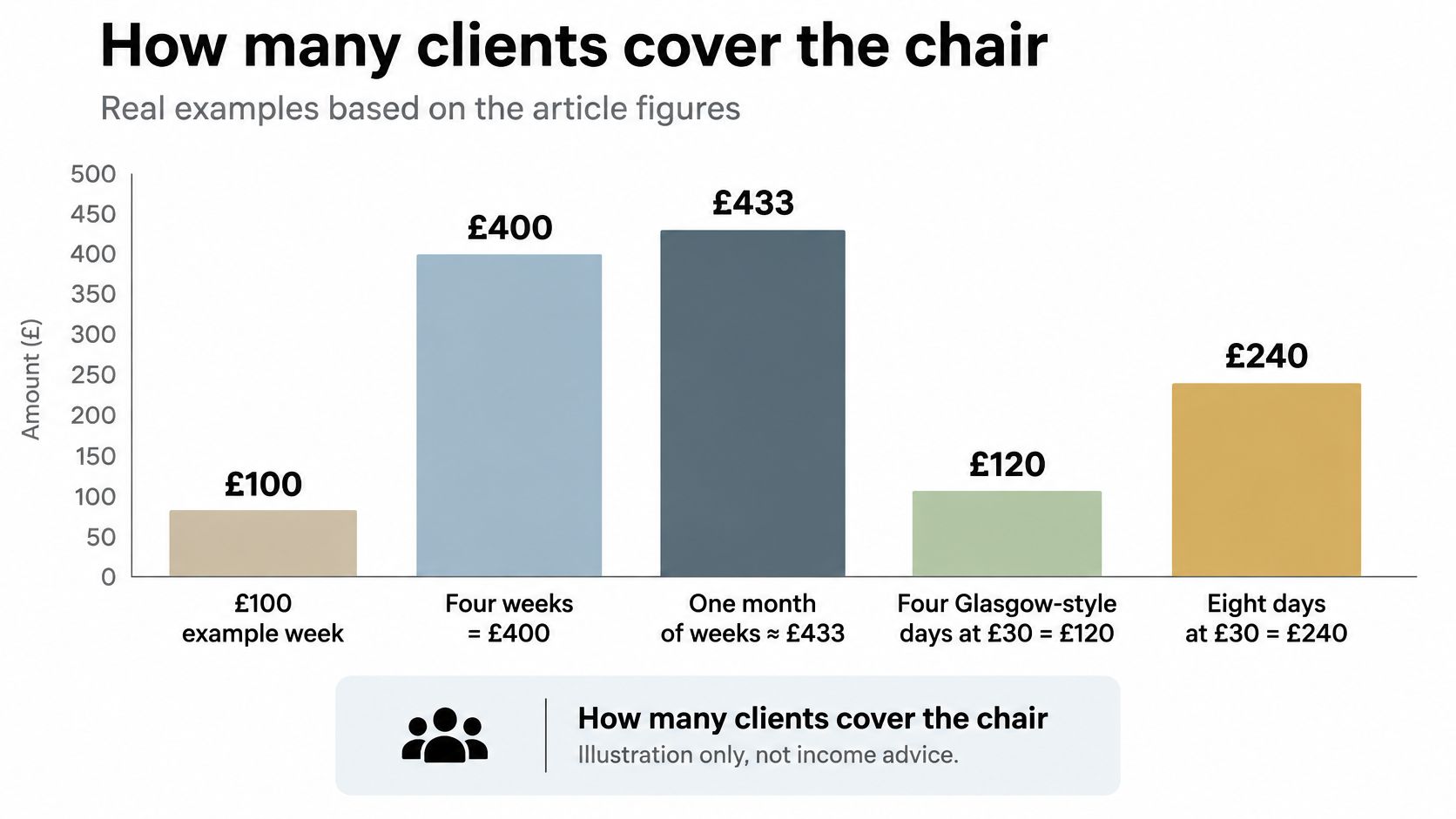
Use contribution per client, not the haircut price
Clients needed to cover workspace costs = workspace costs ÷ contribution per client, rounded up to a whole appointment.
Contribution is what remains from the service payment after client-specific costs, such as consumables and transaction charges. With a takings-share agreement, deduct the host's share too, without also counting it as fixed rent.
Use this calculation sequence:
- Establish receipts: Enter your own service price and realistic mix of appointments.
- Deduct variable costs: Include blades, products, laundry charged per client and payment fees.
- Total the fixed outgoings: Add rent, relevant insurance, travel and any separately charged services.
- Test the diary: Divide those outgoings by contribution, then compare the result with appointments you can credibly book.
Covering the chair isn't the same as making a living. You still need money for your own pay, tax obligations, equipment replacement and time away from work.
Make the quiet-week test explicit
The fixed weekly options remain payable when clients cancel. Monthly agreements also continue through unused days unless their terms say otherwise.
A day arrangement avoids unused-day rent only when you haven't committed to those days or can cancel within the agreed rules. A pure percentage arrangement reduces the host's charge as receipts fall, but a minimum payment can remove that protection.
For a visual companion to the calculation, this video sits alongside the comparison.
Don't assign a cash value to promised walk-ins until you have a credible basis for expecting them. Run the affordability test on your own book first.
Which Rental Period Fits Your Week
Match the commitment to the diary you have, not the diary you hope to build. A Saturday-only barber should normally start with a day arrangement rather than accept continuous monthly liability.
That approach fits a sector dominated by independent operators. The NHBF's 2024 industry statistics report that 58% of people working in hair and beauty were self-employed, while more than 80% of businesses employed fewer than five people. Those figures explain why flexible workspace is relevant, but your own appointments should determine the commitment.
Which period fits each working pattern
| Working pattern | Best period | Refuse if |
|---|---|---|
| Saturday only | Day rate | A monthly commitment is required |
| Two midweek days | Day rate, unless a weekly bundle replaces enough costs | A month is required without a supporting book |
| Three or four regular days | Week | Monthly liability starts before demand is established |
| Full book, kit shown in photos | Month, including suitable offers in the £400 to £1,500 range | The book doesn't support continuous access |
| New book in a new town | Takings share, if the percentage and terms work | Fixed monthly rent exceeds a credible quiet-period budget |
| Overflow chair only | Day rate | A minimum term creates unused capacity |
These are starting recommendations, not automatic verdicts. A weekly offer can beat daily access for limited attendance if the included services replace enough genuine expenditure.
Regular days justify a different negotiation
For recurring midweek work, ask for the same station and hours each time. Consistency lets you give clients clear directions, organise equipment and avoid discovering that another renter has the chair when you need it.
Once your appointments reliably occupy the available week, negotiate around continuity rather than just price. Storage, access before opening and permission to leave equipment may be more useful than a nominal discount.
A monthly arrangement makes sense when you've tested both the premises and the demand. Photographs should show the station you'll use, but a visit should establish whether the working space suits your services.
Commitment test: Choose the longest period your existing demand supports, not the longest period the host offers.
Exceptions that favour flexibility
An overflow chair exists to absorb demand you can't accommodate elsewhere. Don't turn it into another fixed base unless clients consistently need it.
A distant chair also needs caution. Check whether existing clients will travel before assuming a lower rent compensates for the location.
Where employed barbers already cover your preferred hours, establish how appointments and walk-ins will be allocated. Paying for access doesn't guarantee access to the shop's customer flow.
For a new town, a takings share can limit fixed exposure while you establish demand. Recalculate once receipts become predictable: an arrangement that protects a quiet book may become expensive for a busy one.
Checks and First Message Before You Enquire
Compare the listing's daily, weekly and monthly lines before contacting the host. Then introduce your services and intended days so the owner can judge whether you're suitable for the shop and its clients.
We let renters search by town or postcode, browse spaces and message hosts free of charge. Rent is agreed directly between the renter and host in pounds sterling, so the enquiry needs to establish the actual offer rather than assume the marketplace supplies standard terms.
Use the comparison strip as a prompt before sending your message.
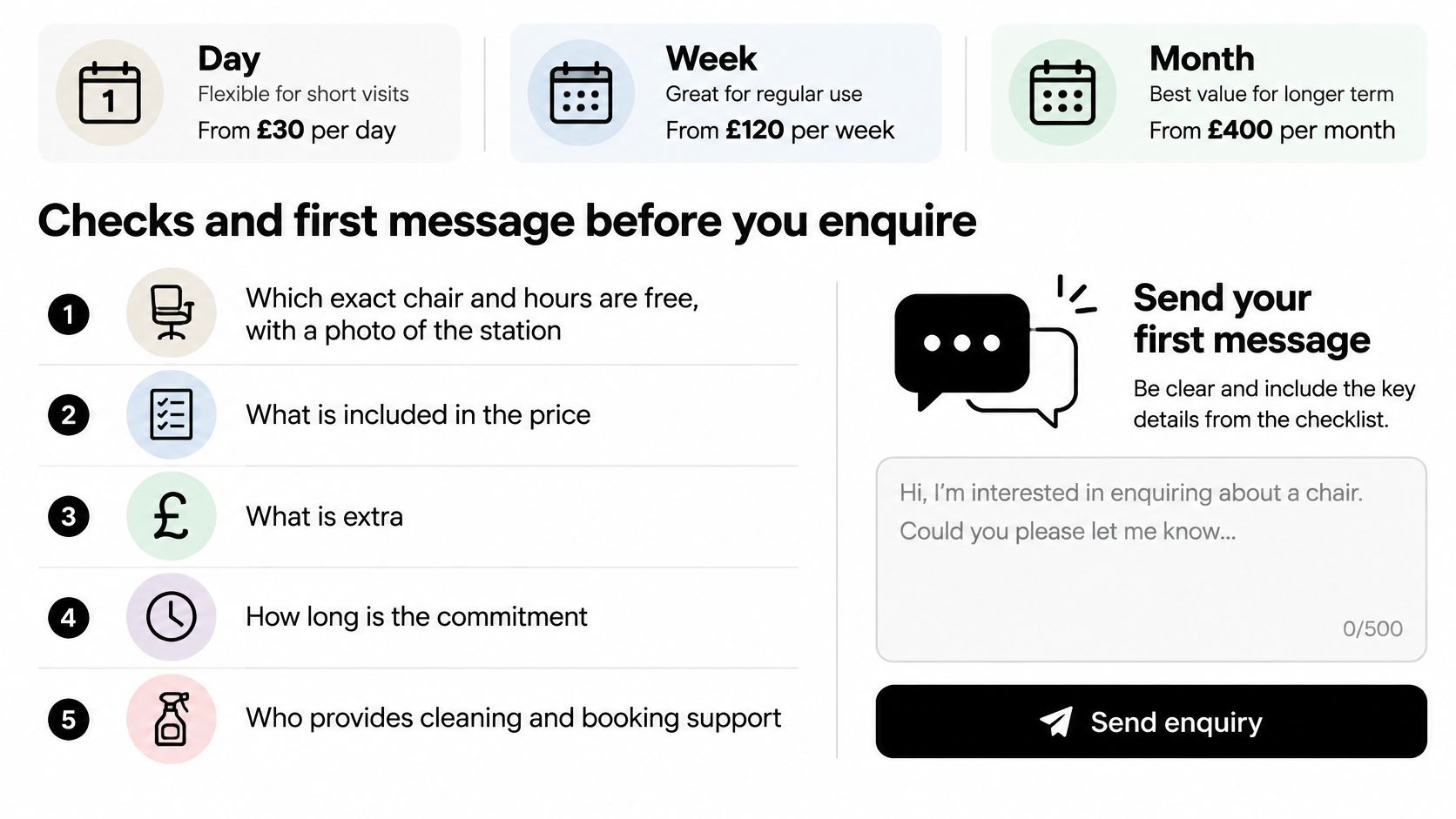
Ask in the order you'll use the answers
- Station and hours: Which exact chair is available, and can the host send a photograph of that station? Include setup and clearing time.
- Shared access: Will your hours overlap with an employed barber or another renter using the same chair?
- Total price: What is included, what is charged separately, and is VAT added?
- Commitment: What deposit, minimum term, notice and cancellation conditions apply to each side?
- Payments and records: Who takes client payments, handles refunds and controls access to booking records?
- Insurance: What cover does the host expect you to hold? Don't assume their policy covers an independent renter.
- House rules: Establish expectations for products, music, late appointments, cleaning and leaving equipment.
- Trial access: Request a paid trial day before accepting a monthly commitment.
Our guide to what to agree before a renter's first day provides a useful basis for recording the resulting agreement.
Send a message that can produce a clear answer
A practical opening is:
I'm a self-employed barber offering cuts and beard services, looking for recurring Saturday access. I've compared the listed rental periods and would like to discuss a day arrangement. Please confirm what the rate includes, whether VAT applies, and whether a deposit or minimum commitment is required. Could you also confirm the exact station and available hours, and whether a paid trial day is possible?
Follow with any unresolved checks rather than asking the host to repeat information already on the listing. Keep the reply and written terms together so you can compare offers on the same basis.
Reject a mismatched product before negotiating its price. A shared nail setup may not suit barbering, a monthly-only offer may not fit occasional work, and a distant station may lose the clients you're trying to serve.
If the nearby offer requires more commitment than your book supports, keep searching. An available chair isn't automatically an affordable chair.
FindMy.beauty offers location-based workspace listings with day, week or month prices and free direct enquiries to hosts. Visit FindMy.beauty, search your town or postcode, and shortlist stations that fit your booked days before asking for the full price, inclusions and commitment terms.
Refined using Outrank