


You're looking at three listings for therapy rooms to rent in London, and none of them really compare. One's £80 a day, one's £300 a week, one's £650 a month, and only one mentions cleaning. You've got clients who'll follow you if the room's right, but you don't yet know whether any of these rents leave you a margin, or whether the cheapest room even has the basin and ventilation your treatments need.
That's the decision to slow down. A headline rent tells you the price of time in a room. It doesn't tell you cost per client, whether the space suits your most demanding treatment, or who carries the licence and insurance duties. Work through those three questions before you message a host, and you'll waste far fewer viewings.
Table of Contents
- Listed London Rents by Booking Length
- Turning a Quoted Rent into Cost per Client
- Where London Therapy Rooms Are Clustered
- Matching Room Type to Your Treatment
- Hygiene and Ventilation Checks Before You Commit
- Licences, Insurance and Permitted Use to Confirm
- Shortlist and Contact Hosts Directly
Listed London Rents by Booking Length
Start with what hosts advertise, then judge whether the booking length matches your diary. Listed rents in London run from £50 to £150 a day, £125 to £450 a week and £400 to £2,500 a month.
| Booking length | Listed range in London | Best suited to |
|---|---|---|
| Day | £50 to £150 | Trial sessions and occasional clients |
| Week | £125 to £450 | Regular days each week |
| Month | £400 to £2,500 | Fixed schedules with steady bookings |
Reading the Ranges Properly
A day rate suits a trial, a pop up clinic, or a small group of clients you can batch into one day. It's the lowest commitment, but usually the highest price per working day. You're paying for flexibility, and for the option to walk away if the room, noise level or client flow doesn't work.
A week rate suits regular days each week, say Tuesdays and Thursdays in the same salon. You're not funding a full premises, but you've got a repeatable pattern clients can book around. A month rate suits a fixed schedule with steady bookings, where storage, consistency and a stable base matter more than the freedom to cancel.
A Short Check Before You Compare
- Note the booking length: Write down whether each listing quotes a day, week or month rate, and don't convert loosely in your head.
- Match it to your schedule: Count the days you'll realistically use, not the days you'd like to fill in three months.
- Carry the matching figure forward: Use that rent for your cost per client calculation, not the cheapest headline you saw.
Ranges vary by area and listing, so compare rates within the same area first. On FindMy.beauty, listings show the space type, location and rent, can be seen on a map, and you can search by entering a town or postcode. That helps you build a like for like shortlist before you turn any rent into cost per client.
Turning a Quoted Rent into Cost per Client
Maya T., a London lash technician, replaced a six-month room contract she used three days a week with renting a lash room by the week. She messaged two hosts on a Sunday evening and visited one on the Tuesday. Her move worked because she stopped buying days she wasn't using and matched the rent period to her actual bookings.
A quoted rent is a price for time, not for a treatment. Two rooms at different rents can produce the same cost per client, and a dearer room can work out cheaper once included services are counted. I would never compare therapy rooms to rent in London on headline rent alone.
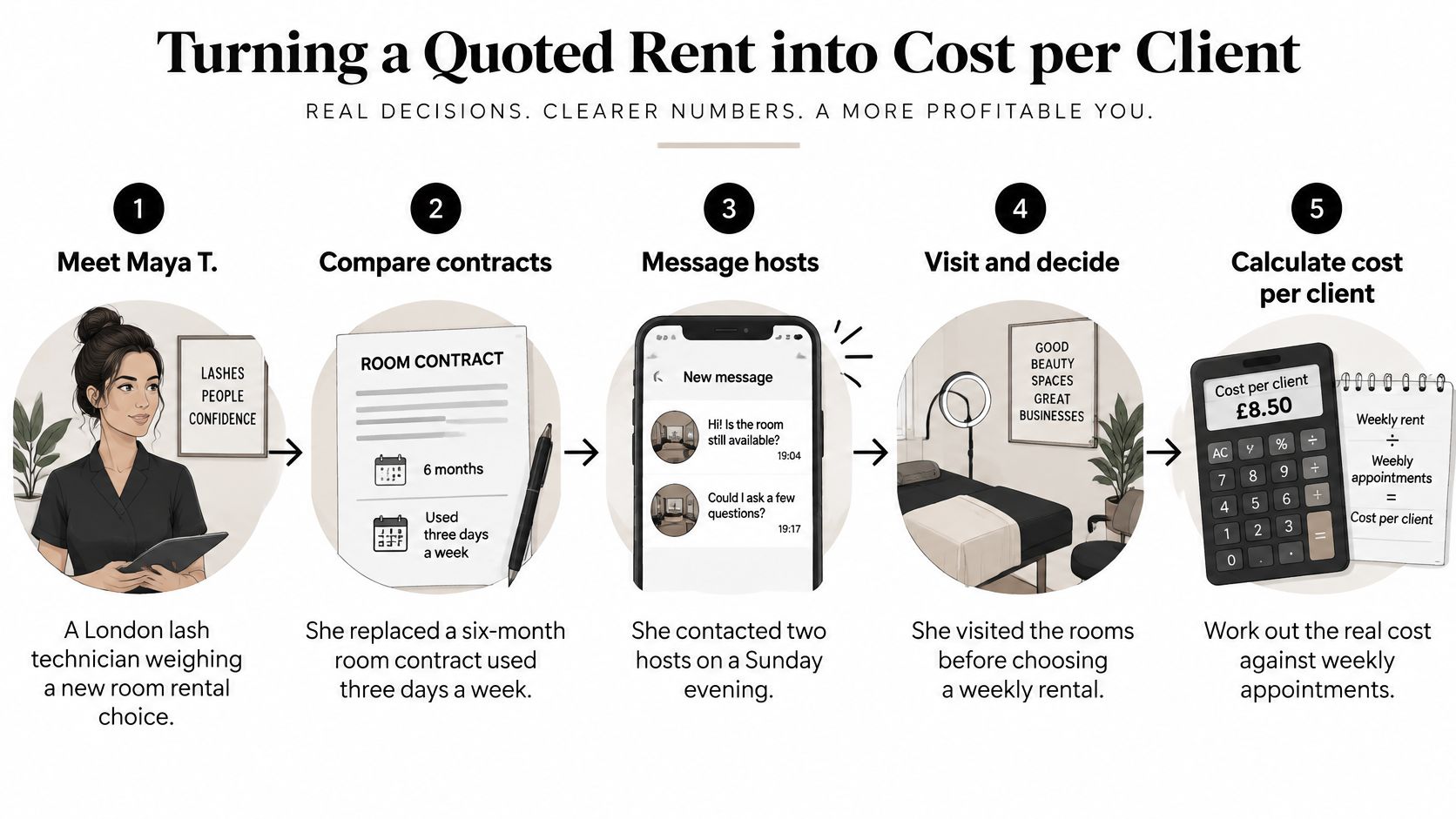
Six Steps to One Comparable Figure
- Write down the booking format: Record whether the quote is per day, week or month, plus notice terms and any minimum commitment.
- Count realistic client slots: Use filled appointments you can defend, with gaps for late arrivals, cleaning and notes, not a back to back fantasy diary.
- Divide rent by slots: Rent divided by realistic slots gives your starting cost per client.
- Add excluded extras: Add utilities, cleaning, laundry, card fees, consumables, waste disposal and insurance where the rent excludes them.
- Add unpaid time: Count set up, turnaround cleaning and travel between sites as lost earning time, even though no invoice arrives for it.
- Compare with price and margin: Set the total against your treatment price and the margin you need after products and your own time.
For help setting that treatment price against rent, see our guide on how to price a salon chair or room and run the same slot count for every room on your shortlist.
What Sits on Top of Rent
| Cost item | Who usually pays | Why it changes cost per client |
|---|---|---|
| Rent | Renter | Headline figure; confirm the booking period and notice terms |
| Utilities | Check agreement | Heating, lighting and water can be included or charged extra |
| Cleaning and laundry | Check agreement | Towels and linen add cost to every session |
| Treatment consumables | Renter | Products and disposables are a per-client cost |
| Card and payment fees | Renter | Charged on every booking taken |
| Insurance | Renter for own cover; host for the building | Public liability and treatment cover add a fixed monthly cost |
| Waste disposal | Check agreement | Sharps and clinical waste rules can add a separate charge |
| Business rates | Check agreement | Occupancy and letting structure decide liability |
Confirm each row in the agreement rather than assuming the usual split applies. Hosts package rooms differently. One includes reception, towels and cleaning because staff are already on site. Another charges a bare room rate and expects you to bring linen, remove waste and clean between clients yourself.
Worked Contrast and Break Even
Take two illustrative rooms, each giving you 40 client slots in a month. Room A costs £400 a month and excludes £60 utilities and £40 cleaning and laundry. Your true monthly cost is £500, so cost per client is £12.50.
Room B costs £480 a month and includes utilities, cleaning and laundry. Divided by the same 40 slots, cost per client is £12.00. The dearer advertised room is cheaper per session, before you count the unpaid laundry and cleaning time Room A pushes onto you.
Practical rule: If a listing won't say what's included, price it as if nothing is included until the host confirms otherwise in writing.
Break even follows from the same maths. Divide your fixed monthly costs by the contribution each treatment makes after per-client products and fees. That gives the number of treatments you must deliver each month before the room starts paying you rather than the other way round.
These overheads aren't background noise. The Longitudinal Small Business Survey 2025 from the UK government found taxation, VAT, PAYE, National Insurance and business rates were the most frequently reported major obstacle to SME success in 2025, cited by 67% of respondents, up 6 percentage points from 2024. A room that bundles predictable costs can therefore protect margin better than a low rent surrounded by small, variable charges. The cheapest advertised room is not automatically the lowest cost option.
Where London Therapy Rooms Are Clustered
London's supply is spread across boroughs, so a narrow search misses good rooms. Industry data reported by the Institute of Chartered Accountants in England and Wales hairdressing and beauty profile states that 9,215 salons were based in London in 2025, representing more than 18% of the UK total, while the wider Greater London area also contained just under 25,000 personal-care and beauty amenities, approximately 13% of the national total, according to the British Beauty Council.
That scale is why borough by borough searching matters. A short walk from the right station can matter more than a fashionable postcode.
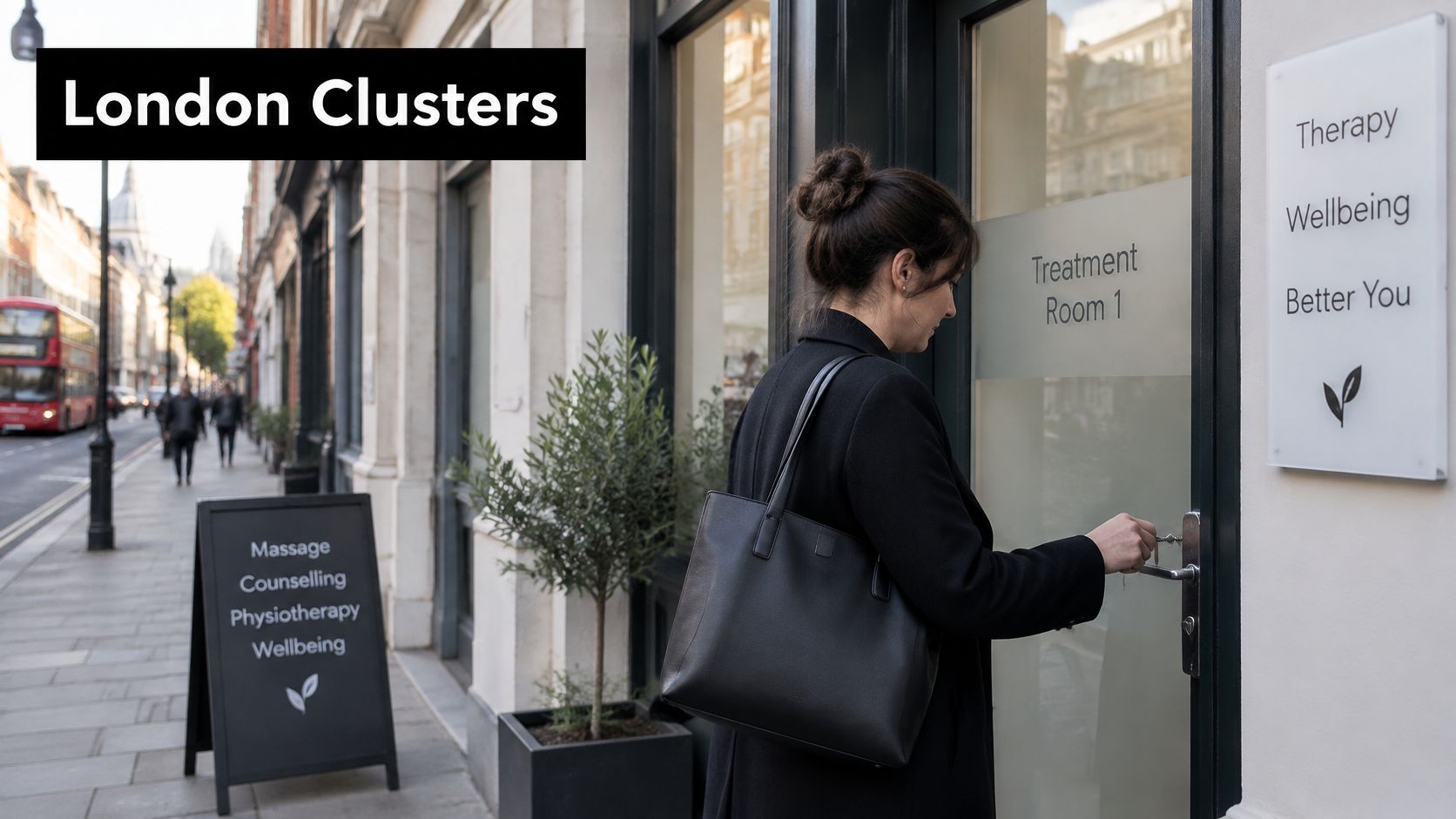
Five Clusters to Start With
London salon spaces cluster in these areas, each with a different trade off:
- Marylebone and Harley Street: Dense client flow and strong professional signalling, but competition is high and clients expect polished premises.
- Knightsbridge and Chelsea: Suits premium treatments and higher prices, but higher rents demand fuller diaries.
- Islington: A mix of local repeat clients and moderate competition, often better for building a regular weekly round.
- Ealing and Acton: Competition is often lower and rooms can be easier to secure, but passing footfall can be lighter.
- Canary Wharf: Suits weekday business clients and lunchtime appointments, but weekends may be quiet.
Search by Journey, Not Just Postcode
London's salon spaces are found across the city, with the Tube, Overground and Elizabeth line putting most salons within reach of clients. Check the actual walk from the nearest station, including step free access if your clients need it. A room five minutes from a station on your clients' line will usually outperform a cheaper room that needs a bus change.
Use the London salon spaces to rent on FindMy.beauty page to search by postcode, pick at most three areas, and compare listed rates within each area before messaging hosts. In London, we had 13 spaces listed in and around the capital, against 8,695 registered hair and beauty businesses in Greater London per ONS UK Business Counts (March 2024), so new spare capacity can appear outside the obvious centres.
Watch a short walkthrough of what to look for when you arrive at a viewing, then do the same station to door walk yourself at the time your clients would travel.
Matching Room Type to Your Treatment
Match the room to the treatment first, and the décor second. We list salon chairs, beauty rooms, treatment rooms, nail stations, barber chairs and salon studios to rent, and those labels describe different working setups, not interchangeable boxes.
| Space type | Suits | Check first |
|---|---|---|
| Beauty room | Lashes, brows, waxing, makeup | Ventilation for waxing and makeup products |
| Treatment room | Facials, massage, aesthetics | Hand-wash basin and special-treatment licence conditions |
| Styling or barber chair | Hairdressing, colouring, barbering | Shared-floor hygiene and product storage |
| Nail station | Nail services | Local extraction or a downdraught table |
| Whole studio | Practitioners needing sole use | Who pays utilities, cleaning and reception |
How to Read the Table
Beauty rooms are for lashes, brows, waxing and makeup. They're often compact, with a couch or reclining chair, good task lighting and storage for smaller kits. That works until you add a treatment that needs more water, extraction or clinical waste handling than the room was built for.
Treatment rooms are private spaces for facials, massage and aesthetics. Privacy alone doesn't make a room suitable for aesthetics. You need the right basin, cleanable surfaces, ventilation and licence position for the specific treatment, not just a lockable door.
A styling or barber chair puts you on a shared floor. That's efficient for hairdressing, colouring and barbering because basins, mirrors and reception already exist. The trade off is control. You share hygiene standards, music, waiting space and product storage with everyone else, so check how the host runs the floor on a busy Saturday, not a quiet Tuesday morning.
A nail station lives or dies on extraction at source. Dust and product vapours are created at the table, so general room freshness isn't enough. A whole studio gives you sole use and a front door feel, but you're more likely to carry utilities, cleaning, reception cover and empty days yourself.
A private room is a description of access, not proof that the room can legally or physically support your treatment.
If You Offer Talking Therapy
Listings on this marketplace focus on beauty and treatment spaces, so counselling and psychotherapy renters need extra checks. Test sound insulation from neighbours while the salon is trading, not after hours. Look for a separate waiting area, a private entrance route, and a layout where clients don't pass an open treatment room or queue at a busy reception desk.
Ask about evening access, lone working arrangements and where clients wait if you run over. A handsome room beside a waxing room with thin walls will undermine confidential work, however reasonable the rent looks.
The Rule That Prevents a Bad Fit
List every service you plan to offer in that room, including the one you only do twice a month. Rule out any room that can't physically and legally serve the most demanding one. I would rather you rejected a pretty room at viewing stage than discovered after signing that your highest margin treatment is the one you can't deliver there.
Hygiene and Ventilation Checks Before You Commit
Treat hygiene as a premises standard, not a tidiness impression. A room can look spotless for a viewing and still lack the basin, ventilation or cleanable surfaces you need between back to back clients.
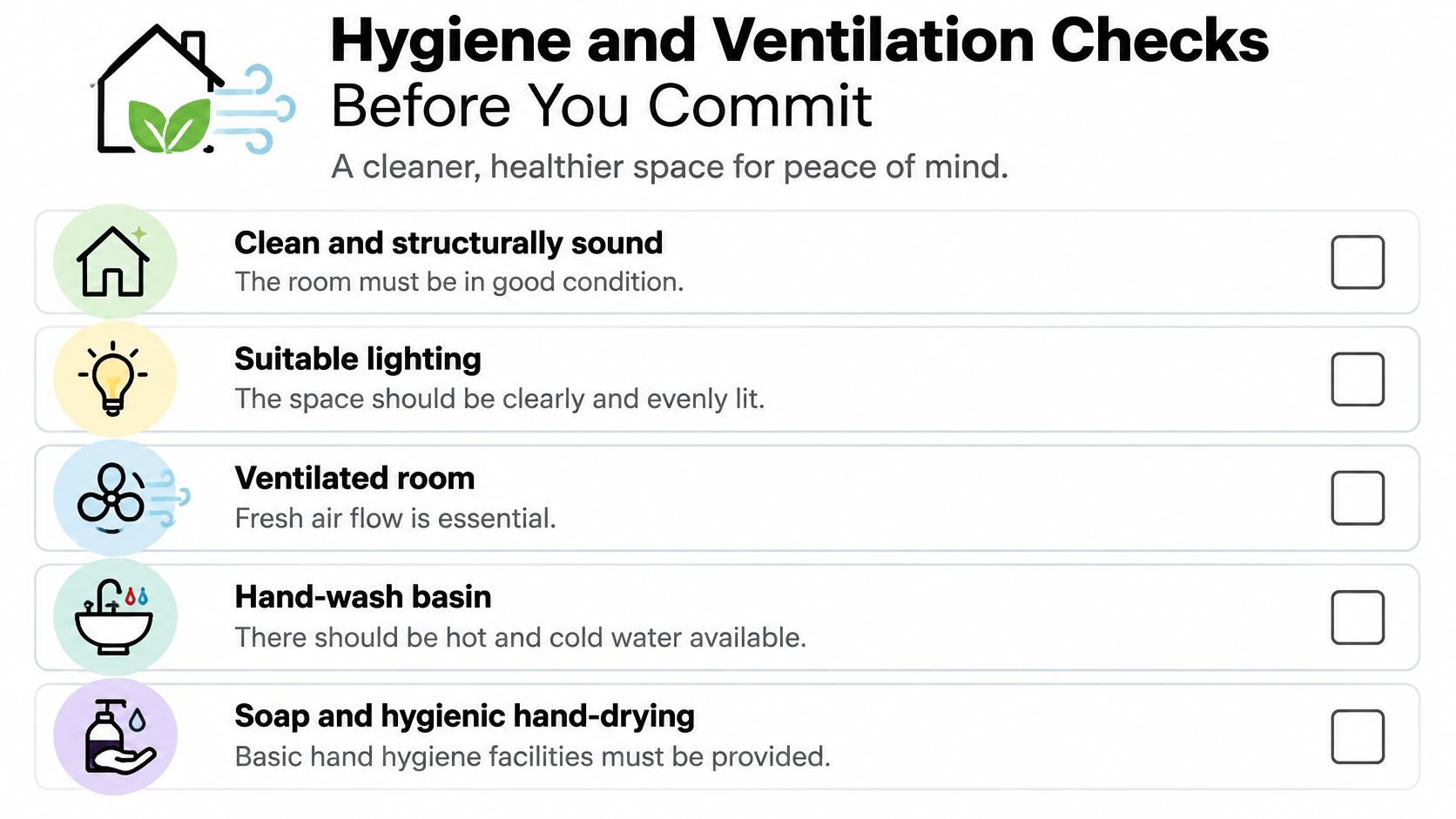
Physical Standard to Verify
- Clean and structurally sound: Walls, flooring and fittings should be intact, with no damp, cracked surfaces or damaged couch coverings that can't be cleaned properly.
- Suitably lit and ventilated: Lighting should let you inspect skin and work accurately, and ventilation should run effectively while clients are present.
- Hand-wash basin: Confirm a suitable basin with hot and cold water, soap and hygienic hand-drying materials, and note whether it's inside the room or shared outside.
- Cleanable surfaces: Worktops, couch coverings and floors should withstand cleaning between clients without harbouring residue in seams or fabric.
- Documented provisions: Ask the host to document room dimensions, basin location, ventilation type and cleaning arrangements so you can compare rooms on facts.
If a cheap room needs plumbing, ventilation or surface upgrades before you can operate, it isn't cheap. Ask who pays for that work, who approves it, and whether you can trade while it's done.
Ventilation as Capacity
Ventilation controls exposure, not just comfort. The Ealing massage and special treatment licence conditions citing UK Health and Safety Executive guidance state that fresh-air supply should normally not fall below 5–8 litres per second per occupant. That benchmark matters because occupancy, treatment duration and chemical or particulate emissions all affect how much stale or contaminated air builds up.
Waxing, nail work, massage and aesthetics create different loads. Nail services generate dust and vapours at the table, so local controls such as extractor hoods or downdraught tables matter more than an open window at the far end of the room. Longer massage and facial appointments also keep two people in a small, warm room for extended periods, which quickly exposes weak ventilation.
Three Questions for the Host
- Is ventilation natural or mechanical: If it's mechanical, confirm it remains effective whenever clients are present and ask who maintains it.
- Does extraction serve the treatment room directly: A system serving a corridor or neighbouring room may not clear your treatment area.
- Does the nail station have source extraction: For nail work, check for extraction at the station rather than relying only on general room ventilation.
Put the answers in your shortlist notes beside the rent. A room that fails these checks shouldn't be rescued by a discount.
Licences, Insurance and Permitted Use to Confirm
Listings emphasise photos, location and price. They rarely prove a room is legally suitable for your specific service. That's the gap you must close yourself, especially for aesthetics, massage and work involving sharps, chemicals or client medical information.
Parliamentary written evidence on hair and beauty premises has called for commercial salons, barbershops, nail bars, beauty and aesthetics premises to register before trading, practitioners to demonstrate appropriate qualifications, independent chair and room renters to be identifiable businesses, and premises to show suitable insurance, health-and-safety and hygiene compliance. Whether or not every proposal applies to your borough, it's a sound standard for your own checks.
Pre-Rental Checklist
- Local-authority registration: Confirm how the premises are registered and whether your treatment falls under special treatment licence conditions in that borough.
- Permitted use: Get the treatments you're allowed to offer written into the agreement, by name where possible.
- Landlord consent: Check the host has consent to let the room for your intended use, not just permission to sublet generally.
- Insurance: Confirm your own public liability and treatment liability cover, and what building cover the host holds.
- Health, safety and hygiene: Agree who cleans, who supplies hand hygiene materials, and who maintains ventilation and the basin.
- Waste handling: For sharps or clinical waste, confirm storage, collection and who holds the contract.
- Data privacy: Decide where client records, consultation forms and medical notes are stored, and who can access the room.
- Access and emergencies: Confirm accessibility, fire exits, emergency procedures and out of hours access rules.
Our checklist on what to agree before a renter's first day helps turn these points into written terms before clients arrive.
Why Flexibility Needs Writing
Direct arrangements are useful because hosts can choose suitable renters and both sides can agree practical terms quickly. The risk is ambiguity. If the agreement doesn't assign licence, cleaning, waste and insurance duties, each side may assume the other has covered them.
If a duty matters for your treatment to be lawful or insured, don't leave it to a friendly verbal understanding.
Confirm every point in writing before the first booking. That protects your clients, your cover and your ability to keep trading if the host's circumstances change.
Shortlist and Contact Hosts Directly
Once you've priced rooms per client and screened them for treatment fit, contact a small number of hosts with specific questions. Broad enquiries to ten salons produce vague replies and wasted viewings.
Four Steps That Keep You in Control
- Search by town or postcode: Open listings that show space type, location and rent, use the map view, and keep only rooms whose booking length matches your diary.
- Shortlist up to three areas: Compare therapy rooms to rent in London within each area using your cost per client figure, including travel and unpaid set up time.
- Message each host directly: Give your name and email, ask what the rent includes, and put the hygiene, ventilation, licence and insurance questions in the first message.
- Agree terms in writing: Confirm dates, payment, notice, permitted treatments and conditions directly with the host before you take bookings there.
Hosts choose who rents their space, so a clear enquiry helps them judge fit for their premises and existing clients. Don't assume fees, deposits or charges from another salon's terms. Confirm them for that room, in writing.
What a Useful First Message Contains
Keep it short enough to answer quickly, but complete enough to avoid three rounds of follow up:
- Who you are: Your name, business name if you trade under one, and the services you plan to offer.
- Booking length wanted: Day, week or month, plus the specific days and start date you have in mind.
- Expected volume: How many clients per week you're realistically bringing at the start.
- Practical needs: Basin, extraction, storage, parking, step free access or evening entry, whichever applies to your work.
- Compliance questions: Licence position, permitted use, waste arrangements and what the rent includes.
Say a massage therapist needs two weekdays to start. A strong message names those days, states expected clients per day, asks whether the basin is inside the room, and confirms whether towels and cleaning are included. The host can answer yes, no or offer an alternative without guessing.
Visit before you commit, ideally while the salon is trading. Listen through the door, run the taps, check storage with your actual kit in mind, and walk from the station as a client would. Small annoyances at a viewing become daily friction once your diary depends on the room.
Shortlist first, calculate second, and sign only when every check is confirmed in writing. That order protects your margin and your reputation, which matter more than securing a room a week sooner.
Ready to compare real rooms against your own cost per client figure? Search therapy rooms to rent in London by town or postcode, check day, week and month rates on each listing, and message hosts directly with your treatment and compliance questions at FindMy.beauty.
Created with Outrank app